Bloodstone (heliotrope): meaning, properties and care
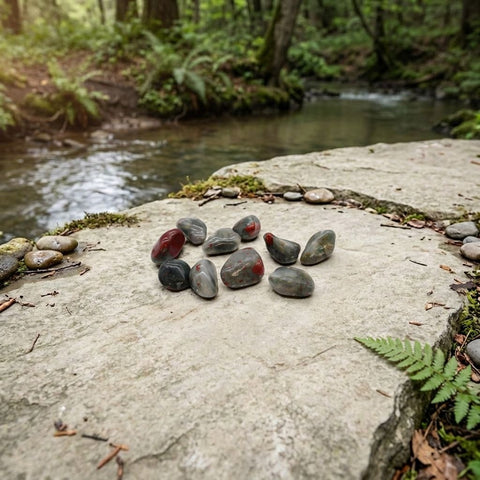
Bloodstone, or heliotrope, is a dark green chalcedony speckled with red. An ancient stone, long engraved into seals and associated with courage.
Key points
| Colour | Dark green to blackish, with red spots like drops of blood |
|---|---|
| Mineral family | Chalcedony (microcrystalline quartz) |
| Mohs hardness | 7 (6.5 to 7 depending on the source) |
| Density | About 2.7 |
| Other names | Heliotrope, blood stone |
| Origin of the name | Greek hélios (sun) and trepein (to turn) |
| Deposits | India (Deccan, Kathiawar), Brazil, Australia, Cyprus, Scotland, Germany |
| Not to be confused with | Green jasper without red spots, unakite |
What is bloodstone?
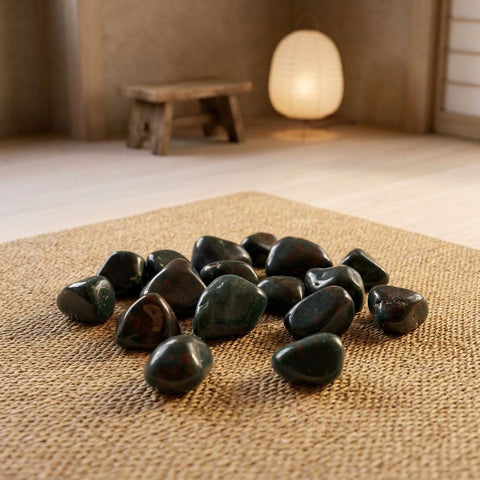
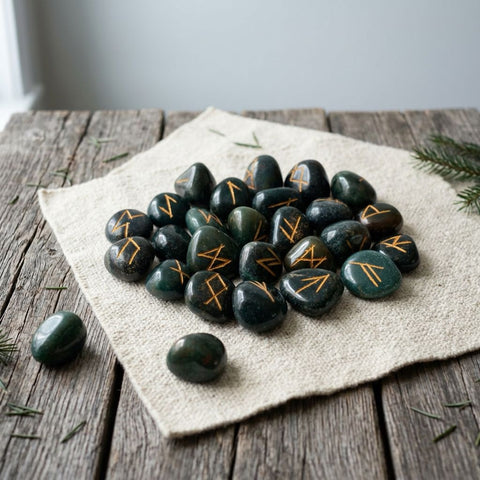
Bloodstone is a variety of chalcedony, that is, a quartz formed from microscopic crystals. Its base colour is a deep green, sometimes almost black, due to tiny inclusions of green minerals. It is dotted with red spots, caused by iron oxides or by small fragments of red jasper. This image of drops of blood on a green background explains its nickname bloodstone (literally, blood stone).
It forms in cracks in volcanic rocks, when water rich in silica gradually deposits the material. It is opaque to slightly translucent, with a smooth, curved fracture. It is mined in particular in India (the Deccan), Brazil, Australia, Cyprus, Scotland and Germany.
The name heliotrope comes from the Greek: hélios, the sun, and trepein, to turn. It refers to the reddish reflection the stone was said to cast on water lit by the sun, according to the explanation most often repeated.
An ancient stone: Antiquity and the Middle Ages
Pliny the Elder already mentions heliotrope and locates it in Ethiopia, Africa and Cyprus. The ancients attributed astonishing powers to it, including that of making the wearer invisible: Boccaccio takes up this theme in his Decameron, where characters search for this stone in order to vanish from the sight of others.
In the Middle Ages, Christians saw in it the drops of Christ’s blood, and it appears in scenes of martyrdom or flagellation; it is sometimes called the “martyrs’ stone”. It was above all engraved into seals, intaglios and jewellery: its hardness allows a fine polish and precise details.
Traditional symbolism
Because of its appearance (green of vegetation, red of blood), bloodstone is associated, in stone traditions, with courage, vitality and endurance. It has also been presented as the stone of those facing a trial: warriors, athletes, travellers.
These are symbols and cultural uses, not medical virtues. The old belief that it stops bleeding, for example, rests on no established fact and must never replace proper care. It is better seen as a talisman, an object that encourages you to hold on.
Traditional correspondences
| Area | Common association |
|---|---|
| Chakra | Root or heart, depending on the author |
| Element | Mostly earth; some authors cite fire because of the red |
| Month | March: it appears as the traditional stone of this month in several English-language lists, alongside aquamarine |
| Signs | Aries and Pisces are cited; the list varies widely |
To compare birthstone lists, see the page birthstones for March. For the first chakra: root chakra.
How to use it
- As a pendant or ring: bloodstone is hard enough for daily wear and works well as a cabochon.
- In your pocket: a tumbled stone accompanies periods of effort or change, as a small reminder.
- As a gift: for someone starting a demanding project, as a symbol of encouragement.
- On a desk: as a visual point of focus while concentrating.
To explore other stones linked with this intention, see stones of courage.
Care and cleansing
With a hardness of 7, bloodstone is robust.
- Cleaning: lukewarm water and mild soap, a soft brush, then dry with a cloth.
- Sun: harmless to the stone, whose colour is stable. Only avoid prolonged heat if it is set on thread or glue.
- Salt: avoid on set jewellery, as it attacks certain metals.
- Symbolic cleansing: smoke, moonlight, or placing it on a quartz geode. See the cleansing guide.
Recognising genuine bloodstone and avoiding confusion
Bloodstone is rarely imitated, but several confusions are common:
- A green jasper without red spots sold under this name is not bloodstone. A completely uniform green is a warning sign.
- Unakite, a rock with pink and green patches, is sometimes mistaken for it because of the two colours. The fine texture and very dark green of bloodstone set it apart.
- The name “bloodstone” is used loosely in the trade: ask for the exact material (chalcedony or jasper).
It is distinguished from jasper by its finer texture and its translucency at the edges. If in doubt, the gemstone glossary and the guide to choosing and caring for your stones explain how to read a seller’s description.
How to choose
Prefer a stone with a deep, even green background and clear red spots that are well distributed, neither so dense that they blur the look nor so rare that they barely show. The polish should be even. Good-quality cabochons remain affordable; a very large piece cut from the mass naturally costs more.
In combination, it goes well with stones from the same family, such as red jasper or hematite, or with a light stone for contrast.
Frequently asked questions
Why is heliotrope called bloodstone?
Because of its red spots on a dark green background, which look like drops of blood.
Is bloodstone a jasper?
Not exactly: it is a chalcedony, a microcrystalline quartz, speckled with iron oxides or red jasper. It differs from jasper in its finer texture.
Does bloodstone dislike water or sunlight?
No. With a hardness of 7, it handles lukewarm water and light well. Only protect the settings, threads and glue.
What signs or month are associated with it?
It is often cited for March and for Aries or Pisces, but these lists vary between traditions.
How can you recognise a fake bloodstone?
Be wary of a uniform green with no red spots. Always ask the seller for the exact material.
Also read
The meanings mentioned belong to tradition and symbolism. They are neither promises of results nor medical advice. Back to Guide to stones.
In the shop