Which stone to give? Gift ideas by occasion, person and budget
Birth, birthday, love, exams, a new home: stone ideas to give, chosen for their traditional symbolism, their hardness and their shape.
Key points
| Principle | A stone is chosen for the person, not for a supposed power |
|---|---|
| Symbolism | Presented as a tradition (“it is associated with”), never as a promise |
| Jewellery or object? | Tumbled stone, sphere, pendant, bracelet: the shape matters as much as the stone |
| To avoid for a child | Small stones (risk of swallowing) and cord bracelets |
| Fragile stones on the wrist | Selenite, malachite, opal, turquoise: better to display them than to wear them |
| Budget | A small tumbled stone is a real gift; quality and size raise the price |
Before you choose: four questions
Giving a stone is a gesture of thoughtfulness: it says “I was thinking of you”. It does not need to be justified by any power, and it would in fact be better to do without one. To find a fitting gift, four questions are enough.
- Who is the person? Do they like jewellery, decoration, collectible objects? Do they believe in stones, are they curious, or sceptical? A gift should respect their tastes, not your convictions.
- What is the occasion? Birth, birthday, thanks, moving house, success, a break-up, bereavement: the same stone does not carry the same meaning.
- What shape? A tumbled stone fits in the hand, a pendant is worn, a sphere is placed on a surface, a geode is admired. See our pages on crystal shapes and jewellery.
- What budget? A gift is not judged by its price. A pretty tumbled stone with a short, sincere note is worth more than a large object chosen without thought.
Ideas by occasion
| Occasion | Stone ideas (traditional symbolism) | Suggested form |
|---|---|---|
| Birthday | Birthstone for the month of birth: for example garnet (January), amethyst (February), aquamarine (March), peridot (August), depending on the lists | Pendant or a small stone in a drawstring pouch |
| Love, Valentine’s Day | Rose quartz (associated with tenderness), rhodonite, rhodochrosite | Heart-shaped stone, bracelet, pendant |
| Birth | Moonstone, rose quartz, amethyst as a decorative object | An object placed out of the baby’s reach; a piece of jewellery for the mother |
| Exams, new job | Fluorite, tiger’s eye, clear quartz (associated with concentration and confidence) | Pocket stone for the desk |
| New home | Selenite (light), amethyst or quartz in a geode or as a point | Geode, selenite lamp, rough stone |
| Thank-you | Agate, green aventurine (associated with luck), jasper | Tumbled stone with a short note |
| Wedding anniversary | By anniversary: silver (25 years), ruby (40 years), gold (50 years), diamond (60 years), the lists varying from one country to another | Jewellery or a gemstone |
| Retirement | Moonstone, labradorite, tiger’s eye | Table sphere or stone tree |
| Bereavement, support for someone close | A soft black stone (obsidian, onyx) or a simple stone, with a message of presence | Small tumbled stone to keep in a pocket |
To go further on birthstone lists, see our guide to birthstones and the stones and materials for wedding anniversaries. To give according to an intention (calm, courage, concentration), see the guide to stones by intention.
Depending on the person
- A curious beginner. A tumbled stone of rose quartz, amethyst or tiger’s eye, with an honest explanatory card. So that they understand what they own, add our guide to choosing and caring for your stones.
- A collector or a mineralogy enthusiast. A rough stone, a geode or a specimen (pyrite, fluorite, malachite, aragonite) with its origin. These people appreciate precision.
- A sceptical person. Look for pure beauty: a clear quartz sphere, a fine polished tiger’s eye, a simple piece of jewellery. There is no need to talk about powers.
- A teenager. A simple bracelet, a pocket stone, a mini crystal to keep in a bag. Avoid fragile gadgets.
- A child. Choose a stone large enough not to be swallowed or inhaled, with no sharp edges (tumbled stone, stone egg). Avoid cord bracelets on a young child. For a baby, never leave a small stone within reach.
- An ill or vulnerable person. Never promise that a stone will help healing; offer it as a sign of presence, as you would offer flowers. It in no way replaces medical follow-up.
Choosing the shape and the material
The stone matters, but so does hardness. For a piece of jewellery worn every day, favour stones that are fairly hard (around 6.5 to 7 on the Mohs scale: quartz, agate, jasper, tiger’s eye, carnelian). Soft stones (selenite, malachite, turquoise, opal, lapis lazuli) are beautiful but scratch, dull or crack more easily; give them rather as an object to display, or as jewellery reserved for special occasions. For jewellery metals (sterling silver 925, steel, brass), see jewellery metals.
In terms of budget, bear in mind that:
- a tumbled stone of medium size is the most affordable option;
- a bracelet or a pendant costs more, because it combines stone and setting;
- a sphere, a large geode or a fine collector’s piece rises quickly in price, because size and the quality of the raw material matter greatly.
Pay close attention to the product listing: a very large piece at a very low price deserves questions (see real or fake stone). For a bracelet, measure the wrist using our tutorial.
Three ready-to-give gifts and what they convey
If you are hesitating, here are three simple options, with the thinking behind each.
- The small ritual. A tumbled stone of rose quartz or amethyst, a fabric pouch and a note suggesting a very simple gesture: keep it on the bedside table, or hold it for a minute before going to sleep. The gift becomes an invitation to slow down. It costs little and suits almost everyone.
- The lasting piece of jewellery. A bracelet or pendant in a hard stone (quartz, agate, jasper, tiger’s eye) on a setting of sterling silver 925 or stainless steel. It is often worn, kept for a long time and needs little care. Check the wrist size and any known allergies to metals.
- The decorative object. A quartz or amethyst geode, a selenite lamp, a small sphere on its stand. It sits on a shelf, is admired, and is a fine gift for a house move or a housewarming. Mention how to care for it and to avoid direct sunlight, which can fade some stones.
In every case, what matters is the attention you show to the person: a stone is given to someone because you know their favourite colours, their tastes, their habits, not because a catalogue of virtues recommends a particular stone for a particular need.
How to present your gift
A few simple gestures make a difference.
- Add a personal note. “I thought of you when I saw this stone because…” is better than a list of properties.
- Describe the symbolism honestly. “This stone is traditionally associated with…” rather than “it will protect you”. You avoid placing an expectation on the person.
- Explain the care. A card reminding them that quartz tolerates water well, that selenite does not, and so on, is much appreciated. See cleansing your stones without damaging them.
- Think about the wrapping. A small fabric bag, a cardboard box, tissue paper: these are the details that count.
- Allow for an exchange. A stone is not a secret; if the recipient does not like it, it should be possible to exchange it.
What to avoid
- Giving a stone while promising an effect on health, love or money.
- Giving a stone “so that you will change”: a gift is not a disguised message.
- Buying at the last minute a dyed or fragile stone for everyday use.
- Imposing a belief: respect the person’s freedom not to share it.
- Buying from a seller who does not say where the stone comes from or whether it has been treated.
The finest gift is one that leaves the person free to see in it whatever they wish: a stone, a memory, a decorative object, or a small daily ritual.
A word on where the stones we give come from
Many people wonder where the stones they give come from. It is a good question. Stones are mined in a variety of countries (Brazil, Madagascar, India, China, Namibia, the United States and South Africa, among others), sometimes in industrial mines, sometimes in artisanal workings where working conditions are difficult. Traceability is often imperfect, even among well-meaning sellers. A few simple habits: choose sellers who state at least the country of origin, avoid buying large, very cheap pieces in bulk, prefer a small number of fine pieces to an accumulation, and accept that “natural” does not mean “ethical”. Giving a stone whose story you know a little is also a gift.
Frequently asked questions
Which stone should I give to someone who knows nothing about them?
A tumbled stone of rose quartz, amethyst or clear quartz, with a short note and a care card. These stones are durable, easy to recognise and pleasant to hold.
Can I give a birthstone?
Yes, it is a classic. Lists of stones by month vary between countries and periods; you can choose the one you like best from those proposed for the month.
Which stone should I give a child?
A tumbled stone large enough not to be swallowed, with no sharp edges. For a baby, avoid any small stone and any cord bracelet.
Can a stone bring good luck?
It is a popular belief, not a verified fact. Giving a stone “for good luck” remains a gesture of goodwill, provided it is not presented as a guarantee.
Which stone should not be used in a bracelet?
Soft stones or stones sensitive to water, such as selenite, malachite or opal, are easily damaged on the wrist. For everyday wear, prefer quartz, agate or jasper.
How can I tell whether the stone is of good quality?
Read the product listing (type of stone, any treatment, origin) and ask for details. For a valuable piece, a certificate is an additional guarantee.
Also read
The meanings mentioned belong to tradition and symbolism. They are neither promises of results nor medical advice. Back to Major topics.
In the shop
Gift ideas: our products
 Stone garden in a mango wood ring: tree of 60 chips
29,90 €
 Faceted stone necklace with butterfly in real silver-tone leaf, 42 cm
23,90 €
 Stone garden and yoga figurine on mango wood: 100 chips
39,90 €
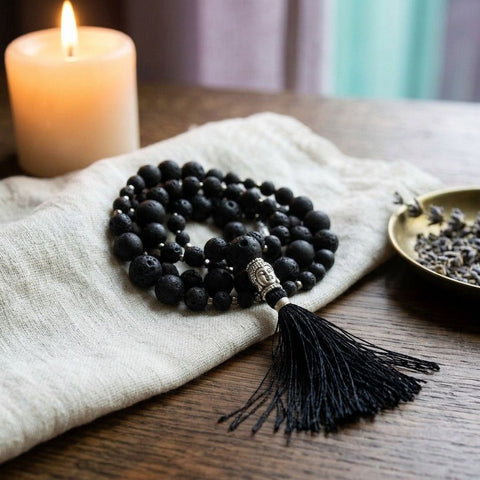 Long lava stone necklace, 42 cm, comes in a gift box with its card
22,90 €
 Oracle of the Sacred Horse: boxed deck and guidebook, text by Kathy Pike (English)
30,90 €
 Soul's Journey Oracle: 44 gold-foil cards and 120-page guidebook (English)
33,90 €
 The Divine Feminine Oracle: 53 cards and guidebook by Meggan Watterson (English)
23,90 €
 The Witch's Way Home Oracle: 44 cards, 4 Power Cards and 136-page book (English)
27,90 €