Green Aventurine: Meaning, Symbolic Properties, Care
Green aventurine is a glittering quartz coloured by tiny flakes of fuchsite. Origin, traditional symbolism, care, and how to avoid glass imitations.
Key points
| Colour | Pale to deep green, translucent to opaque, with small glittering highlights |
|---|---|
| Mineral family | Quartz (SiO2) containing fuchsite, a chromium-rich mica |
| Crystal system | Trigonal (massive quartz, with no crystals visible to the eye) |
| Mohs hardness | 6.5 to 7: fairly hard |
| Deposits | India, Brazil, China and several European sites |
| Chakra (according to tradition) | Heart |
| Symbolism | Luck, optimism, new projects (tradition) |
| Care | Lukewarm water and a soft cloth; handles daily wear well |
What is green aventurine?
Green aventurine is a quartz, from the same mineral family as rock crystal or amethyst, but in a compact form rather than as pointed crystals. Its colour comes from tiny flakes of fuchsite, a variety of mica (muscovite) containing chromium. These flakes reflect light and give the stone a subtle sparkle, known as aventurescence.
The word “aventurine” first referred, in the 18th century, to a glass made in Venice (Murano) whose copper flakes had come about by chance, that is, by accident, according to the most widespread explanation. This glass, today called aventurine glass or goldstone, later lent its name to the natural quartz that resembled it. The two are therefore very different: one is glass, the other a mineral.
Aventurine quartz forms in quartz-rich rocks, the quartzites, which contain fuchsite. It is found notably in India, Brazil and China, as well as in France and other European countries. In shops it is sometimes sold under the trade name “Indian jade”, which is misleading: it is not jade.
Traditional symbolism
As a green stone, aventurine has long been associated with luck, optimism and prosperity. Green evokes plants coming back to life, growth and renewal: it is often chosen to accompany a project, a new job, a move or the start of the school year.
Some authors call it the “gambler’s stone” or a stone of confidence, but these are expressions of popular tradition: no stone attracts luck or guarantees a financial result. Think of aventurine as a visual reminder of the state of mind you wish to cultivate, a small personal lucky charm and nothing more. It has no medicinal power and never replaces professional advice.
Traditional correspondences
According to books, the following links come up most often. They are symbolic and vary from one author to another.
| Area | Suggested correspondence | Note |
|---|---|---|
| Chakra | Heart (anahata) | Green colour, centre of the chest |
| Element | Earth, sometimes Wood | According to Western or Chinese tradition |
| Signs | Taurus, Virgo, Pisces according to authors | No consensus |
| Birth month | No official one | Not on the classic lists |
To better understand this system, see our page on the heart chakra.
How to use it
Green aventurine is one of the stones that is easiest to live with: its price is modest and its hardness allows daily use.
- Wear: a bead bracelet, pendant, ring or earrings. It handles everyday wear well.
- Carry: a tumbled stone in a pocket or wallet, as a lucky charm.
- Place: on a desk, near a shop till, or in the entrance hall of the home.
- Meditate: hold it against your chest while thinking about a project, breathing slowly.
- Give: a lovely gift for a birthday, a new job or a birth, accompanied by a few personal words.
Discover our bracelets and our tumbled stones.
Care and cleansing
With a hardness of 6.5 to 7, green aventurine is sturdy. It can be cleaned in lukewarm water with a little mild soap, then dried with a soft cloth. Avoid harsh chemicals, violent knocks and sudden temperature changes.
- Sun: it tolerates short exposure, but intense and very prolonged sunlight can dull its colour over time; prefer soft light.
- Salt: avoid it on stones set in jewellery, as salt corrodes metals and threads.
- Symbolic cleansing: incense smoke, a singing bowl, or placing it on a cluster of quartz. These gestures belong to tradition and have no measurable effect.
Our complete guide gives the details, stone by stone.
Recognising genuine green aventurine
Three materials can pass themselves off as it:
- Aventurine glass (green goldstone): manufactured glass with copper flakes. It often has a very regular sparkle, too uniform, and looks “too perfect”. Bubbles under a loupe give the glass away.
- Quartzites or other rocks dyed green: a very vivid, saturated colour concentrated in the cracks may indicate dye.
- Other green stones such as chrysoprase or jade, sometimes sold under similar names (“Indian jade”).
Natural aventurine shows small irregular flakes, variable transparency and a more nuanced colour. The best guarantee remains a seller who states the exact material and accepts returns.
How to choose your green aventurine
Look for an even colour, a sparkle visible in light and a regular polish. A deep, well-saturated green with few white spots is generally more sought after; very pale or milky pieces are often less expensive. For jewellery, check the drilling of the beads (no chips) and the quality of the thread.
It pairs well with complementary green stones such as malachite or peridot, or with light stones like rose quartz for a heart bracelet. For shape, see our guide to choosing and caring for your stones.
Frequently asked questions
Is green aventurine the same as jade?
No. Aventurine is a quartz, whereas jade is either nephrite or jadeite. It is sometimes sold as “Indian jade”, which is not accurate.
How can I tell whether my aventurine is glass?
Aventurine glass (goldstone) shows very regular flakes and may contain small bubbles under a loupe. It is smoother and more “perfect” than natural quartz. An honest seller will say so.
Can green aventurine go in water?
Yes, lukewarm water does not damage it. However, avoid harsh products and the dishwasher.
What is green aventurine used for in tradition?
It is associated with luck, optimism and prosperity. It is a personal symbol, with no proven effect and no guaranteed result.
Is green aventurine expensive?
No, it is an affordable stone, which makes it ideal for beginners. The price varies with the colour and the quality of the polish.
Also read
The meanings mentioned belong to tradition and symbolism. They are neither promises of results nor medical advice. Back to Guide to stones.
In the shop
Green aventurine: our products
 Small seated meditating alien, carved in stone
18,90 €
 Orgonite and stone chip pendulum, chain of seven chakra beads
18,90 €
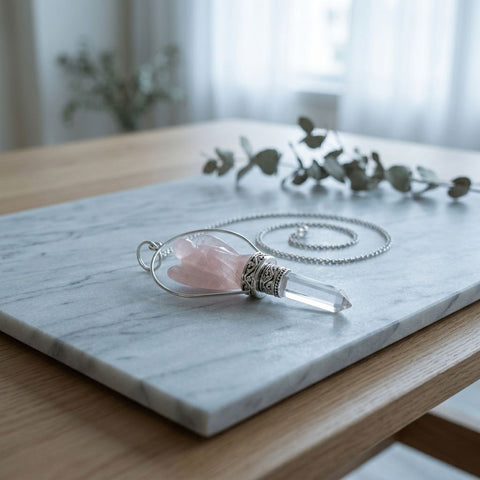 Angel pendulum: small stone angel under a silver-tone hoop
29,90 €
 Tree of Life seven chakra pendulum: cut stone and coloured chips
19,90 €
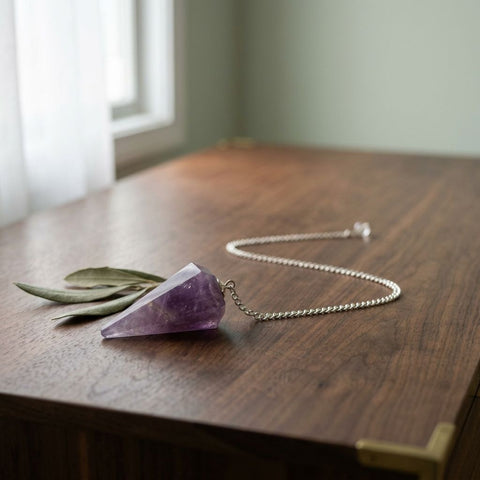 Cut stone pendulum, approx. 4 cm, silver-tone chain
16,90 €
 Natural stone ball pendulum: choice of 8 stones, silver-tone chain
19,90 €