Choir of Archangels: Origins, Pseudo-Dionysius and Angels 57 to 64
The Archangels, eighth choir of angels: 1 Thessalonians 4:16 and Jude 9, Pseudo-Dionysius, Gregory the Great, and angels 57 to 64 of the list of 72, from Nemamiah to Mehiel.
Key points
| Rank | eighth of the 9 choirs (third triad) |
|---|---|
| Angels in the list of 72 | No. 57 to 64 (Nemamiah to Mehiel) |
| Annual rulings | 26 December to 3 February |
| Daily hours | 18:40 to 21:20 |
| Greek word | archangeloi, “chiefs of the messengers” |
| Biblical texts | 1 Thessalonians 4:16; Jude 9 |
| Main source | Pseudo-Dionysius, Celestial Hierarchy, chapter 9 |
Who are the Archangels?
The Archangels are the eighth choir of angels, at the centre of the third triad. The Greek archangelos combines arche (chief) and angelos (messenger): a “chief of the messengers”. This is the name that everyday language gives to Michael, Gabriel and Raphael.
Beware of a common confusion: the choir of Archangels in the list of 72 is not the list of named archangels (Michael, Gabriel, Raphael, Uriel, and so on). The latter belong to other traditions and are presented in our guide to the archangels. In the list of 72, the choir gathers angels 57 to 64. For the origin of the system, read our introduction to the 72 angels.
The archangels in the Bible
The word archangelos is very rare in the Bible. It appears only twice in the New Testament:
- 1 Thessalonians 4:16: the Lord will descend from heaven “with the voice of an archangel” and the sound of God’s trumpet.
- Jude 9: the archangel Michael, disputing with the devil over the body of Moses, does not dare to bring a railing judgement against him. This account is not found in the Hebrew Bible; Origen attributed it to an apocryphal writing, the Assumption of Moses.
Other texts prepare the idea: Daniel (10:13; 12:1) speaks of Michael as one of the “chief princes” or the “great prince”; Tobit (12:15) says that Raphael is one of the seven angels who stand before God, as in Revelation (8:2). The first book of Enoch (chapter 20), an ancient Jewish text not included in the Jewish, Catholic or Protestant canons, gives a list of seven archangels.
The Archangels in Pseudo-Dionysius
In the Celestial Hierarchy attributed to Pseudo-Dionysius the Areopagite (around 500, chapter 9), the Archangels form the second order of the third triad, between the Principalities and the Angels. The author places them “in the middle”: they share both the governance of the Principalities and the proximity of the Angels to humans.
Gregory the Great (late sixth century, homily 34) specifies that the Archangels carry the most important messages, as opposed to ordinary angels. From this he derives the meaning of the names: Michael, “who is like God?”, Gabriel, “strength of God”, Raphael, “medicine of God”. He notes that “angel” is a name of function, not of nature. The meaning of these names is a traditional etymology, debated by Hebrew scholars.
The eight angels of the choir in the list of 72
In the list of 72 names of the Shem HaMephorash, the Archangels gather eight angels, from No. 57 to No. 64. Each one rules for five days of the year and for twenty minutes of the day, according to the most common calendar.
| No. | Angel | Ruling period | Ruling hours |
|---|---|---|---|
| 57 | Nemamiah | 26 to 30 December | 18:40 to 19:00 |
| 58 | Yeialel | 31 December to 4 January | 19:00 to 19:20 |
| 59 | Harahel | 5 to 9 January | 19:20 to 19:40 |
| 60 | Mitzrael | 10 to 14 January | 19:40 to 20:00 |
| 61 | Umabel | 15 to 19 January | 20:00 to 20:20 |
| 62 | Iah-Hel | 20 to 24 January | 20:20 to 20:40 |
| 63 | Anauel | 25 to 29 January | 20:40 to 21:00 |
| 64 | Mehiel | 30 January to 3 February | 21:00 to 21:20 |
The dates follow the most common calendar (angel No. 1 rules from 21 to 25 March, then five days per angel). Sources sometimes differ by a few days: see how to calculate your guardian angel.
Other readings and images
Other readings:
- The Catholic Church retains only three archangels named in Scripture: Michael, Gabriel and Raphael, celebrated together on 29 September since 1969. These same three are presented on our pages Michael, Gabriel and Raphael.
- Orthodoxy celebrates the archangels on 8 November (the Synaxis of the Archangels) and names seven or eight of them.
- Islam names Jibril (Gabriel) and Mika’il (Michael) in the Quran (2:98), and tradition adds Israfil and Azrael.
- The first book of Enoch names seven archangels, including Raguel, Sariel and Remiel, whom we present on our pages Raguel, Sariel and Remiel.
A symbolism for today
In today’s symbolism, the Archangels are the bearers of important messages: the ones we put off, the ones that change a life. They are read as a reminder of the weight of what we say, and of what we leave unsaid.
This reading invites you to reflect on your own “great messages”. It promises no revelation.
A gentle practice
An exercise in “a message to write”, lasting ten minutes:
- Think of someone to whom you have something important to say: thanks, an apology, a disagreement, tenderness.
- Write the message in ten lines at most, starting with “I”.
- Read it aloud and remove any sentence that accuses.
- Decide whether you will send it, say it face to face, or keep it to yourself; writing it already has value.
This exercise is a matter of personal reflection and does not replace medical advice or psychological support.
Keep in mind
The nine choirs are a construction of Christian theology, based on Pseudo-Dionysius (around 500), then Gregory the Great and Thomas Aquinas. It draws on lists of names found in the New Testament; it is not an official teaching of the Church, which affirms the existence of angels (Catechism, § 328) without fixing a precise hierarchy.
The attribution of eight Kabbalistic angels to each choir is, for its part, an esoteric construction of the Renaissance, which the Catholic Church does not recognise: it retains only the three archangels named in Scripture, Michael, Gabriel and Raphael. Nothing demonstrates that a particular angel corresponds to your date of birth, and no one can promise you protection or any event. Read these pages as a symbolic bestiary: for the images and the reflection they inspire.
See also the guide to the 72 angels and the guide to the archangels.
Frequently asked questions
What does “archangel” mean?
The Greek archangelos means “chief of the messengers”. The word appears only twice in the New Testament (1 Thessalonians 4:16 and Jude 9).
Are the Archangels of the list of 72 Michael, Gabriel and Raphael?
No. The choir of Archangels in the list of 72 gathers eight Kabbalistic angels (57 to 64). The named archangels, such as Michael, are presented in the guide to the archangels, which follows other traditions.
Which angels in the list of 72 are Archangels?
According to the division of eight angels per choir, the Archangels gather angels 57 to 64, from Nemamiah to Mehiel, who rule from 26 December to 3 February.
How many archangels are there?
It depends on the tradition: three named by the Catholic Church, seven or eight in Orthodoxy, seven in the book of Enoch with different names. The number seven comes from Tobit 12:15 and Revelation 8:2.
Does the Catholic Church recognise archangels other than Michael, Gabriel and Raphael?
It retains only these three biblical names and advises against inventing others, since a synod in Rome in 745 condemned the invocation of angels not attested in Scripture.
Also read
The meanings mentioned belong to tradition and symbolism. They are neither promises of results nor medical advice. Back to Guide to the 72 guardian angels.
In the shop
Stone jewellery: our products
 Faceted stone necklace with butterfly in real silver-tone leaf, 42 cm
23,90 €
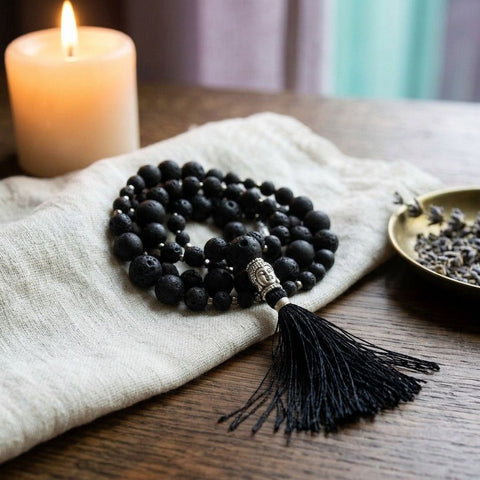 Long lava stone necklace, 42 cm, comes in a gift box with its card
22,90 €
 Engraved brass or copper cuff bracelet: Nepalese designs, adjustable
23,90 €
 Hand-knotted Balinese temple thread bracelet with beads
27,90 €
 Set of three semi-precious stone bracelets with butterfly: 7 gift boxes
31,90 €
 Wooden bead bracelet with Buddha head
10,90 €
 Wooden bead bracelet with lucky coin: 6 tie-on colours
13,90 €
 Tri Hita Karana wood, glass and stone bracelet from Bali
24,90 €