Choir of Angels: Origins, Pseudo-Dionysius and Angels 65 to 72
The Angels, ninth and last choir: messengers in the Bible, the guardian angel of Christian tradition, Pseudo-Dionysius, and angels 65 to 72 of the list of 72, from Damabiah to Mumiah.
Key points
| Rank | ninth of the 9 choirs (third triad) |
|---|---|
| Angels in the list of 72 | No. 65 to 72 (Damabiah to Mumiah) |
| Annual rulings | 4 February to 15 March |
| Daily hours | 21:20 to 00:00 |
| Words of origin | malakh (Hebrew), angelos (Greek): “messenger” |
| Biblical texts | Psalm 91:11; Matthew 18:10; Hebrews 1:14 |
| Main source | Pseudo-Dionysius, Celestial Hierarchy, chapter 9 |
Who are the Angels?
The Angels form the ninth and last choir of the celestial hierarchy. The word is both the name of a specific order and the general name for all angelic beings: the Hebrew malakh and the Greek angelos both mean “messenger”. Augustine (fifth century) already said that “angel” is the name of a function, not of a nature: one is an angel when one carries a message.
In the Kabbalistic and esoteric tradition of the 72 angels, this choir gathers angels 65 to 72. For the origin of the list, read our introduction to the 72 angels.
Angels in the Bible
Angels are very present in the Bible, in varied forms:
- The angel of the Lord appears to Hagar (Genesis 16), to Abraham (Genesis 22:11), to Moses in the burning bush (Exodus 3:2), and to Elijah in the desert (1 Kings 19:5).
- The angels of the psalms: “he will give his angels charge over you, to guard you in all your ways” (Psalm 91:11).
- The messengers of the Gospel: the angel to Joseph in a dream (Matthew 1:20), the angel to Mary (Luke 1:26-38), the angels of Christmas (Luke 2).
- The angels of the little ones: “their angels always see the face of my Father” (Matthew 18:10).
- Peter’s angel: when Peter, freed, knocks at the door, the community says “it is his angel” (Acts 12:15), a sign of a widespread belief in an angel attached to each person.
- The Letter to the Hebrews (1:14) describes them as “ministering spirits sent to serve those who are to inherit salvation”.
The Angels in Pseudo-Dionysius
In the Celestial Hierarchy attributed to Pseudo-Dionysius the Areopagite (around 500, chapter 9), the Angels are the last order of the third triad, the closest to the human world. They pass on to humans what they receive from the higher orders. Pseudo-Dionysius notes that the name “angel” is shared by all beings of the hierarchy, but that this order bears it as its own, because it is the closest to us.
One idea became established in Christian tradition: each person has a guardian angel. Jerome (fourth century), commenting on Matthew 18:10, writes that every soul receives an angel at birth to guard it. The Catechism of the Catholic Church (§ 336) takes up the idea: from childhood to death, human life is surrounded by their protection and intercession. The Church celebrates the holy guardian angels on 2 October, a date fixed for the whole Church in 1670.
The eight angels of the choir in the list of 72
In the list of 72 names of the Shem HaMephorash, the Angels gather eight angels, from No. 65 to No. 72. Each one rules for five days of the year and for twenty minutes of the day, according to the most common calendar.
| No. | Angel | Ruling period | Ruling hours |
|---|---|---|---|
| 65 | Damabiah | 4 to 8 February | 21:20 to 21:40 |
| 66 | Manakel | 9 to 13 February | 21:40 to 22:00 |
| 67 | Eyael | 14 to 18 February | 22:00 to 22:20 |
| 68 | Habuhiah | 19 to 23 February | 22:20 to 22:40 |
| 69 | Rochel | 24 to 28 February | 22:40 to 23:00 |
| 70 | Jabamiah | 1 to 5 March | 23:00 to 23:20 |
| 71 | Haiaiel | 6 to 10 March | 23:20 to 23:40 |
| 72 | Mumiah | 11 to 15 March | 23:40 to 00:00 |
Do not confuse the guardian angel of theology, which the Church affirms without naming, with the “guardian angels” calculated from the date of birth. The latter are a construction of the Renaissance, which the Church does not recognise. See how to calculate your guardian angel for the method.
The dates follow the most common calendar (angel No. 1 rules from 21 to 25 March, then five days per angel). Sources sometimes differ by a few days: see how to calculate your guardian angel.
Other readings and images
Other readings:
- Judaism counts the malakh among the creatures of God, serving his will; in Maimonides, malakhim is the sixth of ten ranks.
- Islam believes in angels (mala’ika), created from light, and mentions two angels who record the deeds of each person.
- Art shows them as winged young men dressed in white robes; wings are a late attribute, appearing in Christian art around the fourth century.
- In the list of 72, this choir covers the end of winter, from 4 February to 15 March, and the end of the day, from 21:20 to midnight.
A symbolism for today
In today’s symbolism, the Angels suggest closeness: discreet attention, a helping hand, a message that arrives at the right moment. They are seen as an image of kindness, which we can also choose to show to someone else.
This reading does not establish that an angel is with you. It proposes a way of looking at the attention we give to others.
A gentle practice
An exercise in “a little messenger”, lasting ten minutes:
- Think of a person going through a difficult period.
- Write, in three lines, a message that expects no reply: a shared memory, an encouragement, a concrete suggestion (a coffee, a call).
- Send it without any ulterior motive.
- Simply note what you felt as you sent it.
This exercise is a matter of personal reflection and does not replace medical advice or psychological support.
Keep in mind
The nine choirs are a construction of Christian theology, based on Pseudo-Dionysius (around 500), then Gregory the Great and Thomas Aquinas. It draws on lists of names found in the New Testament; it is not an official teaching of the Church, which affirms the existence of angels (Catechism, § 328) without fixing a precise hierarchy.
The attribution of eight Kabbalistic angels to each choir is, for its part, an esoteric construction of the Renaissance, which the Catholic Church does not recognise: it retains only the three archangels named in Scripture, Michael, Gabriel and Raphael. Nothing demonstrates that a particular angel corresponds to your date of birth, and no one can promise you protection or any event. Read these pages as a symbolic bestiary: for the images and the reflection they inspire.
See also the guide to the 72 angels and the guide to the archangels.
Frequently asked questions
What does “angel” mean?
The word comes from the Greek angelos, a translation of the Hebrew malakh: “messenger”. For Augustine, it is the name of a function and not of a nature.
Does the Catholic Church believe in guardian angels?
Yes: the Catechism (§ 336) affirms that human life is surrounded by their protection. It does not name them or link them to the date of birth: the system of the 72 angels is not recognised by the Church.
Which angels in the list of 72 are Angels?
According to the division of eight angels per choir, the choir of Angels gathers angels 65 to 72, from Damabiah to Mumiah, who rule from 4 February to 15 March.
Why do angels have wings?
Biblical angels do not have wings: they appear in human form. Wings appear in Christian art around the fourth century, under the influence of images of winged messengers from Antiquity.
When are the guardian angels celebrated?
On 2 October, in the Catholic calendar. The feast was extended to the whole Church in 1670.
Also read
The meanings mentioned belong to tradition and symbolism. They are neither promises of results nor medical advice. Back to Guide to the 72 guardian angels.
In the shop
Stone jewellery: our products
 Faceted stone necklace with butterfly in real silver-tone leaf, 42 cm
23,90 €
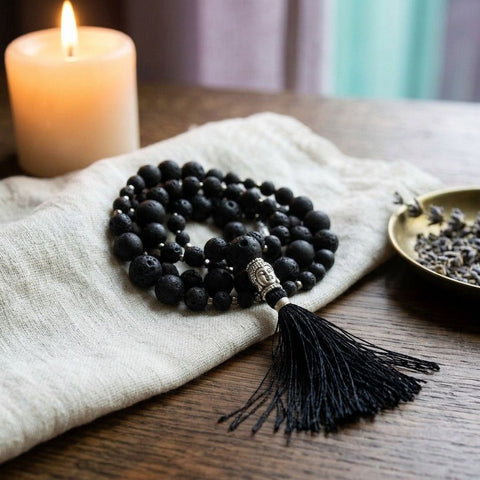 Long lava stone necklace, 42 cm, comes in a gift box with its card
22,90 €
 Engraved brass or copper cuff bracelet: Nepalese designs, adjustable
23,90 €
 Hand-knotted Balinese temple thread bracelet with beads
27,90 €
 Set of three semi-precious stone bracelets with butterfly: 7 gift boxes
31,90 €
 Wooden bead bracelet with Buddha head
10,90 €
 Wooden bead bracelet with lucky coin: 6 tie-on colours
13,90 €
 Tri Hita Karana wood, glass and stone bracelet from Bali
24,90 €