Angel Habuhiah (No. 68): Ruling Period, Psalm, Symbolism and Reading
Habuhiah, the sixty-eighth angel of the Shem HaMephorash, in the Choir of Angels, rules from 19 to 23 February. Dates, ruling hour, Psalm 106 and symbolism according to tradition.
Key points
| Number | 68 of 72 |
|---|---|
| Ruling period | 19 to 23 February |
| Ruling hour | 10:20 p.m. to 10:40 p.m. |
| Choir | Angels |
| Associated psalm | Psalm 106, verse 1 |
| Hebrew triplet | חבו (Heth, Beth, Vav) |
| Symbolic theme | Gratitude, the fertility of the earth, the garden |
Who is Habuhiah, angel no. 68?
Habuhiah is the sixty-eighth angel on the list and the fourth of the Choir of Angels. His name is also written Habuiah in English editions. French works associate him with the fertility of the earth, farming, gardens and the abundance of nature, with gratitude as the common thread.
Several editions add health, in the symbolic sense of a life in harmony with the seasons. This is in no way a treatment: for your health, consult a professional.
The number 68 in the list of the 72 angels belongs to Habuhiah; the list itself is drawn, according to the kabbalistic tradition, from three verses of Exodus (14:19 to 21). We present it here according to the kabbalistic and esoteric tradition, with its divergences. For the history of the system, see our introduction to the 72 angels.
Traditional reference points
| Reference | According to tradition |
|---|---|
| Number in the classical list | 68 of 72 |
| Ruling period (5 days) | 19 to 23 February |
| Ruling hour (20 minutes) | 10:20 p.m. to 10:40 p.m. |
| Choir | Angels (the fourth of the 8 angels of the choir) |
| Traditionally associated psalm | Psalm 106, verse 1 |
| Triplet of Hebrew letters | חבו (Heth, Beth, Vav) with the suffix יה (Iah) |
| Approximate zodiac sign | Pisces |
Calendar followed: five ruling days per angel in continuous succession from 21 March (angel no. 1), with no extra day. Printed or online lists do not always coincide to within a few days; for leap years, consult how to calculate your guardian angel. The ruling hour is often understood as local solar time, which authors do not always specify.
The verse and the name
The verse of Psalm 106 says: “Hallelujah! Give thanks to the Lord, for he is good, for his steadfast love endures forever.” The formula “give thanks to the Lord, for he is good, for his steadfast love endures forever” recurs in several psalms (106, 107, 118 and 136) and in the first book of Chronicles (16:34): Chronicles presents it as a refrain of the liturgy of the Temple in Jerusalem. Psalm 106 itself also recalls the people’s infidelities: gratitude does not ignore faults.
The name is formed from the triplet חבו (Heth, Beth, Vav) followed by the ending Iah. No established philological meaning is attached to it. Verse 1 carries the same number in Hebrew and English numbering; the Vulgate places this psalm at number 105.
What tradition associates with Habuhiah
According to French editions, Habuhiah evokes:
- The fertility of the earth and farm work.
- Gardens and attention to the cycles of nature.
- Abundance, understood as what one receives without having produced it.
- Gratitude, the theme of the verse.
These associations come from esoteric works; they vary from one author to another and are not established facts.
A reading for today
Gratitude is a practice: naming it regularly helps you notice it. Habuhiah invites you to turn your gaze to what grows, whether it is a vegetable patch, a flowering balcony or a single plant on a windowsill.
Gardening and walks in nature are activities that many people enjoy, with no therapeutic claim made here. No angel makes your seeds sprout: water, light and patience take care of that.
His period of the year and his sign
Habuhiah’s period, from 19 to 23 February, falls at the end of winter (northern hemisphere, within the framework of the original calendar). It roughly covers the sign of Pisces. The end of February is when seedlings are started under cover across much of France, which gives this period a concrete meaning. In the table of the 36 decans, each ten-day span receives two angels: Habuhiah shares his with Eyael (no. 67).
In the Choir of Angels
The Angels form the last choir of the “Celestial Hierarchy” of Pseudo-Dionysius (around 500), the closest to the human world; angelos in Greek and malakh in Hebrew mean “messenger.” The Christian tradition entrusts them with the guarding of persons: the Bible speaks of the “angels” of little children (Matthew 18:10), and the Catechism of the Catholic Church, in § 336, mentions the guardianship of angels around human life. In the list of 72, this choir includes angels 65 to 72.
Habuhiah is the fourth of the Angels. After the joy of Eyael, he brings gratitude for what comes. He comes before Rochel.
To place Habuhiah among the other angels, here are his immediate neighbours: Eyael (no. 67) before him and Rochel (no. 69) after him. The choir is presented in detail on the page Choir of Angels.
A gentle practice with Habuhiah
A small sowing, about fifteen minutes long:
- Take a pot or a seed tray, and some potting compost (or damp cotton wool for garden cress).
- Sow a few seeds meant for eating, cover them very lightly and water gently.
- Place the pot near a bright window.
- Note the date and, each day, one line of observation; read verse 1 of Psalm 106, giving thanks for what grows.
Avoid seeds coated with treatment products if you plan to eat them; wash your hands after sowing.
What to keep in mind
This system is symbolic, not an established fact. No angel makes the earth fertile or guarantees good health, and no one can promise you a result. Read these pages for the images they offer and for the reflection they prompt.
Let us recall that the Catholic Church does not recognise this system: only Michael, Gabriel and Raphael are named as archangels in Scripture, and the list of 72 names does not include them. The psalms cited remain, for their part, a text of prayer shared by many believers.
See also the guide to the 72 angels and the guide to the archangels.
Frequently asked questions
What is Habuhiah’s ruling period?
According to the classical calendar, Habuhiah (angel no. 68) rules from 19 to 23 February. Some sources shift these dates by a few days, and leap years are handled differently depending on the author.
At what time does Habuhiah rule?
His ruling hour of 20 minutes runs from 10:20 p.m. to 10:40 p.m., every day, according to tradition. Many authors specify that this is local solar time.
Which psalm is associated with Habuhiah?
Tradition associates Habuhiah with Psalm 106, verse 1: “Hallelujah! Give thanks to the Lord, for he is good, for his steadfast love endures forever.” Verse lists vary from one author to another.
Is Habuhiah the angel of healing?
Some recent websites say so. In French editions, he is mainly linked to nature and gratitude; he has no therapeutic role.
Is Habuhiah the angel of gardeners?
It is a natural reading of his link with farming and the fertility of the earth. It remains symbolic.
Where does the phrase “for he is good, for his steadfast love endures forever” come from?
It recurs in Psalms 106, 107, 118 and 136 and in the first book of Chronicles. Chronicles presents it as a refrain of thanksgiving in the Temple liturgy.
Also read
The meanings mentioned belong to tradition and symbolism. They are neither promises of results nor medical advice. Back to Guide to the 72 guardian angels.
In the shop
Stone jewellery: our products
 Faceted stone necklace with butterfly in real silver-tone leaf, 42 cm
23,90 €
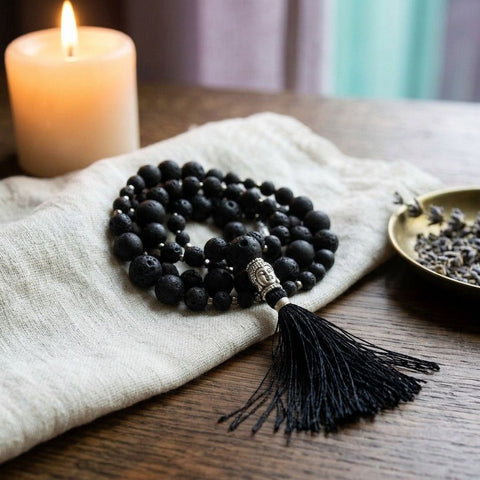 Long lava stone necklace, 42 cm, comes in a gift box with its card
22,90 €
 Engraved brass or copper cuff bracelet: Nepalese designs, adjustable
23,90 €
 Hand-knotted Balinese temple thread bracelet with beads
27,90 €
 Set of three semi-precious stone bracelets with butterfly: 7 gift boxes
31,90 €
 Wooden bead bracelet with Buddha head
10,90 €
 Wooden bead bracelet with lucky coin: 6 tie-on colours
13,90 €
 Tri Hita Karana wood, glass and stone bracelet from Bali
24,90 €