Angel Jabamiah (No. 70): Reign, Verse, Symbolism and Reading
Jabamiah, the seventieth angel of the Shem HaMephorash, in the Choir of Angels, reigns from March 1 to 5. Dates, hour, Genesis verse and the symbolism of rebirth, according to tradition.
Key points
| Number | 70 of 72 |
|---|---|
| Reign period | March 1 to 5 |
| Reign hour | 23:00 to 23:20 |
| Choir | Angels |
| Associated verse | Genesis 1:1 (not a psalm) |
| Hebrew triplet | יבמ (Yod, Bet, Mem) |
| Traditional meaning of the name | “The Word that produces all things” |
| Symbolic theme | Creation, regeneration, transformation |
Who is Jabamiah, angel no. 70?
Jabamiah is the seventieth angel in the list of the Shem HaMephorash, in the Choir of Angels, the last of the nine choirs. His name is also written Iabamiah or Yabamiah. French works associate him with the idea of creation and regeneration: what begins, what grows back, what transforms. A traditional gloss renders his name as “the word that produces all things”, an image that points to the creative word at the beginning of the Bible.
He occupies a place apart: unlike most of his neighbours, tradition gives him not a psalm verse but the very first verse of Genesis. Everything that follows is presented according to the Kabbalistic and esoteric tradition. For the origin of the system, read our introduction to the 72 angels.
Reference points in tradition
| Reference | According to tradition |
|---|---|
| Number in the classical list | 70 of 72 |
| Reign period (5 days) | March 1 to 5 |
| Reign hour (20 minutes) | 23:00 to 23:20 |
| Choir | Angels (the 6th of the 8 angels of the choir) |
| Traditionally associated verse | Genesis 1:1 |
| Triplet of Hebrew letters | יבמ (Yod, Bet, Mem) with the suffix יה (Yod, He) |
| Approximate zodiac | Pisces (15° to 20°) |
Dates follow the most common calendar (angel no. 1 reigns from March 21 to 25, then five days per angel); sources sometimes shift by a few days, and leap years are handled differently: see how to calculate your guardian angel. According to many authors, the hour is counted in local solar time.
The verse and the name
The verse chosen is the first sentence of the Bible: “In the beginning God created the heaven and the earth”. In Hebrew it has seven words and twenty-eight letters. Tradition reads in it the act that opens everything, hence the idea of an angel of creation and, by extension, of what renews itself.
According to tradition, the name is formed from the triplet of letters יבמ (Yod, Bet, Mem), obtained by reading together verses 19, 20 and 21 of chapter 14 of Exodus, followed by the ending Yod and He (Iah, an abbreviation of the divine name). Spellings vary (Iabamiah, Yabamiah) depending on transliteration. Verse lists differ from one author to another; this one is the classical list taken up by French-language literature.
What tradition associates with Jabamiah
Nineteenth- and twentieth-century French works associate several themes with him:
- Regeneration: nature starting again after winter, body and mind regaining momentum, moral rebirth after a trial.
- Transformation: some authors link him to alchemy, understood as an image of inner work (turning lead into gold) more than as a technique.
- Philosophical reflection: the search for first causes, curiosity about the origin of things.
- The creative word: writing, naming, formulating a project, in the sense that saying something helps bring it into being.
These are interpretations: the names of the angels do not appear in the Bible, and these attributions vary between publishers.
A reading for today
Today, Jabamiah can serve as an emblem of a quiet new beginning: not the impetus of the very first departure (that is the symbolic role of the first angel, Vehuiah), but the resumption after an ending, a failure or a pause. Starting again does not mean erasing what came before: a gardener who replants does not forget the previous season.
If a difficult period weighs on you, this figure does not replace a real person to talk to: a friend, a doctor or a professional in psychological support.
His season of the year and his sign
Jabamiah’s period, March 1 to 5, marks the end of winter in the Northern Hemisphere, the setting of the original calendar; March 1 is also the start of meteorological spring. It roughly covers the end of the sign of Pisces (15° to 20° in the five-degree division per angel). In the table of the 36 decans, each ten-day span receives two angels: Jabamiah shares his, from February 24 to March 5, with Rochel (no. 69).
A few weeks remain before the equinox, from which the list begins again with Vehuiah: the end of the list announces its own new beginning.
In the Choir of Angels
In the “Celestial Hierarchy” attributed to Pseudo-Dionysius the Areopagite (around 500), the Angels form the ninth and last choir, the closest to humans. The word comes from the Greek angelos, “messenger”, which translates the Hebrew malakh. In the list of 72, this choir groups angels 65 to 72.
Jabamiah is its sixth. His immediate neighbours are Rochel (no. 69) before him and Haiaiel (no. 71) after him. The choir is presented in detail on the page Choir of Angels.
A gentle practice with Jabamiah
A ten-minute exercise, the “notebook of new beginnings”:
- Note one thing that ended or did not work recently, in one sentence, without judging it.
- Write down what it left you: a skill, an encounter, a useful piece of information.
- Choose one very small step of resumption (a call, ten minutes of work, a page) and set the moment you will carry it out.
- If you wish, read the first verse of Genesis, or simply look at a plant coming back to life at the end of winter.
These exercises belong to personal reflection and do not replace medical advice or psychological support.
What to keep in mind
This system is symbolic, not an established fact. Nothing shows that a specific angel corresponds to your date of birth, and no one can promise you protection or an event. Read these pages as a bestiary: for the images and the reflection they inspire.
The Catholic Church does not recognise this system: it retains only the three archangels named in Scripture, Michael, Gabriel and Raphael. Believers of all faiths nonetheless find in the Psalms a text for prayer.
See also the guide to the 72 angels and the guide to the archangels.
Frequently asked questions
What is Jabamiah’s reign period?
According to the classical calendar followed here, Jabamiah (angel no. 70) reigns from March 1 to 5. Some sources shift these dates by a few days, and leap years are handled differently depending on the author.
At what time does Jabamiah reign?
His 20-minute reign hour runs from 23:00 to 23:20, every day, according to tradition. Many authors specify that this is local solar time.
Which verse is associated with Jabamiah?
Tradition associates him with Genesis 1:1, not a psalm, which sets him apart from most of the 72 angels. Verse lists vary from one author to another.
Is Jabamiah the angel of alchemy?
This is the attribution of some French authors, who read alchemy as an image of inner transformation. It does not appear in the oldest lists and has no technical significance.
If I was born on March 3, is Jabamiah my angel?
According to this calendar, yes. Other lists, aligned on the signs of the zodiac, give slightly different dates, and the Catholic Church does not recognise this system: the guardian angel of theology is not an angel calculated from the date of birth.
Also read
The meanings mentioned belong to tradition and symbolism. They are neither promises of results nor medical advice. Back to Guide to the 72 guardian angels.
In the shop
Stone jewellery: our products
 Faceted stone necklace with butterfly in real silver-tone leaf, 42 cm
23,90 €
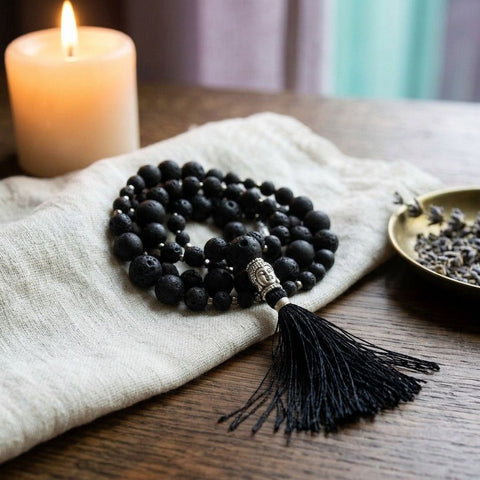 Long lava stone necklace, 42 cm, comes in a gift box with its card
22,90 €
 Engraved brass or copper cuff bracelet: Nepalese designs, adjustable
23,90 €
 Hand-knotted Balinese temple thread bracelet with beads
27,90 €
 Set of three semi-precious stone bracelets with butterfly: 7 gift boxes
31,90 €
 Wooden bead bracelet with Buddha head
10,90 €
 Wooden bead bracelet with lucky coin: 6 tie-on colours
13,90 €
 Tri Hita Karana wood, glass and stone bracelet from Bali
24,90 €