Archangel Gabriel: Meaning, the Annunciation, Jibrîl and Stones
Gabriel, whose name is read as "God is my strength", is the messenger of announcements in the Bible and of revelation in Islam (Jibrîl). Sources, image, feast and modern stones.
Key points
| Name | Gavri'el, in Hebrew: "God is my strength" (or "man of God") |
|---|---|
| Main sources | Daniel 8 and 9, Luke 1, Enoch; Quran 2:97 and 66:4 (Jibrîl) |
| Traditional role | Messenger: announcements, visions, revelation |
| Feast | 29 September (Roman Catholic); 26 March and 8 November (Orthodox) |
| Attributes | Lily, trumpet, scroll, messenger's staff |
| Modern colour | White (or copper, depending on the author): modern system |
| Day (scholarly tradition) | Monday, linked to the Moon |
| Modern stones | Moonstone, selenite, rock crystal, opal |
Who is Gabriel?
Gabriel is the archangel of the message. His name is read in Hebrew (Gavri'el) as "God is my strength", or else "man of God": the exact etymology is debated. In the three great traditions of the Book, he is the one who brings people a word from elsewhere: an explanation of a vision, an announced birth, a revelation.
He is one of the rare angels to bear a name in the biblical texts, along with Michael (and Raphael in the Book of Tobit). This article complements our guide to the archangels, where we always separate the ancient texts from modern correspondences.
What the texts say
| Source | Status | What it says about Gabriel |
|---|---|---|
| Book of Daniel (8:16; 9:21) | Biblical | Gabriel explains to Daniel his vision of the ram and the goat, then brings him the teaching on the "seventy weeks". |
| Gospel of Luke (1:11-38) | New Testament | He announces to Zechariah the birth of John the Baptist, then to Mary that of Jesus: this is the Annunciation. |
| Book of Enoch (chapters 9, 10, 20, 40) | Ancient Jewish, apocryphal | He is among the seven archangels, and is sent against the giants and the fallen angels. |
| Babylonian Talmud and rabbinic texts | Jewish tradition | He intervenes in several accounts (for example around Sodom); some rabbinic texts make him one of the angels surrounding the throne. |
| Quran (2:97-98; 66:4) and tradition | Islam | Jibrîl is named as the one who brings down the word upon the heart of the Prophet. Muslim tradition makes him the great messenger of revelation, notably on the Night of Decree and during the night journey. |
In Islam, Jibrîl therefore holds an even more central place than in Christianity: he is the mediator of the revelation of the Quran. Christianity, for its part, links him to the Incarnation.
Iconography: the Annunciation and its lilies
The scene of the Annunciation is one of the most painted subjects in the history of art, from Fra Angelico to Leonardo da Vinci. Gabriel appears there kneeling or standing before Mary, often with a white lily (a symbol of purity in Christian tradition), a messenger's sceptre, or a scroll bearing the greeting "Ave". In other images he holds a trumpet (for the Last Judgement, according to popular tradition), a lantern, or an olive branch.
In Persian and Ottoman art, Jibrîl is sometimes shown winged, sometimes wrapped in flames, notably in the miniatures of the Prophet's night journey. Since the Prophet himself is rarely depicted, it is often the angel who occupies the image.
Feast and traditional day
The Roman Catholic Church has celebrated the archangels on 29 September since 1969; before that, Gabriel had his own feast on 24 March, the eve of the Annunciation. The Orthodox Churches celebrate him on 26 March (the day after the Annunciation), on 13 July, and on 8 November (Synaxis of the Archangels). Pope Pius XII proclaimed him patron of telecommunications in 1951, because he is a messenger.
Renaissance scholarly magic (Trithemius, the Heptameron) links Gabriel to the Moon and therefore to Monday. This is an occult correspondence, not a religious teaching.
Symbolism: the word, the threshold, the announcement
Gabriel embodies the word that arrives at the right moment. He is associated with the announcement of a birth: that is why people think of him in connection with parenthood, writing, creativity or communication. The Moon, to which he is linked by scholarly tradition, adds the themes of intuition, dreams and cycles.
These are symbols. Saying that Gabriel "helps" in this or that area is a matter of personal belief and cannot be presented as a fact.
What comes from tradition and what is modern
- Ancient texts: God's messenger (Daniel, Luke, Quran, Enoch).
- Scholarly tradition: Moon and Monday, linked to medieval astrology.
- Modern systems: the colour (white, according to most authors, sometimes copper or silver) and the stones associated with him. They rest on the "rays" of theosophy and of the teachings of the Ascended Masters, then on New Age literature; authors do not agree.
The stones associated in modern traditions
White, mother-of-pearl and lunar shades guide the choices. A recent convention, with variable lists:
- Moonstone: feldspar with a milky sheen, obviously linked to the Moon.
- Selenite: white gypsum, very soft (hardness 2), which fears water.
- Rock crystal: transparent quartz, very common and robust.
- Opal: hydrated silica with play-of-colour, fragile and sensitive to knocks.
Care requirements differ greatly: read the page for each stone before cleaning it.
Respectful practice
- A white candle, set firmly on a non-flammable surface, that you light for a moment of writing or for an important letter. Blow it out before leaving the room.
- A notebook: in five minutes, write down the sentence you want to say to someone or to yourself. The archangel of the message lends himself well to this exercise.
- A gentle meditation: breathe calmly and imagine a clear light accompanying your words. No result is promised.
- If you are a believer: the angel of the Annunciation inspires the Angelus prayer among Catholics. Muslims honour Jibrîl as the angel of revelation, without a prayer addressed to him, since prayer is directed to God alone.
Frequently asked questions
What does the name Gabriel mean?
From the Hebrew Gavri'el: "God is my strength" or "man of God". The precise etymology is debated.
Who is Jibrîl in Islam?
It is the Arabic name of Gabriel, the angel of revelation. The Quran names him twice (2:97 and 66:4), and tradition makes him the one who conveyed God's word to the Prophet.
When is the feast of the Archangel Gabriel?
On 29 September among Roman Catholics, together with Michael and Raphael. Among the Orthodox, notably on 26 March and 8 November.
Is Gabriel a feminine angel?
In the ancient texts, he is presented in the masculine. Some modern readings speak of an androgynous or feminine energy, but this is a recent and free interpretation.
Which stones are associated with Gabriel?
Moonstone, selenite, rock crystal and opal are cited. This is a modern convention, which varies from one author to another.
Also read
The meanings mentioned belong to tradition and symbolism. They are neither promises of results nor medical advice. Back to Guide to the archangels.
In the shop
Stone jewellery: our products
 Faceted stone necklace with butterfly in real silver-tone leaf, 42 cm
23,90 €
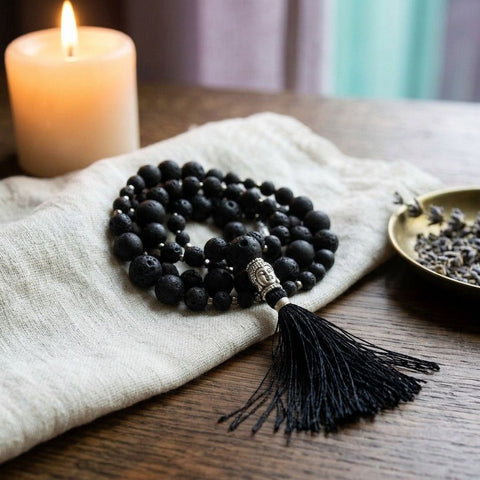 Long lava stone necklace, 42 cm, comes in a gift box with its card
22,90 €
 Engraved brass or copper cuff bracelet: Nepalese designs, adjustable
23,90 €
 Hand-knotted Balinese temple thread bracelet with beads
27,90 €
 Set of three semi-precious stone bracelets with butterfly: 7 gift boxes
31,90 €
 Wooden bead bracelet with Buddha head
10,90 €
 Wooden bead bracelet with lucky coin: 6 tie-on colours
13,90 €
 Tri Hita Karana wood, glass and stone bracelet from Bali
24,90 €