Archangel Raphael: Meaning, the Book of Tobit, Symbolism and Stones
Raphael, "God has healed", is the travelling companion of Tobias in the Greek Bible and the archangel of the road and of care in tradition. Sources, image, feast and modern stones.
Key points
| Name | Rapha'el, in Hebrew: "God has healed" or "God heals" |
|---|---|
| Main source | Book of Tobit (3 and 12); Book of Enoch (10, 20) |
| Status of the Book of Tobit | Canonical for Catholics and Orthodox; absent from the Hebrew Bible and Protestant Bibles |
| Feast | 29 September (Roman Catholic); 8 November (Orthodox) |
| Image | Traveller with a staff, a fish and Tobias |
| Modern colour | Green (modern ray system) |
| Day (scholarly tradition) | Wednesday, linked to Mercury |
| Modern stones | Green aventurine, emerald, malachite, peridot, jade |
Who is Raphael?
Raphael is the archangel of the road, of travel and of healing in tradition. His name comes from the Hebrew Rapha'el, translated as "God has healed" or "God heals". This name has fed his reputation as a healing angel; it describes an action of God through his messenger, not a medical power.
He is one of the three archangels named by the Catholic and Orthodox Churches, along with Michael and Gabriel. This page belongs to our guide to the archangels.
What the texts say
| Source | Status | What it says about Raphael |
|---|---|---|
| Book of Tobit (3:17; 5 to 12) | Canonical for Catholics and Orthodox; classed among the apocrypha by Protestants; absent from the Hebrew Bible | Raphael takes the appearance of a companion and guides the young Tobias: he helps him recover a sum of money, marry Sarah, and heal the blindness of his father Tobit. At the end he introduces himself: "I am Raphael, one of the seven angels who stand before the Lord" (12:15). |
| Book of Enoch (10:4-8; 20) | Ancient Jewish, apocryphal | He is charged with binding the rebel angel Azazel and casting him into a desert. He is one of the seven archangels, "set over the spirits of men". |
| Gospel of John (5:2-4) | New Testament (verse absent from several early manuscripts) | An unnamed angel stirs the water of the pool of Bethesda. Some Church Fathers and writers thought of Raphael; the text does not say so. |
In Islam, Raphael is not mentioned in the Quran. Some authors link him with Isrâfîl, the angel of the trumpet of Judgement, but this identification is not unanimous and Muslim tradition distinguishes them.
Iconography: the traveller and the fish
In art, Raphael is most often shown walking with Tobias, who carries a fish. In the story, the young man catches a fish whose gall will later be used to restore his father's sight. Raphael also holds a pilgrim's staff, a flask or a small box of remedies. He appears in Renaissance painting (Botticelli, Perugino, Murillo) and on devotional images intended for travellers.
This set of attributes explains his traditional patronages: travellers, young people leaving their family, pharmacists, nurses, or people suffering from eye complaints. These are devotional patronages, with no value as treatment.
Feast and traditional day
Among Roman Catholics, Raphael's feast falls on 29 September, shared with Michael and Gabriel since 1969. Before that reform, he had his own feast on 24 October, fixed at the beginning of the 20th century. The Orthodox celebrate him on 8 November, with the other archangels.
Renaissance scholarly magic links Raphael to Mercury and to Wednesday (the day of Mercury), because he is a guide and a messenger. This is an occult correspondence.
Symbolism: the discreet companion
In the story of Tobias, Raphael does nothing extraordinary on the surface: he walks, he advises, he knows where to go. He is the symbol of accompaniment. His discretion is the most striking feature of the text: Tobias does not know who his guide is until the very end.
For this reason, he today evokes journeys, transitions, convalescence, and kindness towards oneself. We use these words as symbols. We do not claim that Raphael heals: no archangel replaces a doctor or a treatment.
What comes from tradition and what is modern
- Ancient texts: companion of Tobias, conqueror of Azazel (Tobit, Enoch).
- Scholarly tradition: Mercury and Wednesday.
- Modern systems: the colour green, the "green ray" and the stones associated with him come from theosophy, then from the teachings of the Ascended Masters and from the New Age. Green is linked to the heart in chakra systems, which explains the choice. These correspondences are not religious and vary from one author to another.
If you want to understand the link with the green of the heart, read our page on the heart chakra, bearing in mind that chakras also belong to a symbolic framework and not to medicine.
The stones associated in modern traditions
- Green aventurine: quartz with green mica inclusions, robust and affordable.
- Emerald: green beryl, precious, often oiled or treated; beware of imitations.
- Malachite: banded green copper carbonate, soft and sensitive to acids.
- Peridot: olive green, magnesium and iron silicate.
- Jade: the name of two materials, nephrite and jadeite, which causes confusion.
These associations are modern. Our pages specify the common imitations and treatments of each stone.
Respectful practice
- A walk: the archangel of the road lends himself well to a walk without a phone. It can become your ritual.
- A green or white candle, placed in a stable holder on a non-flammable surface, that you light to reflect on a departure or a stage of life. Keep an eye on it and blow it out before going to sleep.
- A meditation: imagine the discreet companion walking beside you, leaving you to choose the way.
- If you are a believer: you may pray to Raphael in your own words, or with the traditional prayer of travellers. A prayer is neither a promise nor a treatment.
If you or someone close to you is ill, consult a health professional: the practices on this page do not replace one.
Frequently asked questions
What does the name Raphael mean?
It comes from the Hebrew Rapha'el: "God has healed" or "God heals".
Is Raphael in the Bible?
Yes, in the Book of Tobit, which is recognised as canonical by Catholics and Orthodox but not by Protestants or in the Hebrew Bible. He also appears in the Book of Enoch.
Is Raphael the archangel of healing?
That is his reputation in tradition, based on his name and the episode of Tobias. It is a symbol or a devotion, not a medical fact.
What is Raphael's colour?
Green, in modern esoteric systems. The ancient texts give him no colour.
What is the feast of Saint Raphael?
29 September for the Roman Catholic Church, and 8 November for the Orthodox.
Also read
The meanings mentioned belong to tradition and symbolism. They are neither promises of results nor medical advice. Back to Guide to the archangels.
In the shop
Stone jewellery: our products
 Faceted stone necklace with butterfly in real silver-tone leaf, 42 cm
23,90 €
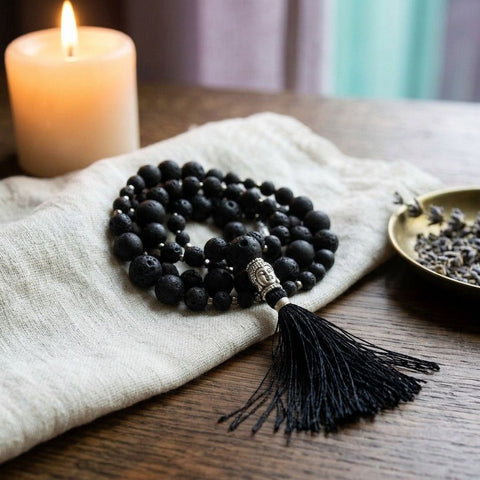 Long lava stone necklace, 42 cm, comes in a gift box with its card
22,90 €
 Engraved brass or copper cuff bracelet: Nepalese designs, adjustable
23,90 €
 Hand-knotted Balinese temple thread bracelet with beads
27,90 €
 Set of three semi-precious stone bracelets with butterfly: 7 gift boxes
31,90 €
 Wooden bead bracelet with Buddha head
10,90 €
 Wooden bead bracelet with lucky coin: 6 tie-on colours
13,90 €
 Tri Hita Karana wood, glass and stone bracelet from Bali
24,90 €