Archangel Uriel: Meaning, the Book of Enoch, Symbolism and Stones
Uriel, "God is my light" or "fire of God", is the angel of light and of the stars in the Book of Enoch and in 4 Ezra. Sources, status, image and modern stones.
Key points
| Name | Ur'i'el, in Hebrew: "God is my light" or "fire of God" |
|---|---|
| Main sources | Book of Enoch (chapters 9, 19-21, 33, 72-82); 4 Ezra (chapters 4-5, 10) |
| Status | Absent from the Hebrew Bible and the New Testament; not recognised by the Catholic Church; venerated by several Orthodox and Eastern Churches |
| Feast | 29 September (Anglicans); 8 November (Synaxis of the Archangels, Eastern Churches) |
| Attributes | Flame, scroll or book, solar disc |
| Modern colour | Varies: red, orange, or purple and gold depending on the author |
| Modern stones | Amber, tiger's eye, garnet, ruby, citrine |
Who is Uriel?
Uriel is the archangel of light. His Hebrew name (Ur'i'el) is understood as "God is my light" or "fire of God". He is known through ancient texts that do not belong to the most common Bibles, which is why his place is more discreet than that of Michael, Gabriel or Raphael. This does not make him any less fascinating: he has inspired painters, poets and many readers for centuries.
One useful point: the name Uriel is borne by men in the Hebrew Bible (for example in the books of Chronicles), but the angel Uriel does not appear there. This page takes its place in our guide to the archangels.
What the texts say
| Source | Status | What it says about Uriel |
|---|---|---|
| Book of Enoch (chapters 9, 10, 19-21, 27, 33, 72-82) | Ancient Jewish (3rd century BCE to 1st century BCE depending on the parts), apocryphal; canonical for the Ethiopian Church | Uriel is one of the seven archangels. He warns Noah of the coming flood, guides Enoch through his visions and shows him the stars, the seasons and the calendar. One passage presents him as set over the world and over the abode of the dead. |
| 4 Ezra (4:1; 5:20; 10:28) | Late Jewish apocalypse (end of the 1st century CE), included as an appendix in some Latin Bibles | Uriel answers Ezra's questions about God's justice, evil and the end of time. |
| Late magical and mystical texts | Various traditions | He is cited among the angels of the four cardinal points. |
| Milton, Paradise Lost (1667) | Literary work | Uriel is the "regent of the sun", the most far-seeing of the spirits of heaven. This literary image left a deep mark on the Western imagination. |
There is no Uriel in the Quran. Muslim tradition retains four major angels: Jibrîl, Mîkâ'îl, Isrâfîl and the angel of death, whom later tradition names Azrâ'îl.
Status in the Churches
The Catholic Church officially recognises only three named archangels: Michael, Gabriel and Raphael. It was even wary of unfamiliar angelic names: in 745, a synod held in Rome condemned the prayer of a preacher, Aldebert, who invoked several angels, among them Uriel, some of whom were judged doubtful; and in 789 Charlemagne's Admonitio generalis forbade invoking angels with unknown names. Uriel was thus caught up in this medieval caution.
Several Orthodox Churches include him in the list of seven archangels (Synaxis of 8 November). The Orthodox Church of Ethiopia, whose canon contains Enoch, counts him among the archangels, and certain Anglican Churches celebrate him on 29 September.
Iconography: the flame and the book
The iconography of Uriel varies from one tradition to another. In the East, he often holds a flaming sword or a flame in his hand. In the West, he carries a book or a scroll, or a solar disc. He has sometimes been identified with the angel of Leonardo da Vinci's Virgin of the Rocks: this is a hypothesis, which the painting itself does not confirm.
Symbolism: the light that illuminates
Uriel symbolises knowledge that illuminates: astronomy, the calendar, study, the understanding of a difficult event. His attributes, the flame and the sun, point to the idea of an inner light that allows us to see more clearly.
In today's practices, he is invoked when thinking about study projects, choices that need clarifying, or times of transition. These are symbols, which have no value as proof.
Feast, day and modern correspondences
Uriel has no day of the week in the Renaissance lists: the Heptameron and Trithemius do not include him in their planetary series. Current lists sometimes assign him Tuesday or Sunday, sometimes none: there is no consensus.
As for colour, authors differ: red or orange for some, "purple and gold" or "ruby" in the teachings of the Ascended Masters, who make the ruby ray that of resurrection and peace. These systems are modern (20th century) and derive from theosophy. They are not religious teachings.
The feasts are 29 September for Anglicans and 8 November for the Synaxis of the Archangels.
The stones associated in modern traditions
The choices follow warm colour and light. A modern convention, with variable lists:
- Amber: fossil resin, light and warm to the touch, often imitated with plastic or glass.
- Tiger's eye: quartz with golden reflections, very common.
- Garnet: deep red, hard and easy to wear.
- Ruby: red corundum, often heated, sometimes filled with glass.
- Citrine: yellow quartz, very often derived from heated amethyst.
Consult each page for common treatments and imitations.
Respectful practice
- A candle: a flame in a stable holder, on a non-flammable surface, away from curtains. Never leave it unattended.
- An evening of study: light the candle before starting work that calls for clarity, and blow it out at the end. The gesture serves as a marker and may help concentration; there is no promise of results.
- A meditation: gently gaze at a flame, then close your eyes and note what comes to you. The aim is clarity of thought, not prediction.
- If you are a believer: you may pray with the words of your tradition. Respect the position of your Church: the Catholic Church does not venerate Uriel, while some Eastern Churches do.
Frequently asked questions
Is Uriel in the Bible?
The angel Uriel does not appear in the Hebrew Bible or in the New Testament. He appears in the Book of Enoch and in 4 Ezra. The name Uriel is borne by men in Chronicles.
Why doesn't the Catholic Church recognise him?
It names only Michael, Gabriel and Raphael, since these are the only names found in its Scriptures. Medieval caution towards angels with unknown names dates from the 8th century.
What is Uriel's colour?
It depends on the author: red, orange, or purple and gold. It is a modern convention, not a traditional one.
When is Uriel's feast?
29 September among Anglicans, and 8 November for the Synaxis of the Archangels in the Eastern Churches.
Which stones are associated with Uriel?
Amber, tiger's eye, garnet, ruby or citrine are cited. The lists vary and are modern.
Also read
The meanings mentioned belong to tradition and symbolism. They are neither promises of results nor medical advice. Back to Guide to the archangels.
In the shop
Stone jewellery: our products
 Faceted stone necklace with butterfly in real silver-tone leaf, 42 cm
23,90 €
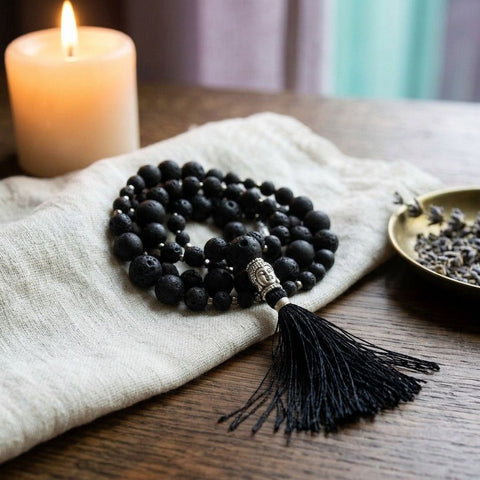 Long lava stone necklace, 42 cm, comes in a gift box with its card
22,90 €
 Engraved brass or copper cuff bracelet: Nepalese designs, adjustable
23,90 €
 Hand-knotted Balinese temple thread bracelet with beads
27,90 €
 Set of three semi-precious stone bracelets with butterfly: 7 gift boxes
31,90 €
 Wooden bead bracelet with Buddha head
10,90 €
 Wooden bead bracelet with lucky coin: 6 tie-on colours
13,90 €
 Tri Hita Karana wood, glass and stone bracelet from Bali
24,90 €