Archangel Chamuel (Camael): Meaning, Origin, Pink Ray and Stones
Chamuel, or Camael, is an angel of the Kabbalistic tradition and of scholarly angelology, who became in modern systems the archangel of the pink ray and of love.
Key points
| Names | Chamuel, Camael, Kamael, Chamael |
|---|---|
| Meaning of the name | Debated: "the one who sees God" (common reading) or "wrath of God" |
| Status | Absent from the Bible; not recognised by the Catholic Church or the Orthodox Churches |
| Scholarly tradition | Chief of the Powers, angel of Geburah (severity), linked to Mars |
| Modern tradition | Archangel of the pink ray, of love and relationships |
| Feast | No official feast |
| Modern stones | Rose quartz, rhodochrosite, kunzite, pink tourmaline, morganite |
Who is Chamuel?
Chamuel is a name found in esoteric literature, not to be confused with a biblical archangel: he is not mentioned in any sacred text of the Old or New Testament. It is written in several ways: Chamuel, Camael, Kamael. Depending on the authors, two very different portraits are superimposed under this name, and we distinguish them carefully on this page of our guide to the archangels.
Origin of the name and earliest sources
The name is of Hebrew origin, but its translation is debated. A common reading understands it as "the one who sees God"; another, from the root chamah (heat, anger), as "wrath of God". Specialists do not settle the question.
The earliest serious mentions come from the scholarly angelology of the Renaissance. Following the classifications of Pseudo-Dionysius the Areopagite (who arranges the angels into nine choirs, including that of the Powers) and of Christian Kabbalah (notably the work of Agrippa, De occulta philosophia, in the 16th century), Camael is presented as the angel who presides over the sphere of Geburah (rigour, strength) and over the planet Mars. This reading is the work of Renaissance authors, not of sacred texts.
There is thus a martial Camael, associated with firmness and courage, very far from the gentleness of the pink archangel of contemporary systems.
Two portraits: the ancient Camael and the modern Chamuel
| Portrait | Period | Main trait |
|---|---|---|
| Scholarly Camael | Renaissance, Christian Kabbalah | Rigour (Geburah), Mars, Powers |
| Chamuel of the rays | 20th century (teachings of the Ascended Masters, New Age) | Pink ray, love, relationships, forgiveness |
Some authors see the modern Chamuel as a reinterpretation of the ancient Camael; others maintain that they are two different beings. Without settling the question, we may note that the meaning of the figure has changed over time.
Iconography
There is no established ancient iconography for Chamuel. Camael is sometimes shown with a chalice and a staff, in the image of the angel who strengthens Jesus in Gethsemane (Luke 22:43), but this identification is a popular tradition without basis in the text, which does not name the angel. In contemporary esoteric art, Chamuel is most often painted in pink and gold tones, with a heart or a soft light.
Symbolism: from rigour to the heart
Depending on the portrait chosen, Chamuel evokes either the strength that defends or the tenderness that gathers. In contemporary use, emphasis falls on the second: he is associated with friendship, love, forgiveness, reconciliation, and the search for harmony in relationships.
These are symbols, not guarantees. A relationship is built between people; no angelic figure takes the place of that work, nor of the advice of a therapist or mediator when needed.
Feast and correspondences
Chamuel has no officially recognised feast. Some esoteric calendars attach him to the archangels' feast of 29 September, but this is a practice of particular groups.
For the day: Camael, linked to Mars, corresponds to Tuesday in the scholarly tradition. Some modern lists suggest Friday instead (day of Venus and of love) for Chamuel, while others give no day. These lists do not agree. The pink colour comes from ray systems (theosophy, then New Age) and has no ancient foundation.
The stones associated in modern traditions
Soft pink stones dominate, by association with the pink ray and the heart chakra:
- Rose quartz: a milky variety of quartz, very widespread. Its colour fades in light.
- Rhodochrosite: striped pink manganese carbonate, relatively soft.
- Kunzite: pink to lilac spodumene that fades in the sun.
- Pink tourmaline: more precious, and often offered as imitations.
- Morganite: peach-pink beryl, rarer.
Avoid prolonged sun exposure for all these pink stones. For a more martial palette, some authors instead cite red stones such as garnet.
Respectful practice
- A pink or white candle, placed in a stable holder on a non-flammable surface, that you light to write a letter or reflect on a relationship. Blow it out before going to sleep.
- A meditation of kindness: think of someone close to you, then of yourself, gently formulating a wish for peace. This exercise comes from very well-studied meditation traditions, which require no particular belief.
- A concrete gesture: write a word, make a call, offer a small kindness. It is often the most useful.
- If you are a believer: pray with the words of your tradition. The Churches recognise Chamuel little or not at all; respect their position.
Frequently asked questions
Is Chamuel the same as Camael?
Authors do not agree. Many regard them as the same name in two spellings, with a portrait that has changed: warrior for Camael, gentle for the modern Chamuel.
Is Chamuel mentioned in the Bible?
No. He appears in the scholarly angelologies of the Renaissance and in modern esoteric systems.
What is Chamuel's colour?
Pink, in modern ray systems. This colour does not come from the ancient texts.
Which stones are associated with Chamuel?
Mainly pink stones: rose quartz, rhodochrosite, kunzite, pink tourmaline, morganite. This is a modern convention.
Can Chamuel bring back a loved one?
No serious tradition promises this. He may be used as a symbol of kindness, without expecting any result regarding another person's will.
Also read
The meanings mentioned belong to tradition and symbolism. They are neither promises of results nor medical advice. Back to Guide to the archangels.
In the shop
Stone jewellery: our products
 Faceted stone necklace with butterfly in real silver-tone leaf, 42 cm
23,90 €
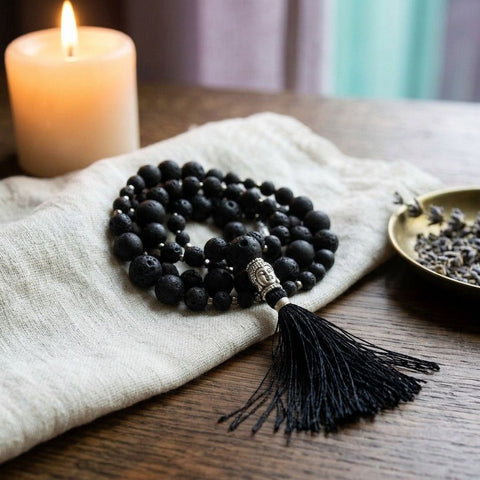 Long lava stone necklace, 42 cm, comes in a gift box with its card
22,90 €
 Engraved brass or copper cuff bracelet: Nepalese designs, adjustable
23,90 €
 Hand-knotted Balinese temple thread bracelet with beads
27,90 €
 Set of three semi-precious stone bracelets with butterfly: 7 gift boxes
31,90 €
 Wooden bead bracelet with Buddha head
10,90 €
 Wooden bead bracelet with lucky coin: 6 tie-on colours
13,90 €
 Tri Hita Karana wood, glass and stone bracelet from Bali
24,90 €