Archangel Remiel: meaning, Enoch, Baruch, hope, associated stones
Remiel, “mercy of God”, is one of the seven holy angels of the book of Enoch, set over those who rise again. Sources, confusion with Ramiel and Jeremiel, and modern readings of hope.
Key points
| Names | Remiel, Rémiel, Jeremiel, Ramiel (another figure), Eremiel |
|---|---|
| Meaning of the name | Yerahme'el: “mercy of God” (or “thunder of God” for Ramiel) |
| Sources | 1 Enoch 20:8; 2 Baruch 55:3; 4 Ezra 4:36 in some versions |
| Ancient tradition | Holy angel set over those who rise; angel of true visions |
| Modern tradition | Archangel of hope and visions |
| Feast day | No official Roman feast |
| Modern stones | Amazonite, aquamarine, angelite |
Who is Remiel?
Remiel, also written Rémiel, is one of the seven holy angels of the first book of Enoch. His name is linked to the Hebrew rahamim, “compassion”, and to El, God: “mercy of God”. He is close to Jeremiel, whom many authors identify with him, and who has his own page. He is presented in our guide to the archangels.
Beware of another mix-up: a Ramiel (or Rameel), whose name is read as “thunder of God”, appears in the same book of Enoch (6:7) among the leaders of the fallen Watchers. The names resemble each other, but the roles are opposed. For most authors these are two distinct figures.
Origin and textual sources
| Source | Status | What it says about Remiel |
|---|---|---|
| First book of Enoch, chapter 20, verse 8 (3rd century BCE) | Ancient Jewish text, outside the Jewish, Catholic and Protestant canons; canonical for the Ethiopian Church | Remiel is one of the seven holy angels, “set over those who rise”: tradition reads this as the dead who are raised. |
| Second book of Baruch (Syriac apocalypse, around 100) | Jewish apocryphal text | The name Ramiel designates the angel who presides over true visions: he explains to Baruch the meaning of what he has seen. |
| 4 Ezra 4:36 | Jewish apocalypse, appendix to the Vulgate | Depending on the versions, it is Jeremiel, Remiel or Uriel who answers Ezra about the time of waiting. |
| Ethiopian tradition | Orthodox Tewahedo Church | Remiel appears in the list of the seven archangels, with Michael, Gabriel, Raphael, Uriel, Raguel and Phanuel. |
Across the major religions of the West, Remiel is not a recognised angel. The Ethiopian Church venerates him. For his neighbour in the book of Enoch, see the page on the archangel Raguel.
Iconography
There is no ancient iconography specific to Remiel. Today’s images show him in blue-green or silvery tones, sometimes against a sky at daybreak. They are recent.
Symbolism: rising and seeing
Two images overlap. The first is that of those who “rise”: in the older sense, the resurrection of the dead; in a broader sense, anyone who gets back up after a fall or a trial. The second is that of the true vision, which Baruch receives from Ramiel: seeing clearly, distinguishing what is real from what is imagined.
In modern literature, Remiel has become the archangel of hope and visions, the latter understood as intuitions or projects rather than prophecies. These are symbols. They do not guarantee any result.
Feast, day and colour
No official feast in the Roman calendar. No day of the week is stably assigned to him. The modern colours (blue-green, silver, pale turquoise) vary according to authors and come from recent choices.
What belongs to tradition and what is modern
- Ancient Jewish texts: Remiel in the book of Enoch, Ramiel in Baruch, with a variant in 4 Ezra.
- Ethiopian tradition: Remiel in the list of the seven archangels.
- Modern systems: an archangel of hope and visions. They are recent, vary from one author to another, and rest on no religion.
The Catholic Church recognises only Michael, Gabriel and Raphael. These correspondences serve as a support for imagination and attention. They should not be taken as facts.
Stones associated in modern traditions
Blue-green tones, associated with clarity and renewal, are the most often cited. Recent convention:
- Amazonite: green-blue feldspar, soft and easily damaged by knocks, and best kept out of strong light for long periods
- Aquamarine: blue-green beryl, often heat-treated to improve its colour
- Angelite: pale blue anhydrite, soft, and best kept away from prolonged contact with water
Each stone page gives its care and precautions.
Respectful practice
- A journal of hopes: note three things you would like to see happen and, for each, one small step that depends on you. No result is promised.
- A morning image: on waking, note in one line an image or a dream you remember, without interpreting it. See also our page on oneirology.
- A soft candle (white or blue-green) set on a stable holder and a non-flammable surface. Keep it in sight.
- If you are a believer: pray with the words of your own tradition. Remiel is not recognised by the Catholic Church; please respect its position.
If hope is lacking for a long time, talk to someone close to you, your doctor or a professional. In France, 3114 (suicide prevention line, free, 24 hours a day) responds to any distress.
Frequently asked questions
What does Remiel mean?
He is linked to the Hebrew rahamim (compassion) and El (God): “mercy of God”. This is a traditional etymology, and it is debated.
Are Remiel and Ramiel the same angel?
Generally not. Ramiel is read as “thunder of God” and appears among the fallen Watchers of Enoch 6:7, but the Apocalypse of Baruch gives him a benevolent role. The names resemble each other, hence the confusion.
Are Remiel and Jeremiel the same angel?
Many authors identify them, others distinguish them. The versions of 4 Ezra read now one, now the other.
Is Remiel in the Bible?
No. He comes from the book of Enoch, from Baruch and from 4 Ezra, which are apocryphal texts.
Which stones are associated with Remiel?
Amazonite, aquamarine and angelite are the most often cited. The lists are recent and vary from one author to another.
Also read
The meanings mentioned belong to tradition and symbolism. They are neither promises of results nor medical advice. Back to Guide to the archangels.
In the shop
Stone jewellery: our products
 Faceted stone necklace with butterfly in real silver-tone leaf, 42 cm
23,90 €
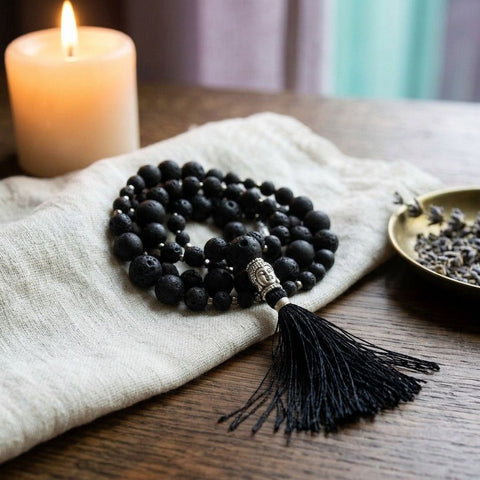 Long lava stone necklace, 42 cm, comes in a gift box with its card
22,90 €
 Engraved brass or copper cuff bracelet: Nepalese designs, adjustable
23,90 €
 Hand-knotted Balinese temple thread bracelet with beads
27,90 €
 Set of three semi-precious stone bracelets with butterfly: 7 gift boxes
31,90 €
 Wooden bead bracelet with Buddha head
10,90 €
 Wooden bead bracelet with lucky coin: 6 tie-on colours
13,90 €
 Tri Hita Karana wood, glass and stone bracelet from Bali
24,90 €