Archangel Jeremiel: Meaning, 4 Ezra, Enoch, Associated Stones
Jeremiel, “mercy of God”, is named in 4 Ezra 4:36 as the archangel of souls who wait. Sources, the link with Remiel, Orthodox traditions and modern readings of hope.
Key points
| Names | Jeremiel, Jérémiel, Hiérémiel, Jerahmeel, Yerahmiel |
|---|---|
| Meaning of the name | Yerahme’el: “God will have mercy”, “mercy of God” |
| Sources | 4 Ezra 4:36; Apocalypse of Zephaniah; sometimes identified with Remiel (Enoch 20:8) |
| Ancient tradition | Archangel who answers Ezra about the time of waiting |
| Modern tradition | Archangel of hope, visions and consolation |
| Feast | 8 November (Synaxis of the Archangels), among Orthodox who count him |
| Modern stones | Amethyst, lepidolite, angelite |
Who is Jeremiel?
Jeremiel (Jérémiel in French), also written Jerahmeel, is an archangel named in one major ancient text: the fourth book of Ezra. His Hebrew name, Yerahme’el, combines rahamim (compassion, mercy) and El (God): “God will have mercy”. He is not named in the Bible recognised by the Catholic and Protestant Churches, and his figure is discreet, compared with those of Michael or Gabriel. He is presented in our guide to the archangels.
Do not confuse him with the prophet Jeremiah, whose name is different. However, the name Yerahme’el is borne by several men in the Hebrew Bible (for example 1 Chronicles 2:9 and Jeremiah 36:26), which can feed the confusion.
Origin and textual sources
| Source | Status | What it says about Jeremiel |
|---|---|---|
| 4 Ezra (or 2 Esdras), chapter 4, verse 36 | Jewish apocalypse written towards the end of the first century, transmitted as an appendix to the Latin Vulgate; outside the Catholic canon | The souls of the righteous ask how long they must wait. The archangel Jeremiel answers that it will be when the number of those like them is complete. Some ancient versions read Uriel or Remiel at this point. |
| Apocalypse of Zephaniah | Ancient Jewish apocalypse preserved in Coptic | An angel named Eremiel, interpreted as Jeremiel, is in charge of the abyss and the abode of the dead, where souls have waited since the Flood. |
| First book of Enoch, chapter 20, verse 8 | Ancient Jewish text, outside the Jewish, Catholic and Protestant canons | Remiel is one of the seven holy angels, “set over those who rise”. Several authors identify him with Jeremiel; others distinguish them. |
| Orthodox tradition | Liturgical calendar | Some calendars count an eighth archangel, Jerahmeel, alongside the seven, in the feast of 8 November. |
In the major religions, Jeremiel is not a recognised angel. The Catholic Church retains only Michael, Gabriel and Raphael. For the closely related Remiel, see the page on the archangel Remiel.
Iconography
There is no ancient iconography specific to Jeremiel. Some modern presentations show him with scales, as in a few late Orthodox icons, but we have not been able to confirm this attribute in an ancient source. Most contemporary images are free illustrations, in shades of violet or lavender.
Symbolism: waiting and mercy
The passage in 4 Ezra depicts a wait: the righteous await the end of times. Jeremiel’s answer is striking, because it gives no date: the wait ends when a number is reached. Readers have seen in it an image of patience, and a way of saying that history does not belong to impatience.
The name itself recalls compassion. Associated with hope, Jeremiel has become, in modern literature, the archangel of those who wait for change, who mourn a project, who need consolation. These are symbols: they commit to no outcome.
Feast, day and colour
He has no Roman feast. In Orthodox tradition, he may be associated with 8 November, the day of the Synaxis of the Archangels. No day of the week is stably attributed to him. Modern colours vary: pale violet, lavender, sometimes midnight blue. There is no consensus: these choices come from recent authors.
What belongs to tradition and what is modern
- Ancient Jewish texts: an archangel named in 4 Ezra (late first century) and, in the form Eremiel, in the Apocalypse of Zephaniah; these are apocalyptic texts, not normative texts.
- Eastern Christian traditions: an eighth archangel in some Orthodox calendars.
- Modern systems: a figure of the archangel of hope and consolation, with colours and stones. They are recent, vary from one author to another, and rest on no religion.
The Catholic Church does not recognise any named archangel beyond Michael, Gabriel and Raphael. This does not make these correspondences useless: they serve as supports for the imagination and for attention. They should not be taken as facts.
Stones associated in modern traditions
Violet and pale blue tones are the most often cited. A recent convention, with no ancient source:
- Amethyst: violet quartz (hardness 7), which fades in strong sunlight
- Lepidolite: pink-lilac mica, soft, to be handled with care
- Angelite: pale blue anhydrite, soft, which dislikes prolonged contact with water
Each stone entry gives its care and precautions.
Respectful practice
- A notebook of waiting: write down three things you are waiting for and cannot control, then, for each one, a small gesture that depends on you. No result is promised.
- A gentle candle (white or lavender) placed on a stable base and a non-flammable surface. Never leave it unattended.
- A word of consolation: write to someone going through a difficult period. A concrete gesture matters more than invocation.
- If you are a believer: pray with the words of your own tradition. Jeremiel is not recognised by the major Churches; respect their position.
If waiting or sadness weigh heavily on you, speak to someone close to you, to your doctor or to a professional. In France, 3114 (suicide prevention, free, 24 hours a day) responds to any distress; in an emergency, call 17 or 112 (the emergency number throughout the European Union).
Frequently asked questions
What does Jeremiel mean?
From the Hebrew name Yerahme’el: “God will have mercy” or “mercy of God”. It is a traditional etymology.
Is Jeremiel in the Bible?
No, not in the Catholic and Protestant canons. He appears in 4 Ezra 4:36, an apocryphal text, which is included as an appendix to the Vulgate.
Are Jeremiel and Remiel the same angel?
Many authors identify them, because the versions of 4 Ezra and Enoch sometimes read one name and sometimes the other. Others distinguish them. Both have their own page on our site.
What is the link with the prophet Jeremiah?
None. The prophet’s name (Yirmeyahu) is different from that of the archangel (Yerahme’el).
Which stones are associated with Jeremiel?
Amethyst, lepidolite and angelite are the most often cited, according to recent conventions that vary from one author to another.
Also read
The meanings mentioned belong to tradition and symbolism. They are neither promises of results nor medical advice. Back to Guide to the archangels.
In the shop
Stone jewellery: our products
 Faceted stone necklace with butterfly in real silver-tone leaf, 42 cm
23,90 €
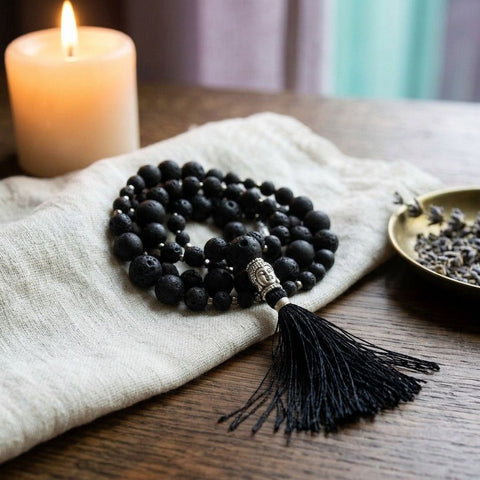 Long lava stone necklace, 42 cm, comes in a gift box with its card
22,90 €
 Engraved brass or copper cuff bracelet: Nepalese designs, adjustable
23,90 €
 Hand-knotted Balinese temple thread bracelet with beads
27,90 €
 Set of three semi-precious stone bracelets with butterfly: 7 gift boxes
31,90 €
 Wooden bead bracelet with Buddha head
10,90 €
 Wooden bead bracelet with lucky coin: 6 tie-on colours
13,90 €
 Tri Hita Karana wood, glass and stone bracelet from Bali
24,90 €