Archangel Sandalphon: Meaning, Talmud, Prayers, Elijah and Stones
Sandalphon is a great angel of Jewish tradition who gathers prayers and carries them up to God. Discover his sources, his early identifications, his modern stones and a gentle practice.
Key points
| Name | Uncertain meaning: possibly from the Greek synadelphos ("brother") or sandalion |
|---|---|
| Sources | Talmud (Hagigah), midrash, Zohar |
| Traditional role | He gathers prayers and weaves them into crowns for God |
| Later identifications | Prophet Elijah; twin brother of Metatron |
| Kabbalistic sphere | Malkhut (the kingdom), in Christian Kabbalah |
| Feast | No official feast |
| Modern stones | Red jasper, agate, haematite, lava stone |
Who is Sandalphon?
Sandalphon is an immense angel: the Talmud (tractate Hagigah) describes him at a height that the texts measure in journeys of years. He is described as the one who stands near the throne and who gathers the prayers of the earth to carry them up. He is known from Jewish texts (Talmud, midrash, Zohar), but not from the Bible. This page is part of our guide to the archangels.
The origin of his name is uncertain. One hypothesis links it to the Greek synadelphos, "brother of the same family", in connection with his role as brother of Metatron. Another connects it to sandalion, "sandal". Nothing is settled.
What the sources say
| Source | Status | What it says about Sandalphon |
|---|---|---|
| Babylonian Talmud, tractate Hagigah | Jewish tradition | He is an angel of immense height, above the living beings of the divine chariot. He is associated with the prayer of humans. |
| Midrash and the liturgy of Sukkot | Jewish tradition | He gathers the prayers of the faithful, weaves them into crowns and offers them to God. |
| Zohar and Kabbalah | Medieval Jewish mysticism | He is a figure of Malkhut, the last sphere, the closest to the material world. In some later sources he is the twin brother of Metatron. |
| Popular Muslim tradition | Folklore | Some accounts place him in the fourth heaven. |
The prophet Elijah, taken up to heaven in a chariot of fire (2 Kings 2), was identified with Sandalphon by some later authors. This identification is not biblical.
Iconography: song and the crown
The image of Sandalphon is that of an angel who weaves garlands from prayers. In tradition, he is also the master of heavenly song, the chanter of the angels. The American poet Longfellow devoted a poem to him in the 19th century, which contributed to his fame outside Jewish tradition: it shows him listening to the prayers of the earth and braiding garlands.
Symbolism: the bridge between heaven and earth
Sandalphon symbolises the continuity between the human and the divine: what we say or hope rises up. In Christian Kabbalah, he is linked to Malkhut, the sphere of matter, of the Earth and of the body. This double nature, heavenly in size and earthly in position, gives him his associations with rootedness, song and music.
These are symbols. Saying that his "answers" reach those who speak to him is a matter of personal belief.
Feast, day and colour
No official feast. Modern lists give him earth colours: brown, moss green, dark red, or all colours at once. No traditional day. These choices are modern.
In Judaism, the feast of Sukkot (Booths) is the time when the liturgy recalls his role of gatherer of prayers: it is a liturgical link, not a feast of the angel.
Stones associated in modern traditions
Earth stones serve as reference points for grounding and the root chakra:
- Red jasper: opaque microcrystalline quartz, very robust.
- Agate: banded quartz, often dyed.
- Haematite: heavy iron oxide with metallic reflections.
- Lava stone: porous volcanic rock.
These associations are modern. Refer to the stone pages for common treatments.
Respectful practice
- A moment of song or music: sing, listen or play an instrument. You may read our guide to singing bowls if sound appeals to you.
- A gratitude list: write down three things that have mattered. Prayers, in the broad sense, may resemble this.
- A candle, placed in a stable holder on a non-flammable surface. Never leave it unattended.
- If you are a believer: pray with the words of your tradition. Respect the position of your Church or community on invoking angels.
Frequently asked questions
What does the name Sandalphon mean?
Its meaning is uncertain. One hypothesis links it to the Greek synadelphos ("brother"), another to sandalion ("sandal").
Is Sandalphon biblical?
No. He appears in the Talmud, the midrash and the Kabbalah, but not in the Bible.
Is Sandalphon Metatron's brother?
Some later sources make him his twin, others confuse the two. This is neither an ancient nor a unanimous piece of information.
Is Sandalphon the prophet Elijah?
Some ancient authors proposed this, through the motif of the prophet taken up to heaven. It is a later, non-biblical identification.
Which stones are associated with Sandalphon?
Red jasper, agate, haematite, lava stone. A modern convention linked to grounding.
Also read
The meanings mentioned belong to tradition and symbolism. They are neither promises of results nor medical advice. Back to Guide to the archangels.
In the shop
Stone jewellery: our products
 Faceted stone necklace with butterfly in real silver-tone leaf, 42 cm
23,90 €
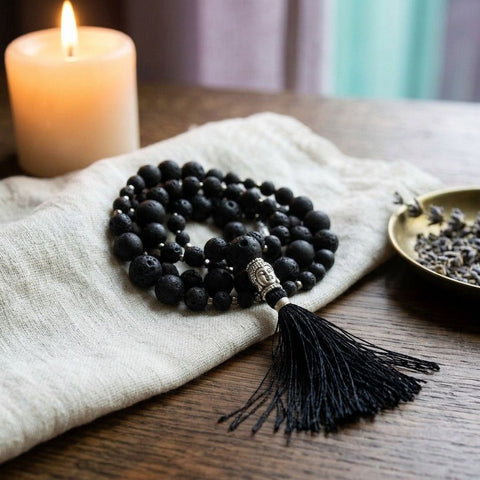 Long lava stone necklace, 42 cm, comes in a gift box with its card
22,90 €
 Engraved brass or copper cuff bracelet: Nepalese designs, adjustable
23,90 €
 Hand-knotted Balinese temple thread bracelet with beads
27,90 €
 Set of three semi-precious stone bracelets with butterfly: 7 gift boxes
31,90 €
 Wooden bead bracelet with Buddha head
10,90 €
 Wooden bead bracelet with lucky coin: 6 tie-on colours
13,90 €
 Tri Hita Karana wood, glass and stone bracelet from Bali
24,90 €