Archangel Sariel (Suriel): meaning, Enoch, Qumran, associated stones
Sariel, also called Suriel or Saraqael, appears in the book of Enoch, the Qumran manuscripts and Coptic texts. Sources, an ambivalent figure, his link with the moon and modern readings.
Key points
| Names | Sariel, Suriel, Souriel, Saraqael, Sarakiel |
|---|---|
| Meaning of the name | Sari'el: “God is my prince” (or “order of God”) |
| Sources | 1 Enoch 8:3 and 20:6; the War Rule of Qumran; the Conflict of Adam and Eve with Satan |
| Ancient tradition | Holy angel set over the spirits that sin; an ambivalent figure |
| Modern tradition | Archangel of the moon, of cycles and of destiny |
| Feast day | Commemorated in the Coptic Church |
| Modern stones | Moonstone, labradorite, selenite |
Who is Sariel?
Sariel, sometimes written Suriel or Souriel (Coptic form), is an angel name found in several ancient Jewish and Christian texts. The Hebrew Sari'el combines sar (prince) and El (God): “God is my prince”, or, according to another reading, “order of God”. He is presented in our guide to the archangels.
His figure is ambivalent: in the book of Enoch, a Sariel is named among the Watchers who teach forbidden knowledge, and a Saraqael, probably the same, appears among the holy angels. This ambivalence is part of his history, and it should not be hidden.
Origin and textual sources
| Source | Status | What it says about Sariel |
|---|---|---|
| First book of Enoch, chapter 8, verse 3 | Ancient Jewish text, outside the Jewish, Catholic and Protestant canons | In the Ethiopic version, Sariel is one of the fallen Watchers who teach humans knowledge, here the course of the moon. |
| First book of Enoch, chapter 20, verse 6 | Same text | Saraqael is one of the seven holy angels, “set over the spirits that sin against the spirit”. |
| War Rule (Qumran, 1QM IX) | Dead Sea manuscript | The names of Michael, Gabriel, Sariel and Raphael are inscribed on the shields of the fighters. |
| The Conflict of Adam and Eve with Satan (around the 6th century) | Christian apocryphal text | Souriel, with Selaphiel, leads Adam and Eve to the Cave of Treasures. |
| Magic bowls of Babylonia (6th–7th centuries) | Popular practice | The name of Sariel is invoked in protective incantations. |
| Coptic Church | Liturgical tradition | Souriel is counted among the seven archangels and commemorated on a fixed date. |
Across the major religions of the West, Sariel is not a recognised angel. The Coptic Church honours him.
Iconography
There is no ancient iconography specific to Sariel. Today’s images often show him in blue and silver, under a night sky where a moon appears. They are recent.
Symbolism: the moon and cycles
Through the passage of Enoch 8:3, Sariel is associated with the “course of the moon”: the angel who teaches how to count the months. Lunar calendars are among the oldest in humanity, and the idea of knowledge handed down by an angel is one expression of this.
Today, modern literature makes him the archangel of cycles, of the passing of time and, more vaguely, of destiny. These are symbols. They do not guarantee any result. Our page on the new moon and the one on simple moon rituals offer quiet gestures.
At Qumran, the War Rule describes the final battle between the sons of light and the sons of darkness; inscribing the names of Michael, Gabriel, Sariel and Raphael on the shields is a symbolic protective practice. It bears witness to the place of these names in Jewish piety of the 1st century BCE, without saying anything about their existence.
Feast, day and colour
No feast in the Roman calendar. The Coptic Church commemorates Souriel on a fixed date in its calendar; the date varies according to sources. No day of the week is stably assigned to him. The modern colours are blue, silver and white; they come from the choices of recent authors.
What belongs to tradition and what is modern
- Ancient Jewish texts: Sariel and Saraqael in the book of Enoch, Sariel in the Qumran manuscripts. The roles differ from one passage to another.
- Eastern Christian traditions: Souriel in The Conflict of Adam and Eve with Satan and in the Coptic Church.
- Modern systems: an archangel of the moon, of cycles and of destiny. They are recent, vary from one author to another, and rest on no religion.
The Catholic Church recognises only Michael, Gabriel and Raphael. These correspondences serve as a support for imagination and attention. They should not be taken as facts.
Stones associated in modern traditions
The moon points the choice towards stones with milky reflections. Recent convention:
- Moonstone: feldspar with milky reflections, soft and fragile to knocks
- Labradorite: feldspar with blue and golden flashes, not to be rubbed
- Selenite: soft gypsum (hardness 2), which is damaged by water
Each stone page gives its care and precautions.
Respectful practice
- A lunar journal: for one month, each evening note the appearance of the moon (or its absence) and what you did during the day. No effect of the moon on daily life has been demonstrated; the exercise serves as observation.
- An evening walk: walk for ten minutes looking at the sky, without a screen.
- A soft candle (white or blue) set on a stable holder and a non-flammable surface. Keep it in sight.
- If you are a believer: pray with the words of your own tradition. Sariel is not recognised by the Catholic Church; please respect its position.
Frequently asked questions
Are Sariel and Suriel the same angel?
Yes, in general: Suriel is the Coptic or Greek form of the same name. Saraqael is a Greek variant, probably identical.
Is Sariel a good or a bad angel?
The sources differ: a fallen Watcher in Enoch 8:3 (Ethiopic version), a holy angel in Enoch 20:6, an archangel in the Coptic Church. He is therefore rather an ambivalent figure.
Is Sariel in the Bible?
No. He comes from the book of Enoch, the Qumran manuscripts and Eastern Christian texts.
Why is Sariel linked to the moon?
Because of Enoch 8:3, which credits him with teaching the course of the moon. Modern literature has made him the archangel of cycles.
Which stones are associated with Sariel?
Moonstone, labradorite and selenite are the most often cited. The lists are recent and vary from one author to another.
Also read
The meanings mentioned belong to tradition and symbolism. They are neither promises of results nor medical advice. Back to Guide to the archangels.
In the shop
Stone jewellery: our products
 Faceted stone necklace with butterfly in real silver-tone leaf, 42 cm
23,90 €
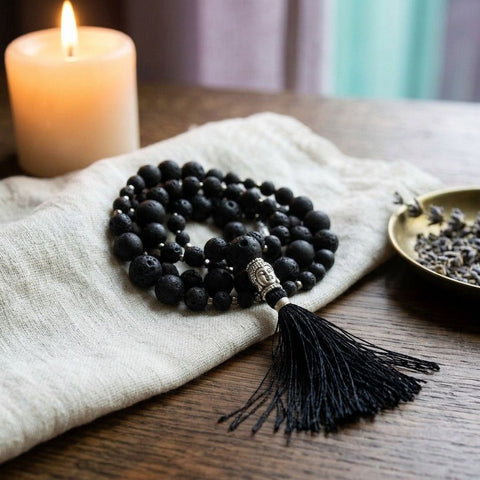 Long lava stone necklace, 42 cm, comes in a gift box with its card
22,90 €
 Engraved brass or copper cuff bracelet: Nepalese designs, adjustable
23,90 €
 Hand-knotted Balinese temple thread bracelet with beads
27,90 €
 Set of three semi-precious stone bracelets with butterfly: 7 gift boxes
31,90 €
 Wooden bead bracelet with Buddha head
10,90 €
 Wooden bead bracelet with lucky coin: 6 tie-on colours
13,90 €
 Tri Hita Karana wood, glass and stone bracelet from Bali
24,90 €