Full moon: astronomy, traditions, symbolism and what science says
The full moon is the phase in which the Moon, opposite the Sun, shows its entire lit disc. It rises at sunset and lights up the night; lunar eclipses can only occur at this time.
Key points
| Sun-Earth-Moon angle | 180° (the Earth lies between the Sun and the Moon) |
|---|---|
| Visible lit part | 100% of the disc, for a precise instant |
| Approximate rising and setting | At sunset, at sunrise |
| Brightness | About 400,000 times fainter than the Sun |
| Tides | Spring tides (maximum range, as with the new moon) |
| Eclipses | Lunar eclipse possible, if the Moon crosses the Earth's shadow |
What the full moon is
At the full moon, the Earth lies (almost) between the Sun and the Moon. The face of the Moon turned toward us is fully lit. For astronomers, this is a precise instant; in practice, the Moon appears full for two to three nights. It rises as the Sun sets and sets as the Sun rises: it is the only phase visible all night long.
If the Moon crosses exactly through the Earth's shadow, a lunar eclipse occurs. This does not happen at every full moon, because the Moon's orbit is tilted by about 5 degrees: most of the time, it passes above or below the shadow.
Borrowed light
The full moon is the brightest object in the night sky, with an apparent magnitude of about -12.7, compared with -26.7 for the Sun: a difference corresponding to a brightness roughly 400,000 times lower. This light is that of the Sun, reflected by a dark surface (the Moon reflects only a small part of the light it receives). It is nonetheless enough to walk outdoors without a torch, in an open place.
Near the horizon, the Moon looks enormous. This is the Moon illusion: its actual size does not change (a coin held at arm's length hides it just as well high in the sky as on the horizon). No single explanation is agreed; the most widespread hypothesis involves the way we judge distances.
Full moon and traditions
The full moon has been a calendar landmark for a very long time. The Christian Easter is tied to it: Easter is the Sunday following the first full moon of spring, defined by calculation tables (the "paschal full moon") rather than by observation. In the Hebrew calendar, Passover (Pesach) falls on the fifteenth day of the month, around the full moon. In East Asia, the Mid-Autumn Festival revolves around the full moon of the eighth lunar month, with its mooncakes. In Buddhism, several important festivals, including Vesak, are celebrated at the full moon.
In France, people also speak of the "lune rousse" (red moon) for the spring moon (April–May), which was blamed for scorching young shoots. In reality, the Moon does not cause the frost: a clear sky does, letting the warmth of the ground escape during the night.
In autumn, the "harvest moon" is the full moon closest to the equinox. At our latitudes, it rises at almost the same time for several evenings in a row, extending the light in the fields.
Contemporary symbolism: the moment of review
In practices inspired by esotericism, the full moon symbolises fulfilment, clarity, gratitude and the moment of "letting go": we look at what has happened since the new moon, give thanks, and release what weighs us down. Other traditions see it as a time of strong emotions and gatherings.
These readings are modern and varied, with no proven basis. Their main value is as a regular appointment with yourself.
Full moon, sleep, births: what science says
It is often said that the full moon makes people restless, disturbs sleep or brings more babies into the world. The research is nuanced. A review of 37 studies (1985) found no link between the phases of the Moon and behaviour. A Swiss laboratory study from 2013 suggested lighter sleep around the full moon, but it involved 33 people and was not reproduced by larger studies. A field study from 2021 noted that people went to bed slightly later in the days before the full moon. An analysis of 38.7 million births in France found a very small excess of births at the full moon, too slight to be noticed in a maternity ward.
The word "lunatic" (like the French lunatique) comes from the Latin luna: the idea is ancient, but it rests on no evidence. If your sleep worries you, speak to a health professional.
Simple gestures for the full moon
- Take stock of the month in a notebook: three things that moved forward, three things to be thankful for.
- Walk or watch the Moon as it rises, simply for the pleasure of the sight.
- Place your stones on a windowsill, if you like the tradition of "recharging" them in moonlight. This does not damage them, but be careful with selenite, which is fragile in damp conditions.
- Gather friends for a meal: it is the oldest of lunar rituals.
Frequently asked questions
Does the full moon last one night or three?
For astronomers, it is an instant. In everyday use, the Moon appears full for about three nights. People speak of "the night of the full moon" for the one closest to the exact instant.
Why does the full moon look bigger near the horizon?
It is an optical illusion. Its actual size does not change. No explanation is accepted by everyone, but the phenomenon is well known and can be checked by measuring the Moon at arm's length.
Is there an eclipse at every full moon?
No. The Moon's orbit is tilted by about 5 degrees; the Moon crosses the Earth's shadow only a few times a year.
What is the lune rousse?
A traditional French name for the April–May moon. The frost damaging young shoots was attributed to the Moon, when the real cause is the clear sky that lets heat escape.
Does the full moon really affect sleep?
The results are thin and debated. A 2013 study suggested it, but larger studies did not confirm it. If you sleep poorly, a health professional is the right person to consult.
Also read
The meanings mentioned belong to tradition and symbolism. They are neither promises of results nor medical advice. Back to Guide to the moon.
In the shop
Moonstone: our products
 Raw rainbow moonstone on a black metal stand: 13 cm mineral specimen
27,90 €
 Polished moonstone obelisks and points
59,90 €
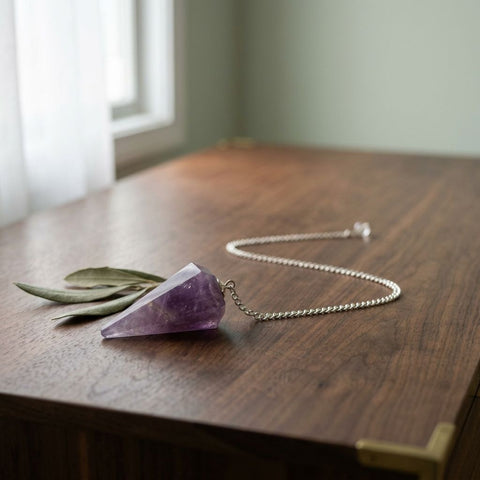 Cut stone pendulum, approx. 4 cm, silver-tone chain
16,90 €
 Rainbow moonstone runes: 25 milky stones engraved in gold
59,90 €
 Rainbow moonstone chips: bluish, by the kilo
37,90 €
 Moonstone chips: pearly, by the kilo
34,90 €
 Four stone shapes – rainbow moonstone
14,90 €