Waxing gibbous moon: phase, observation and symbolism
The waxing gibbous moon is the phase in which more than half of the disc is lit, between the first quarter and the full moon. It can be seen early in the afternoon and for much of the night.
Key points
| Illumination | 51% to 99% of the disc |
|---|---|
| Age of the Moon | About 7.4 to 14.8 days after the new moon |
| Rising and setting | From early to late afternoon; setting after midnight, later and later |
| Shape | Convex, "humped": the terminator, the boundary between day and night, is curved |
| Lit side (northern hemisphere) | Right, with a dark area on the left |
| French name | Lune gibbeuse croissante |
A "humped" moon
The word gibbous comes from the Latin gibbus, meaning hump. When the lit part exceeds half the disc without filling it entirely, the dark zone becomes a crescent along the edge, and the bright zone bulges outward: the Moon takes on the shape of an egg or of a deflated ball on one side. "Waxing" means that the lit part grows from one day to the next.
This phase begins at the first quarter, about 7.4 days after the new moon, and ends at the full moon, a little over seven days later. Its length varies slightly from month to month, because the Moon does not travel at a constant speed around the Earth.
How to observe it
The waxing gibbous moon is a sight of the evening and early night. It appears early in the afternoon and sets later and later: after midnight at the start of the phase, and almost at dawn by the end. It can therefore be observed without staying up very late.
It is lovely to watch with the naked eye, because the large dark patches known as maria (vast plains of cooled lava, with no water) are easy to make out. Binoculars and telescopes always reveal fine relief along the boundary between lunar day and night, where the shadows are long. As the full moon approaches, this relief fades: the light falls more and more head-on.
An amusing detail: we always see the same face of the Moon, because it rotates on its axis in exactly the time it takes to orbit the Earth. Slight rocking motions, known as librations, reveal about 59% of its surface over time.
The Moon's markings in cultures
The lunar maria have inspired many images. In Europe, people often speak of the "Man in the Moon". In China, Japan and Korea, one sees instead a rabbit pounding something with a mortar. Other cultures see a woman carrying a bundle of sticks, a frog or a crab. These figures are projections of the imagination onto dark patches, which alone shows how much the Moon's symbolism varies from one people to another.
Gardening by the Moon: a point of vocabulary
In traditional gardening, people speak of the "waxing moon" and the "rising moon". These are not the same thing. The waxing (or waning) moon describes the phase, that is, the amount of light visible. The rising (or falling) moon describes the height of the Moon in the sky from one day to the next: it climbs for about thirteen days, then descends for thirteen days. A waxing moon can therefore be falling, and vice versa.
According to this tradition, sowing leafy vegetables or fruiting plants is best done in a waxing moon. Independent scientific evidence for these rules is lacking; favourable results come mainly from biodynamic gardening circles. Feel free to treat it as a game, without expecting a guaranteed result.
Contemporary symbolism: refining and waiting
In practices inspired by esotericism, the waxing gibbous moon is the phase of adjustment: the project is underway, the decision has been made, and what remains is to refine and persevere before the "moment of truth" of the full moon. The word most often associated with it is patience: what was begun is not yet finished, but it is moving forward.
This is an image, not a law. It helps to structure the month: beginning, momentum, decision, adjustment, review. If this reading does not speak to you, you lose nothing by setting it aside.
Simple gestures for the waxing gibbous moon
- Take stock of progress: where do your new-moon intentions stand? What still needs finishing before the full moon?
- Prepare what you want to celebrate or conclude at the full moon: a meal, a letter, a tidy-up.
- Look at the lunar maria with the naked eye, then with binoculars, and see which figure you can make out.
- Arrange your stones or ritual objects so that they can sit in the moonlight on the evening of the full moon, if you enjoy this practice (see the guide to cleansing and recharging your stones).
Frequently asked questions
What is the difference between gibbous and crescent?
A crescent shows less than half of the disc lit, with an inward-curving edge. A gibbous moon shows more than half, with a lit edge that bulges outward.
What time can the waxing gibbous moon be seen?
In the afternoon and evening, and then for part of the night: it rises between early and late afternoon, depending on how far the phase has progressed, and sets after midnight.
Is the waxing moon the same as the rising moon?
No. "Waxing" describes the phase (the light is increasing); "rising" describes the Moon's height in the sky from one day to the next. The two cycles are independent.
Why do we always see the same face of the Moon?
Because the Moon rotates on its axis in the same time it takes to orbit the Earth. This is called synchronous rotation.
Does this phase really have an influence on us?
No solid influence on sleep, mood or health has been demonstrated. The symbolism of the phase is a cultural reading.
Also read
The meanings mentioned belong to tradition and symbolism. They are neither promises of results nor medical advice. Back to Guide to the moon.
In the shop
Moonstone: our products
 Raw rainbow moonstone on a black metal stand: 13 cm mineral specimen
27,90 €
 Polished moonstone obelisks and points
59,90 €
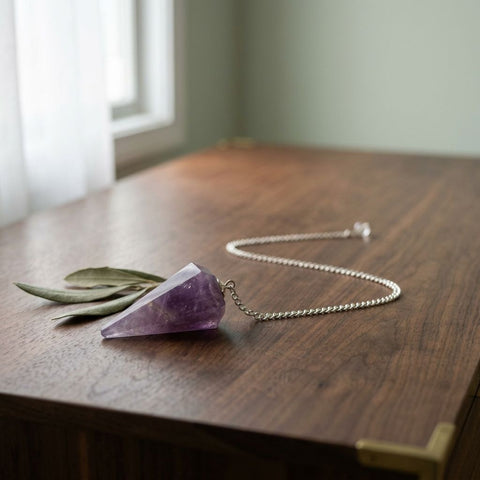 Cut stone pendulum, approx. 4 cm, silver-tone chain
16,90 €
 Rainbow moonstone runes: 25 milky stones engraved in gold
59,90 €
 Rainbow moonstone chips: bluish, by the kilo
37,90 €
 Moonstone chips: pearly, by the kilo
34,90 €
 Four stone shapes – rainbow moonstone
14,90 €