First quarter moon: astronomy, observation and symbolism
At the first quarter, the Moon has completed a quarter of its orbit and shows a half-lit disc on the right. It is an ideal phase for observing lunar features.
Key points
| Sun-Earth-Moon angle | 90° (a quarter turn from the new moon) |
|---|---|
| Visible lit part | Half of the disc (50%), on the right in the northern hemisphere |
| Age of the Moon | About 7.4 days after the new moon |
| Rising, culmination, setting | Around noon, around 6 p.m., around midnight (average values) |
| Tides | Neap tides (smallest range) |
| Memory aid | The "p" of "premier" (French for "first"): the Moon draws a p in the northern hemisphere |
Why "quarter" when we see half?
It is a classic trap. The word quarter here refers to the quarter of the journey the Moon has covered along its orbit since the new moon, not to a quarter of the lit disc. At the first quarter, the Moon is 90° from the Sun in the sky, and we see half of its lit face: a clean half-disc bounded by a straight line, the terminator, which separates lunar day from lunar night.
This moment falls on average 7.4 days after the new moon. The actual interval varies somewhat, from about 6.6 to 8.2 days depending on the month, because the Moon does not travel at a constant speed along its elliptical orbit.
Where and when to observe it
The first quarter rises around noon, reaches its highest point around 6 p.m. and sets around midnight. You can therefore see it in the middle of the afternoon, well before nightfall, and during the first half of the evening. Many people are surprised to see the Moon in a still-blue sky: this is perfectly normal.
In the northern hemisphere, the lit side is on the right. To avoid confusing it with the last quarter, think of the letter p (for "premier", French for "first"): the lit half-disc resembles a tiny p, with its bowl on the right. The last quarter, by contrast, looks like a d. Be aware that this memory aid only works in the northern hemisphere.
| Phase | Approximate rising time | Setting time |
|---|---|---|
| First quarter | Around noon | Around midnight |
| Full moon | At sunset | At sunrise |
| Last quarter | Around midnight | Around noon |
The best phase for viewing features
With binoculars or a telescope, the first quarter is a beautiful phase to observe. Near the terminator, the Sun lights the features at a low angle: the shadows are long, which brings out the craters, mountain ranges and the edges of the lunar seas. At the full moon, by contrast, the light falls head-on and the features look flat. It was by observing these shadows that Galileo became convinced, in 1609–1610, that the Moon had mountains; he published this in his Sidereal Messenger.
Around this time, enthusiasts may also watch for the "lunar X", a light effect in which lit features form a small X-shaped figure, for just a few hours.
Tides and the first quarter
At both quarters, the Sun and the Moon pull on the ocean waters in perpendicular directions. Their effects partly cancel out: the difference between high and low tide is the smallest of the month. These are the neap tides. They alternate with the spring tides of the new and full moon, roughly every week. This is one of the few lunar effects that is firmly established on our planet.
Contemporary symbolism: the moment of decision
In practices inspired by esotericism, the first quarter is often presented as a phase of creative tension: a project was launched at the new moon, and now choices must be made, obstacles overcome, action taken. The image is that of a "crossroads": half light, half dark, nothing yet settled.
This is a modern symbolic reading, not based on any scientific observation. It can serve as a frame for taking stock at the midpoint of the month: where do my intentions stand, what is holding me back, and what small decision can I make today?
Simple gestures for the first quarter
- Take stock of your new-moon intentions: tick off what is moving forward, and rephrase what is stuck.
- Take a small decision you have been putting off, however modest: an appointment, a message, a sort-out.
- Look at the Moon in daylight with children: the half-disc in the blue sky is a wonderful way to explain the phases with a ball and a lamp.
- Note what you see in your sky journal: shape, time, position, weather.
Frequently asked questions
Why is this phase called "first quarter"?
Because the Moon has covered a quarter of its orbit around the Earth since the new moon, not because a quarter of the disc is lit. We see half of it.
When does the first quarter occur?
About a week after the new moon, or 7.4 days on average. Almanacs and ephemerides give the exact date and time.
How do you tell the first quarter from the last quarter?
In the northern hemisphere, the first quarter is lit on the right and is seen in the evening; the last quarter is lit on the left and is seen in the morning. In the southern hemisphere, the lit side is reversed.
Can the Moon be seen in daylight?
Yes, very often, especially around the quarters. The Moon is bright enough to stand out against the blue sky.
Does the first quarter affect mood or sleep?
No solid study has shown this. Research on the Moon and human behaviour gives thin and contradictory results.
Also read
The meanings mentioned belong to tradition and symbolism. They are neither promises of results nor medical advice. Back to Guide to the moon.
In the shop
Moonstone: our products
 Raw rainbow moonstone on a black metal stand: 13 cm mineral specimen
27,90 €
 Polished moonstone obelisks and points
59,90 €
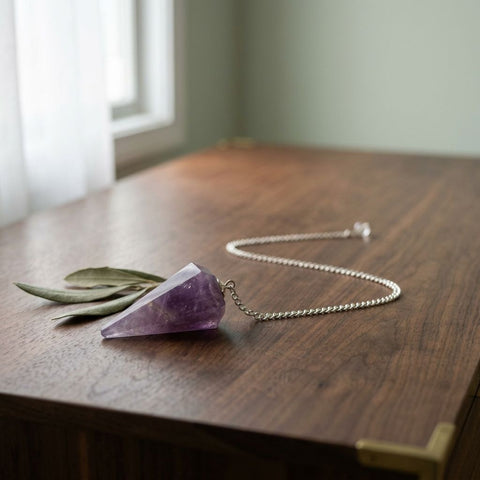 Cut stone pendulum, approx. 4 cm, silver-tone chain
16,90 €
 Rainbow moonstone runes: 25 milky stones engraved in gold
59,90 €
 Rainbow moonstone chips: bluish, by the kilo
37,90 €
 Moonstone chips: pearly, by the kilo
34,90 €
 Four stone shapes – rainbow moonstone
14,90 €