Last quarter moon: astronomy, observation and symbolism
At last quarter, the Moon has completed three quarters of its orbit and shows a half-lit disc on the left. It rises around midnight and is seen mostly in the morning.
Key points
| Sun-Earth-Moon angle | 270° (three quarters of a turn since the new moon) |
|---|---|
| Visible lit portion | Half of the disc (50%), lit on the left in the northern hemisphere |
| Age of the Moon | About 22 days after the new moon |
| Moonrise, highest point, moonset | Around midnight, around 6 a.m., around noon (average values) |
| Tides | Neap tides (smallest range) |
| Memory aid | The letter d of the French word dernier (last): the Moon draws a d in the northern hemisphere |
What the last quarter is
About a week after the full moon, the Moon is once again at a right angle to the Sun: this is the last quarter. As at the first quarter, we see half of the disc lit, and the terminator, the boundary between lunar day and night, is a straight line. Only the side changes: in the northern hemisphere, the lit half is the left one.
The word "quarter" refers to the quarter of the orbit covered, not to the fraction visible. At last quarter, the Moon has completed three quarters of its circuit since the new moon, about 22 days on average. It has roughly seven and a half days left before it returns to new moon.
Where and when to observe it
The last quarter rises around midnight, reaches its highest point around 6 a.m. and sets around noon. It is therefore a morning moon: you can see it in the second half of the night, then high in the sky at daybreak, often still visible in the middle of the morning. It is much loved by people who walk their dog at dawn or catch the first train.
To tell it apart from the first quarter, remember the letter d (for dernier, French for "last"): the bowl of the d is on the left, like the lit part. This memory aid works in the northern hemisphere; in the south, the Moon appears upside down.
| Quarter | Lit side (northern hemisphere) | Time of visibility |
|---|---|---|
| First quarter | Right | Afternoon and first half of the night |
| Last quarter | Left | Second half of the night and morning |
Quarters, geometry and Aristarchus
At the quarters, the triangle formed by the Earth, the Moon and the Sun has a right angle at the Moon. This property was put to use as early as Antiquity: in the 3rd century BCE, the Greek scholar Aristarchus of Samos tried to estimate the relative distances of the Sun and the Moon by measuring the angle between them at the moment of the half disc. His method was sound in principle, but the angle to be measured, very close to 90°, is almost impossible to read with the naked eye, and he found a Sun about 19 times farther away than the Moon, whereas it is about 390 times farther. A measurement error, not a reasoning error.
Neap tides and the last quarter
As at the first quarter, the pulls of the Sun and the Moon on the oceans are at right angles: they partly cancel each other out, and the tides are the weakest of the month. These are the neap tides, which precede the return of the spring tides at new moon. Shore anglers and boaters find gentler tide times at this point in the month.
Contemporary symbolism: the turning point
In practices inspired by esotericism, the last quarter is the phase of "letting go" and review: you sort through what has served you and what has not, you correct course, and you free yourself from a habit or an overdue task. Some authors present it as a second crossroads of the month, symmetrical with the first quarter: a decision, but this time to remove something rather than add it.
This reading is modern and symbolic. It does not claim any action on the world, only to give a framework to a clear-out you would want to do anyway.
Simple steps for the last quarter
- Sort out a drawer, an app or an unnecessary subscription.
- Write down what you are letting go on paper: a habit, a grudge, a task you will not do.
- Get up to see the Moon high in the early-morning sky, once, for the pleasure of it.
- Prepare what comes next: list what you would like to try by the next new moon.
Frequently asked questions
Why is the last quarter lit on the left?
Because the waning Moon is west of the Sun: the side facing the Sun is, seen from the northern hemisphere, the left side. At the first quarter, it is the opposite.
What time can you see the last quarter?
Mostly after midnight and in the morning: it rises around midnight, reaches its highest point around 6 a.m. and sets around noon.
Is there really a "good time" for a clear-out?
It is a modern tradition, with no scientific validation. Clearing out on a fixed date can be useful, whatever the phase of the Moon.
Are the tides stronger at the last quarter?
No, they are weaker: these are the neap tides. The strong tides (spring tides) occur around new moon and full moon.
How many days are left before the new moon?
About seven and a half days on average, with a variation of a few hours from one month to the next.
Also read
The meanings mentioned belong to tradition and symbolism. They are neither promises of results nor medical advice. Back to Guide to the moon.
In the shop
Moonstone: our products
 Raw rainbow moonstone on a black metal stand: 13 cm mineral specimen
27,90 €
 Polished moonstone obelisks and points
59,90 €
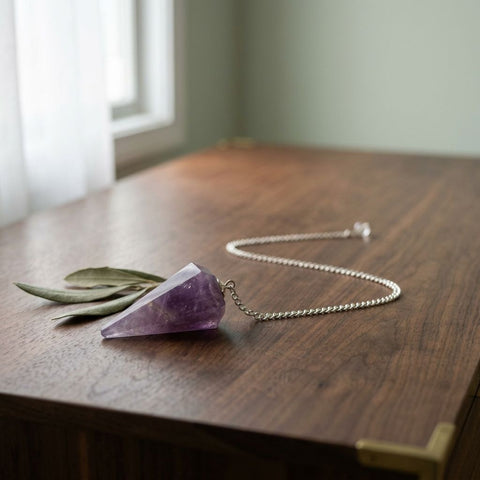 Cut stone pendulum, approx. 4 cm, silver-tone chain
16,90 €
 Rainbow moonstone runes: 25 milky stones engraved in gold
59,90 €
 Rainbow moonstone chips: bluish, by the kilo
37,90 €
 Moonstone chips: pearly, by the kilo
34,90 €
 Four stone shapes – rainbow moonstone
14,90 €