Waning crescent moon: observation, astronomy and symbolism
The waning crescent is the thin arc of Moon visible before dawn, just before the new moon. It marks the end of the lunar cycle, and earthshine may appear on its dark side.
Key points
| Common name | Waning crescent (old moon, waning moon) |
|---|---|
| Illumination | From about 49% down to about 1% of the disc |
| Age of the Moon | About 22 to 29 days after the new moon |
| Where and when to look | In the east, before sunrise |
| Lit side (northern hemisphere) | Left |
| Special feature | Earthshine visible at daybreak; end of the cycle |
What is the waning crescent?
After the last quarter, the lit part keeps shrinking and the Moon takes the shape of a crescent: less than half of the disc shines, with a curve hollowed inward. This is the waning crescent (in French, dernier croissant), which shortly precedes the new moon. Each day the crescent gets thinner and moves closer to the Sun in the sky.
It spends less and less time above the horizon before sunrise. In the final days, it disappears into the brightness of dawn.
How to observe it
The waning crescent rises before the Sun, in the east: it is an object of dawn. The best time to see it is between one hour and half an hour before sunrise, with a clear horizon to the east. The closer the date is to the new moon, the lower and thinner it is, and the earlier you must get up, under a clear sky.
In the northern hemisphere, the lit part is on the left, that is, on the side of the Sun still to come; the shape suggests the letter C. A French saying goes that "the Moon is a liar": lit on the right, it looks like a D and is waxing; lit on the left, it looks like a C and is waning, which is the opposite of what the letters suggest in French (D for décroissant, C for croissant). This cue only works in the northern hemisphere.
A clear sky to the east, away from city lights, and an early alarm are worth more than a telescope: the naked eye is enough, and simple binoculars reveal earthshine when it is present.
The old Moon in the arms of the new
A few days before the new moon, the dark part of the disc is sometimes visible, in a soft grey: this is earthshine, sunlight reflected by the Earth. It can be seen at dawn with the waning crescent, just as it can be seen at dusk with the waxing crescent. The English expression "the old Moon in the new Moon's arms" describes the image well.
Leonardo da Vinci described this phenomenon in the early 16th century. Today, precise measurement of earthshine is used to study how much light the Earth sends back into space, a useful indicator for climate research.
In calendars: the end of the month
In lunar calendars, the waning crescent marks the end of the month. In the Islamic calendar, a month has 29 or 30 days: it ends when the appearance of the new crescent in the evening is observed (or calculated). In popular tradition in several regions, the last days of the lunation were considered a rest from field work; these beliefs are local and vary widely, so no general rule can be given.
Contemporary symbolism: rest before renewal
In practices inspired by esotericism, the waning crescent is the phase of rest and introspection: the cycle is complete, you slow down, and you prepare to set out again. It is readily associated with the legitimate tiredness after a month of effort, with sobriety and with silence. Some authors see in it the "dark moon" that precedes the new moon.
This is a modern and poetic reading. Nothing proves that this phase influences energy or sleep; but slowing down from time to time is a good idea on any date.
Simple steps for the waning crescent
- Go to bed earlier once or twice, with no goal, for the pleasure of rest.
- Review the past month: what went well, what tired you, what you would like to change.
- Go out before dawn and look at the crescent, possibly alongside a bright planet such as Venus.
- Prepare for the new moon: choose two or three intentions for the next cycle.
Frequently asked questions
Why is the waning crescent seen in the morning?
Because the waning Moon is west of the Sun in the sky: it rises before the Sun does. So it is seen before dawn, in the east.
What is the difference between the first and last crescent?
The first crescent is lit on the right and is seen in the evening in the west. The last crescent is lit on the left and is seen in the morning in the east (in the northern hemisphere).
Why can we sometimes see the rest of the disc in grey?
This is earthshine: sunlight reflected by the Earth faintly lights the dark face of the Moon.
How long does this phase last?
About a week, from around day 22 to day 29 of the cycle, with slight variations from one month to the next.
Should you rest during the waning crescent?
It is a modern tradition, not a rule. Resting does you good at any point in the month.
Also read
The meanings mentioned belong to tradition and symbolism. They are neither promises of results nor medical advice. Back to Guide to the moon.
In the shop
Moonstone: our products
 Raw rainbow moonstone on a black metal stand: 13 cm mineral specimen
27,90 €
 Polished moonstone obelisks and points
59,90 €
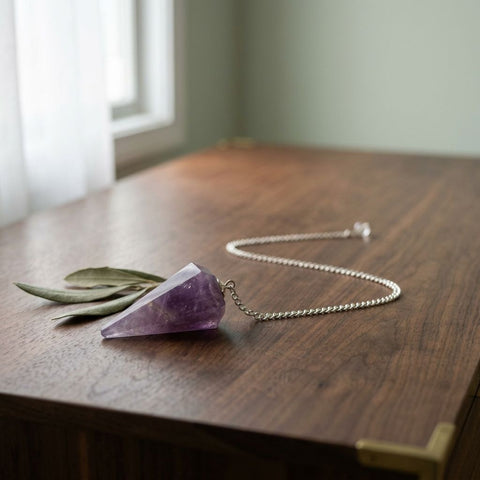 Cut stone pendulum, approx. 4 cm, silver-tone chain
16,90 €
 Rainbow moonstone runes: 25 milky stones engraved in gold
59,90 €
 Rainbow moonstone chips: bluish, by the kilo
37,90 €
 Moonstone chips: pearly, by the kilo
34,90 €
 Four stone shapes – rainbow moonstone
14,90 €