First crescent moon: observation, astronomy and symbolism
The first crescent is the thin arc of Moon visible in the early evening after the new moon. It announces the growth of the lunar disc, and earthshine often appears on the dark part.
Key points
| Common names | First crescent (waxing crescent, crescent moon) |
|---|---|
| Illumination | About 1% to 49% of the disc |
| Age of the Moon | About 1 to 6 days after the new moon |
| Where and when to look | In the west, after sunset |
| Lit side (northern hemisphere) | Right |
| Special feature | Earthshine: the rest of the disc is faintly lit by the Earth |
What is the first crescent?
A few days after the new moon, the Moon moves away from the Sun in the sky and shows us a slender lit band: this is the first crescent, also called the waxing crescent. The word "crescent" describes the shape (a curve hollowed inward), and "waxing" indicates that the Moon is growing, as opposed to the last crescent.
The lit part grows each day and covers less than half of the disc. At the end of this phase, the Moon reaches the first quarter.
How to spot it in the sky
The first crescent is an object of the early evening. It follows the Sun closely, appears in the west at dusk, then sets an hour or a few hours after it. The thicker the crescent, the longer it stays in the sky: on the first evening it is very low, very thin and hard to see; a few days later, it is higher and easier to spot.
At our latitudes (northern hemisphere), the lit part is on the right, the side of the setting Sun. In the southern hemisphere, the Moon is seen "upside down": the waxing crescent is lit on the left. Near the equator, it looks rather like a smile lying on its side.
Practical tip: look for a clear horizon to the west, about half an hour after sunset, and give your eyes time to adjust. Binoculars help a great deal.
Earthshine
On the first evenings, you can often make out the rest of the lunar disc, in a very soft grey. This is earthshine (in French, clair de Terre): seen from the Moon, the Earth is then almost "full", and it reflects sunlight back toward the Moon's dark face. Leonardo da Vinci described the phenomenon in the early 16th century. He believed the light came mainly from the oceans; today we know that clouds contribute even more.
The English expression"the old Moon in the new Moon's arms", captures its poetry well.
The first crescent in calendars and cultures
The first visible crescent plays a central role in the Islamic calendar: the month begins with the sighting of the hilal, this first crescent, including for the start date of Ramadan. Since a very young crescent is extremely difficult to see, some communities rely on local observation and others on astronomical calculation. This is why neighbouring countries may begin the month a day apart.
The crescent is also an ancient symbol. In the Mediterranean world of antiquity, it accompanies lunar and hunting goddesses such as Selene, Artemis or Diana. Later, it became an emblem found on the flags of several countries. It therefore carries very different meanings from one culture to another, and is best cited with care rather than reduced to a single reading.
Contemporary symbolism: the seed and the impetus
In modern practices inspired by esotericism, the first crescent is associated with emerging growth: an idea taking root, a project taking shape, an intention beginning to be put into action. Many people see it as the time for first small steps, after setting their intentions at the new moon.
This is a symbolic reading, based on the image of a crescent that is growing. It is not a rule: everyone is free to see it as a simple calendar landmark.
Simple gestures for the first crescent
- Go out at dusk to look for the crescent, with binoculars if you have them: a moment of calm that costs nothing.
- Reread your intentions from the new moon and choose one first step, a very small one.
- Keep a sky journal: note the date, the time, the shape, and the Moon's position against a landmark in the landscape. After a few weeks, you will see the cycle with your own eyes.
- Look for a planet: the crescent sometimes passes near Venus or another bright planet, a lovely sight without any equipment.
Frequently asked questions
Why is the first crescent visible in the evening and the last crescent in the morning?
Because the waxing Moon lies east of the Sun: it sets after the Sun, so it is seen in the evening. The waning Moon lies west of the Sun: it rises before the Sun, so it is seen before dawn.
Is the crescent always in the same position?
No. Its shape depends on the phase; its orientation depends on your latitude and the time of day. At our latitudes, the waxing crescent is lit on the right.
When is the very first crescent seen?
Rarely on the day of the new moon itself. It usually takes more than a day for the Moon to move far enough from the Sun to be visible in twilight, depending on the sky and the season.
What is earthshine?
The faint glow of the unlit part of the Moon, caused by sunlight reflected off the Earth. It is clearly visible when the crescent is thin.
Is there an ideal moment to make a wish at the first crescent?
It is a modern tradition with no scientific basis. If the ritual appeals to you, it gives you a monthly landmark; otherwise, nothing requires you to follow it.
Also read
The meanings mentioned belong to tradition and symbolism. They are neither promises of results nor medical advice. Back to Guide to the moon.
In the shop
Moonstone: our products
 Raw rainbow moonstone on a black metal stand: 13 cm mineral specimen
27,90 €
 Polished moonstone obelisks and points
59,90 €
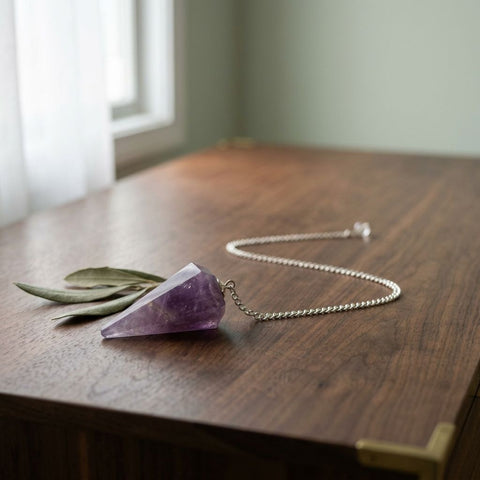 Cut stone pendulum, approx. 4 cm, silver-tone chain
16,90 €
 Rainbow moonstone runes: 25 milky stones engraved in gold
59,90 €
 Rainbow moonstone chips: bluish, by the kilo
37,90 €
 Moonstone chips: pearly, by the kilo
34,90 €
 Four stone shapes – rainbow moonstone
14,90 €