Waning gibbous moon: phase, observation and symbolism
The waning gibbous moon follows the full moon: more than half of the disc is still lit, but the light is diminishing. It rises in the evening and can be seen in the second half of the night.
Key points
| Illumination | 99% to 51% of the disc, decreasing |
|---|---|
| Age of the Moon | About 14.8 to 22.1 days after the new moon |
| Rising and setting | In the evening after sunset, later and later; sets in the morning |
| Lit side (northern hemisphere) | Left |
| French name | Lune gibbeuse décroissante |
| Special feature | Visible in the blue morning sky |
What "waning gibbous" means
After the full moon, the lit part of the Moon shrinks each day: it is waning, that is, decreasing. As long as it covers more than half the disc, it is called gibbous, from the Latin gibbus, meaning hump. The dark zone first appears as a thin sliver on the right, then grows until the last quarter.
This phase lasts roughly a week, between the full moon and the last quarter. As with all phases, the exact day varies by a few hours from one month to the next.
Where and when to look
The waning gibbous moon rises after nightfall, about fifty minutes later each day on average, and sets in the morning. It is therefore a moon of the second half of the night and of early morning. It is the phase you are most likely to notice when you come home late or get up early.
In the northern hemisphere, the lit part is on the left and the dark part on the right: the reverse of the waxing gibbous moon. In the southern hemisphere, the orientation is reversed.
It remains visible in the blue morning sky, which makes it easy to show to children: the pale disc, like a scrap of paper, above the rooftops.
With binoculars, the relief reappears along the boundary between lunar day and night, but this time on the side opposite to that of the waxing moon: it is the lunar sunset that lights the features at a low angle. Following the Moon evening after evening, or morning after morning, you will see the edge of the lunar night gain a little ground each day on the lit part, like a slow tide of shadow.
A Moon that is drifting away
An astronomical fact suits this phase of withdrawal well: the Moon is slowly moving away from the Earth, by about 3.8 centimetres per year. This is measured by firing laser pulses at the reflectors left by the Apollo and Luna missions. On the scale of a human life this is imperceptible, but over hundreds of millions of years it has changed the tides and the length of the day.
The average Earth–Moon distance is about 384,400 km: light takes a little over a second to cover it.
Waning moon, descending moon: not to be confused
In gardening calendars, the "waning moon" is sometimes mixed up with the "descending moon". The first refers to the phase (the light is decreasing); the second to the height of the Moon in the sky from one day to the next. The two cycles are independent. Tradition recommends working the soil, planting and pruning during the descending moon, and other rules for the waning phase, depending on the author.
No solid independent study has established these rules. They form part of popular knowledge, whose charm can be appreciated without relying on it.
Contemporary symbolism: sharing and lightening the load
In practices inspired by esotericism, the waning gibbous moon is the phase of gratitude and sharing: after the peak of the full moon, we pass on what we have learned, give thanks, and begin to shed what is no longer useful. Many writers present it as the start of "letting go", which continues at the last quarter.
This is a modern symbolic reading. It fits well with the image of a light that is diminishing, but it is neither scientific nor obligatory.
Simple gestures for the waning gibbous moon
- Say thank you: write to someone who helped you, or note three good things that happened in a notebook.
- Pass on a skill, lend a book, or explain to a child why the Moon changes shape.
- Declutter: give away what you no longer use, empty an inbox, tidy a shelf.
- Go out early in the morning to see the Moon in the clear sky before sunrise.
Frequently asked questions
At what time does the waning gibbous moon rise?
After sunset, at an increasingly later time: in the evening at first, then after midnight. It sets in the morning.
Why is the Moon visible during the day?
Because it is bright enough to stand out against the blue sky when it is above the horizon at the same time as the Sun, which happens mainly around the quarters.
Is the waning moon the same as the descending moon?
No. "Waning" describes the phase; "descending" describes the Moon's height in the sky from one day to the next. They do not coincide.
Is the Moon really moving away from the Earth?
Yes, by about 3.8 cm a year, measured by laser using the reflectors left by the Apollo missions.
Are there rituals suited to this phase?
Many writers suggest gratitude and tidying rituals. They are modern traditions with no proven effect, but pleasant to follow.
Also read
The meanings mentioned belong to tradition and symbolism. They are neither promises of results nor medical advice. Back to Guide to the moon.
In the shop
Moonstone: our products
 Raw rainbow moonstone on a black metal stand: 13 cm mineral specimen
27,90 €
 Polished moonstone obelisks and points
59,90 €
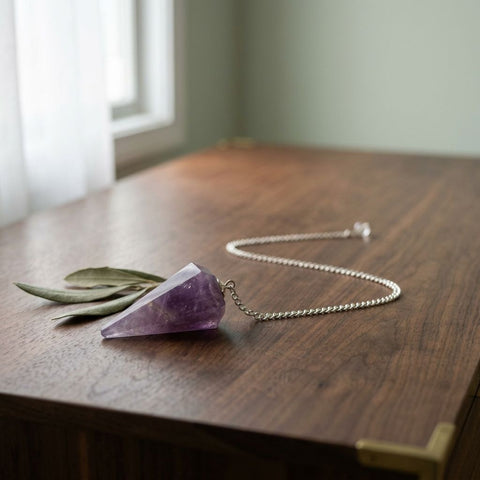 Cut stone pendulum, approx. 4 cm, silver-tone chain
16,90 €
 Rainbow moonstone runes: 25 milky stones engraved in gold
59,90 €
 Rainbow moonstone chips: bluish, by the kilo
37,90 €
 Moonstone chips: pearly, by the kilo
34,90 €
 Four stone shapes – rainbow moonstone
14,90 €