Archangel Selaphiel: meaning, prayer, icons, associated stones
Selaphiel, “I asked God”, is the archangel of prayer in the Orthodox tradition, shown with lowered eyes and arms crossed. Sources, links with Salathiel and modern readings.
Key points
| Names | Selaphiel, Sealtiel, Salathiel, Selatiel, Selathiel |
|---|---|
| Meaning of the name | Sheal-ti-El: “I asked God” |
| Sources | Orthodox list of the seven archangels; the Conflict of Adam and Eve with Satan; absent from the Bible |
| Orthodox tradition | Archangel of prayer and adoration, honoured on 8 November |
| Modern tradition | Archangel of contemplation and prayer |
| Feast day | 8 November (Synaxis of the Archangels) |
| Modern stones | Selenite, amethyst, rock crystal |
Who is Selaphiel?
Selaphiel is known in several forms: Sealtiel, Selatiel, Salathiel. His name comes from the Hebrew Sheʾaltiʾel: “I asked God” or “ask God”. It is a name about prayer in its simplest sense: asking. He is presented in our guide to the archangels.
Selaphiel is not named in the Bible. He belongs to the list of the seven archangels of the Orthodox and Byzantine tradition, whose names spread through iconography. The similar name Salathiel (Shealtiel) was borne by men in the Bible, which can cause confusion.
Origin and textual sources
| Source | Status | What it says about Selaphiel |
|---|---|---|
| Byzantine list of the seven archangels | Orthodox liturgical and iconographic tradition | Selaphiel is the fifth name there, after Michael, Gabriel, Raphael and Uriel. |
| The Conflict of Adam and Eve with Satan (Christian apocryphal text, around the 6th century) | Apocryphal text preserved in Ethiopic and Arabic | God sends Selaphiel (Salathiel) and Suriel (Sariel) to lead Adam and Eve out of danger and bring them to the Cave of Treasures. |
| Revelation 8:3–4 | Canonical text | An angel holds a golden censer and offers the prayers of the saints. A Christian tradition identifies him with Selaphiel; the text gives no name. |
| Devotion to the seven archangels (Palermo, 1516; Rome, 16th century) | Popular devotion, later restricted by the Church | The name circulated in the West before the Church recalled that it recognised only three archangels. |
In the Bible, Salathiel (Shealtiel) is the father of Zerubbabel (1 Chronicles 3:17; Ezra 3:2; Haggai 1:1) and appears in the genealogies of Jesus (Matthew 1:12; Luke 3:27). In 4 Ezra 3:1, the narrator presents himself as “Salathiel, who is also Ezra”. These are men, not angels.
Across the major religions of the West, Selaphiel is not a recognised angel. The Orthodox Church assigns him to the feast of 8 November.
Iconography
Selaphiel is easy to recognise: he is shown with head bowed, eyes lowered and hands crossed over his chest, in the attitude of an orant. Sometimes he kneels and holds a censer. The image conveys inwardness more than action: he is the archangel who prays before he is the one who acts.
Symbolism: asking and falling silent
Prayer is often summed up as a request, but Selaphiel’s attitude is one of silence: head lowered, arms crossed. In this image, praying does not mean speaking at length, but putting oneself in a state of listening. Many spiritual traditions, religious or not, link contemplation to a bodily posture that slows the mind.
In modern systems, Selaphiel has thus become the archangel of contemplation, prayer and meditation. These are symbols. They do not guarantee any result.
Feast, day and colour
The feast falls on 8 November, the day of the Synaxis of the Archangels among Orthodox and Eastern Catholic Christians. No day of the week is stably assigned to him. The modern colours (midnight blue, indigo, violet, white) vary from one author to another and come from recent choices.
What belongs to tradition and what is modern
- Orthodox tradition: Selaphiel in the list of the seven archangels, feast of 8 November, the iconography of the orant.
- Apocryphal text: the Conflict of Adam and Eve with Satan against Satan, where he intervenes together with Suriel.
- Modern systems: an archangel of prayer, contemplation and meditation. They are recent, vary from one author to another, and rest on no religion.
The Catholic Church recognises only Michael, Gabriel and Raphael. These correspondences serve as a support for imagination and attention. They should not be taken as facts.
Stones associated in modern traditions
Pale and violet stones, associated with contemplation, are the most often cited. Recent convention:
- Selenite: soft gypsum (hardness 2), which is damaged by water and can be scratched with a fingernail
- Amethyst: violet quartz (hardness 7), which fades in strong light
- Rock crystal: colourless quartz (hardness 7), often imitated by glass
Each stone page gives its care and precautions.
Respectful practice
- Five minutes of silence: sit down, hands resting on your knees, eyes half-closed, and count ten slow breaths. No result is promised.
- A soft candle (white or midnight blue) set on a stable holder and a non-flammable surface. Never leave it unattended.
- One request in a sentence: write down what you would like to ask, in a single sentence. Then read it again. This exercise helps to clarify.
- If you are a believer: pray with the words of your own tradition. Selaphiel is not recognised by the Catholic Church; please respect its position.
Frequently asked questions
What does Selaphiel mean?
From the Hebrew Sheʾaltiʾel: “I asked God” or “ask God”.
Is Selaphiel in the Bible?
No. The similar name Salathiel (Shealtiel) belongs to a man, the father of Zerubbabel. The archangel comes from the Orthodox tradition.
Why is Selaphiel shown in prayer?
Because Orthodox iconography makes him the archangel of prayer: head bowed, arms crossed over the chest, sometimes with a censer.
When is Selaphiel celebrated?
On 8 November, the day of the Synaxis of the Archangels, in the Orthodox tradition and among Eastern-rite Catholics.
Which stones are associated with Selaphiel?
Selenite, amethyst and rock crystal are the most often cited. The lists are recent and vary from one author to another.
Also read
The meanings mentioned belong to tradition and symbolism. They are neither promises of results nor medical advice. Back to Guide to the archangels.
In the shop
Stone jewellery: our products
 Faceted stone necklace with butterfly in real silver-tone leaf, 42 cm
23,90 €
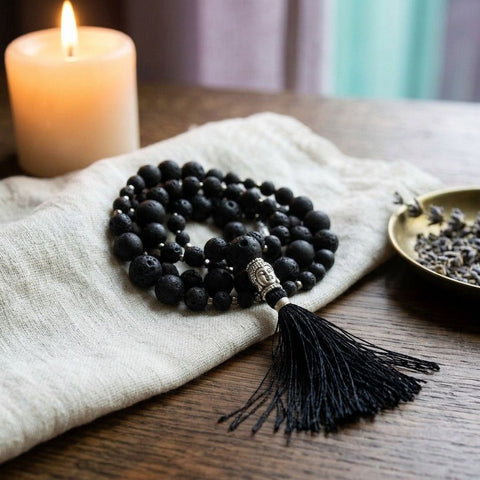 Long lava stone necklace, 42 cm, comes in a gift box with its card
22,90 €
 Engraved brass or copper cuff bracelet: Nepalese designs, adjustable
23,90 €
 Hand-knotted Balinese temple thread bracelet with beads
27,90 €
 Set of three semi-precious stone bracelets with butterfly: 7 gift boxes
31,90 €
 Wooden bead bracelet with Buddha head
10,90 €
 Wooden bead bracelet with lucky coin: 6 tie-on colours
13,90 €
 Tri Hita Karana wood, glass and stone bracelet from Bali
24,90 €