Archangel Barachiel: meaning, blessing, roses, associated stones
Barachiel, “God has blessed”, is one of the seven archangels of the Orthodox tradition, often shown with rose petals. Sources, traditions and modern readings.
Key points
| Names | Barachiel, Barakiel, Barchiel, Baraqiel (a different figure) |
|---|---|
| Meaning of the name | Barakh-El: “God has blessed”, “blessing of God” |
| Sources | Orthodox list of the seven archangels; 3 Enoch; Almadel; absent from the Bible |
| Orthodox tradition | One of the seven archangels, honoured on 8 November |
| Modern tradition | Archangel of blessings, family and home |
| Feast day | 8 November (Synaxis of the Archangels) |
| Modern stones | Rose quartz, rhodonite, pink opal |
Who is Barachiel?
Barachiel, also written Barakiel or Barchiel, is known above all in the Orthodox and Byzantine tradition, which counts him among the seven archangels. His name comes from the Hebrew barakh, “to bless”, and El, God: “God has blessed” or “blessing of God”. He is presented in our guide to the archangels.
He is not named in the Bible. He comes from a list of seven archangels handed down through Orthodox liturgical and iconographic tradition, and from a devotion that emerged in Sicily and Rome in the 16th century. A frequent confusion exists with Baraqiel (“lightning of God”), another name, mentioned in the first book of Enoch (6:7) among the leaders of the fallen Watchers.
Origin and textual sources
| Source | Status | What it says about Barachiel |
|---|---|---|
| Byzantine list of the seven archangels | Orthodox liturgical and iconographic tradition | Barachiel is the seventh name, after Michael, Gabriel, Raphael, Uriel, Selaphiel and Jegudiel. |
| Image of the seven archangels from Palermo (1516) and Roman devotion of the 16th century | Popular devotion, later restricted by the Church | The names spread in the West, notably in Rome, before the Church recalled that it recognised only three names. |
| Third book of Enoch (5th–6th centuries) | Late Jewish mystical text | A prince of angels named Baraqiel, or Barakiel, is cited among the great princes; the identification with Barachiel remains debated. |
| Almadel of Solomon (grimoire) | Late magic | Barachiel appears among the angels entrusted with regions of the sky. |
Across the major religions, Barachiel is not a recognised angel in the West. The Orthodox Church, however, assigns him to the feast of 8 November.
Devotion to the seven archangels
In the 16th century, a devotion to the seven archangels spread from Palermo, where an image of the seven archangels is attested in 1516. In Rome, a Sicilian friar, Antonio Lo Duca, supported it with the authorities, and the church of Santa Maria degli Angeli e dei Martiri, built within the Baths of Diocletian, preserves its memory. The names of Barachiel, Selaphiel, Jegudiel and Uriel circulated there alongside those of Michael, Gabriel and Raphael.
The Church limited its scope: in the 19th century, several popes (Leo XII, Pius VIII, Gregory XVI) refused to authorise the veneration of these names, and the Directory on Popular Piety (2001) advises against naming angels other than the three found in Scripture. Orthodoxy, by contrast, keeps the list in its liturgy.
Iconography
He is the archangel whose image is the most recognisable: he often holds a white rose against his chest, or his clothing is covered with rose petals, symbols of the blessings that fall. In some icons he carries a basket of bread or a staff. These attributes are late and vary from one workshop to another.
Symbolism: blessing
To bless is, etymologically, “to speak well” (the Latin benedicere): to wish someone what will be favourable to them. Blessing is a gesture found in almost every culture, at meals, departures and births.
In modern systems, Barachiel has thus become the archangel of the home, the family and gratitude. These are symbols. They do not guarantee any outcome in family or professional life.
Feast, day and colour
The feast falls on 8 November, the day of the Synaxis of the Archangels among Orthodox and Eastern Catholic Christians. Some authors associate him with Saturday or with the planet Jupiter, but these correspondences are not stable. The modern colours are pink, white and sometimes gold; they come mainly from the image of the rose.
What belongs to tradition and what is modern
- Orthodox tradition: Barachiel in the list of the seven archangels, feast of 8 November, rose iconography.
- Western devotions of the 16th century: the names spread, then the Church reminded everyone that it recognises only Michael, Gabriel and Raphael.
- Modern systems: an archangel of blessings, family and couples. They are recent, vary from one author to another, and rest on no religion.
These correspondences serve as a support for imagination and attention. They should not be taken as facts.
Stones associated in modern traditions
The rose inspires pink stones. Recent convention:
- Rose quartz: quartz with a hardness of 7, whose colour fades in strong light
- Rhodonite: pink manganese silicate veined with black
- Pink opal: a soft opal, sensitive to knocks and to drying out
Each stone page gives its care and precautions.
Respectful practice
- Three words of blessing: write a simple wish (“I wish you…”) to three people around you. No result is promised.
- A rose in a glass: place it on the dining table as a sign of shared gratitude.
- A soft candle (pink or white) set on a stable holder and a non-flammable surface. Keep it in sight.
- If you are a believer: bless your meal with the words of your own tradition. Barachiel is not recognised by the Catholic Church; please respect its position.
Frequently asked questions
What does Barachiel mean?
From the Hebrew barakh (to bless) and El (God): “God has blessed” or “blessing of God”.
Why is Barachiel shown with roses?
In Orthodox iconography, rose petals symbolise the blessings of God falling upon the world. The attribute is late.
Is Barachiel in the Bible?
No. He comes from the Orthodox list of the seven archangels and from late devotions.
Are Barachiel and Baraqiel the same angel?
Not necessarily. Baraqiel (lightning of God) is a name from the book of Enoch, among the fallen Watchers. The two names are close, hence the confusion.
When is Barachiel celebrated?
On 8 November, the day of the Synaxis of the Archangels, in the Orthodox tradition and among Eastern-rite Catholics.
Also read
The meanings mentioned belong to tradition and symbolism. They are neither promises of results nor medical advice. Back to Guide to the archangels.
In the shop
Stone jewellery: our products
 Faceted stone necklace with butterfly in real silver-tone leaf, 42 cm
23,90 €
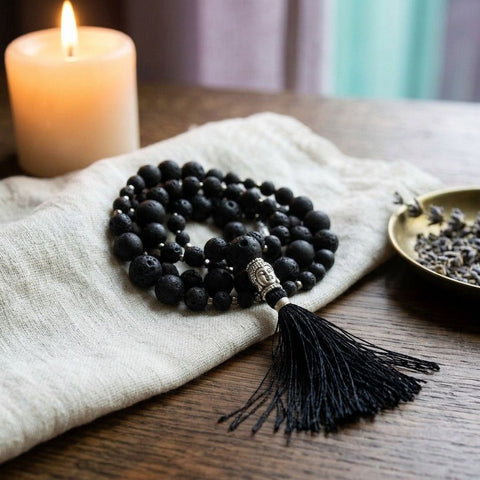 Long lava stone necklace, 42 cm, comes in a gift box with its card
22,90 €
 Engraved brass or copper cuff bracelet: Nepalese designs, adjustable
23,90 €
 Hand-knotted Balinese temple thread bracelet with beads
27,90 €
 Set of three semi-precious stone bracelets with butterfly: 7 gift boxes
31,90 €
 Wooden bead bracelet with Buddha head
10,90 €
 Wooden bead bracelet with lucky coin: 6 tie-on colours
13,90 €
 Tri Hita Karana wood, glass and stone bracelet from Bali
24,90 €