Jade: Nephrite, Jadeite or Serpentine, and How to Tell Them Apart
The word “jade” covers two minerals, nephrite and jadeite, and is also used to sell serpentine or other stones. Markers, treatments and safe tests.
Key points
| Nephrite | Amphibole (tremolite-actinolite), hardness 6 to 6.5, density 2.9 to 3.0 |
|---|---|
| Jadeite | Pyroxene (sodium aluminium silicate), hardness 6.5 to 7, density about 3.3 |
| Serpentine | Family of magnesium silicates, hardness 2.5 to 5.5 depending on the variety, density 2.4 to 2.6 |
| Jadeite deposits | Myanmar (Kachin), Guatemala (Motagua valley) |
| Nephrite deposits | China (Xinjiang, Hotan), Canada, New Zealand, Siberia, Taiwan |
| Jadeite treatments | Type A (not impregnated), B (bleached and impregnated with resin), C (dyed), B+C |
| Reliable identification | In a laboratory (spectroscopy); at home, clues only |
One word, two minerals
For centuries, a green, hard, tough stone was called “jade” without anyone realising that the name covered two different minerals. In 1863, the French mineralogist Alexis Damour demonstrated this and named jadeite. The word “jade” comes from the Spanish piedra de ijada, “stone of the flank”, because it was believed to have effects on the kidneys and colic; “nephrite” is its learned Latin translation.
- Nephrite is a calcium, magnesium and iron silicate of the amphibole group (tremolite-actinolite series). Its structure of interlocking fibres makes it one of the toughest stones there are. It is generally green, sometimes white, yellow or black, with a hardness of 6 to 6.5 and a density of about 2.9 to 3.0. It is the historic jade of ancient China, mined notably in the Hotan region (Xinjiang), and later in Canada, New Zealand, Siberia and Taiwan.
- Jadeite is a sodium aluminium silicate of the pyroxene group, with a hardness of 6.5 to 7 and a density of about 3.3. It has a wider range of colours (“imperial” green, lavender, white, russet) and comes mainly from Myanmar (Kachin) and Guatemala (Motagua valley). It became the most sought-after jade from the 18th century, when it was imported into China.
Neither is “truer” than the other: they are two genuine jades. In China, the word in fact denotes stones of very ancient cultural status, with a reverence that has nothing to do with hardness.
The table for telling them apart from serpentine
| Criterion | Jadeite | Nephrite | Serpentine (often sold as “jade”) |
|---|---|---|---|
| Mohs hardness | 6.5 to 7 | 6 to 6.5 | 2.5 to about 5.5 depending on the variety |
| Density | About 3.3: very heavy in the hand | 2.9 to 3.0: heavy | 2.4 to 2.6: noticeably lighter |
| Lustre | Vitreous to greasy, bright | Greasy, with an oily appearance | Waxy to greasy, sometimes soapy |
| Colour | Very varied, with patches and spots | Fairly uniform green, sometimes white or black | Pale green to yellowish green, often more uniform |
| Surface appearance | “Orange peel” grain possible on polished pieces | Fibrous, blended, finely silky | Easily scratched; may show milky reflections |
As home tests cannot reliably separate jadeite from nephrite, they are mainly useful for spotting what is not jade: a light, soft, soapy-feeling piece is more likely serpentine or another material.
“Jades” that are not jade
In the trade, the word “jade” has been used for many other materials. The most common:
- serpentine (the variety bowenite, “new jade”, “Suzhou jade” or “Korean jade”): a family of softer magnesium silicates;
- “Malaysian jade”: most often dyed quartzite;
- “Mexican jade”: most often dyed calcite;
- “Californian jade”: vesuvianite (idocrase);
- “South African” or “Transvaal jade”: a hydrogrossular garnet;
- “Indian jade”: aventurine;
- “Australian jade”: chrysoprase.
These materials are genuine stones, but they are not jade in the mineralogical sense. As always, the question is not their decorative value but the accuracy of the name. A stone honestly sold as “serpentine” or “chrysoprase” is a fine material, often at a price very different from that of real jade.
Treatments: types A, B, C
Jadeite, especially in jewellery quality, is subject to a common classification:
- Type A: natural, simply polished and sometimes waxed;
- Type B: bleached in an acid bath, then impregnated with a polymer resin to hide the cracks. The impregnation ages poorly: the piece can yellow or become fragile over time;
- Type C: dyed, often with a loss of translucency;
- Type B+C: both treatments combined;
- assemblages (a thin layer of jade glued onto a backing) are sometimes called type D.
These treatments are not visible to the naked eye: laboratory analysis is needed (infrared spectroscopy, for example). A valuable jade piece should therefore come with a certificate specifying the type. In France, decree no. 2002-65 of 14 January 2002 requires dyeing and filling visible under a 10x loupe to be declared, but not traditional oil or wax. Purely decorative pieces or inexpensive beads are generally not accompanied by one: in that case, ask questions about the nature of the material.
Simple, safe tests
- Weigh in the hand two pieces of the same size, one you are sure of and one you are not: jade is noticeably heavier than serpentine.
- Look at the surface in raking light. Jade has a greasy, uniform lustre; serpentine can look milky or waxy, and more matt.
- Look for colour in cracks and hollows under a loupe: a dye builds up there.
- Observe the variations of colour. Very bright, perfectly uniform greens, with no nuances or patches, suggest dye or glass.
- Touch it. Jade stays cool; plastic warms up quickly.
Avoid. Do not strike the piece to listen to its ring (a knock can chip it), do not scratch it, and do not use acid or flame. Acid is precisely the bath used in workshops to bleach type B jadeites: it is not something to try at home.
What these tests cannot prove. They do not separate jadeite from nephrite, and they reveal neither bleaching nor impregnation. Only a laboratory can do that.
Care and choice
Jade is tough but not indestructible: a sharp blow to an edge can chip it. Clean it with lukewarm water and mild soap; avoid acid, ultrasonic cleaners and heat (especially for type B pieces, whose resin deteriorates). Serpentine, being softer, should be protected from friction.
Before buying, ask: jadeite, nephrite, serpentine or another material; type A, B or C; stated origin; a certificate for valuable pieces. See also the jade profile, “Recognising real jade”, the Mohs scale and how to read a label.
Frequently asked questions
What is the difference between nephrite and jadeite?
They are two minerals. Nephrite is an amphibole (calcium, magnesium, iron) with a hardness of 6 to 6.5; jadeite is a pyroxene (sodium, aluminium) with a hardness of 6.5 to 7 and a higher density. Both are called jade.
Is serpentine fake jade?
It is a genuine stone, but from a different family: softer and lighter. It is often sold under the names “new jade” or “Suzhou jade”. It is not jade in the mineralogical sense.
What do types A, B and C mean?
A: natural jadeite, not impregnated. B: bleached in acid, then impregnated with resin. C: dyed. B+C: both. Only a laboratory can identify them reliably.
Can I tell jade by making it ring?
Some people do, but striking the piece risks chipping it, and the result is not reliable. Prefer weight, a loupe and a certificate for valuable pieces.
Is “Malaysian jade” jade?
No. According to gemmologists, it is most often dyed quartzite. It is a trade name.
Also read
The meanings mentioned belong to tradition and symbolism. They are neither promises of results nor medical advice. Back to Recognizing real stones.
In the shop
Jade: our products
 Green Indian jade: mini obelisk and set of polished points
15,90 €
 Green stone bracelet sold as “jade”
10,90 €
 Thin 6 mm stone bead bracelet, stretch, wrist size 17 cm
12,90 €
 Stone chip Tree of Life pendant on a black cord, 3 cm
14,90 €
 Seated carved stone laughing Buddha
23,90 €
 Green jade mala: 108 beads of 6 to 8 mm and tassel
35,90 €
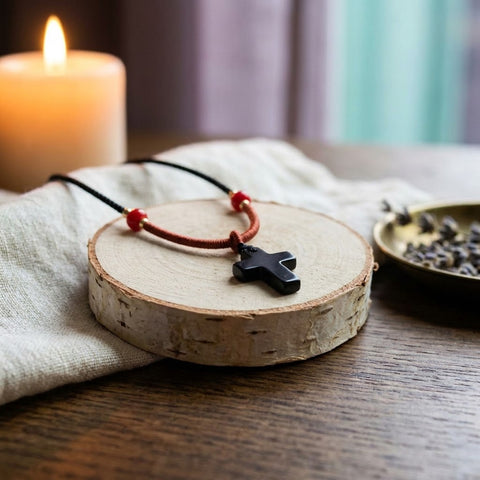 Adjustable cord necklace with small carved stone
21,90 €
 Yellow jade planet on a goldstone stand – 40 mm
29,90 €