Moonstone, Labradorite or Adularia: How to Find Your Way
Three names for feldspars with shifting reflections, often mixed up: adularia, rainbow moonstone and labradorite, along with their glass imitations.
Key points
| Family | Feldspars (aluminium silicates): moonstone = alkali feldspar; labradorite = plagioclase |
|---|---|
| Moonstone | Milky blue sheen, adularescence; hardness 6 to 6.5; density 2.54 to 2.66 |
| Labradorite | Blue, green and golden flashes, labradorescence; hardness 6 to 6.5; density 2.68 to 2.72 |
| Adularia | Name of the feldspar variety that gives moonstone its sheen; comes from the Adula massif |
| Rainbow moonstone | Trade name for a white labradorite with multicoloured reflections |
| Common imitations | Opalescent glass (“opalite”), glass with reflections, plastic |
| Fragility | Two cleavage planes: vulnerable to knocks and ultrasonic cleaners |
Two related families, three names
Feldspars form the most widespread group of minerals in the Earth's crust. Two of them concern us here.
- The “classic” moonstone is an alkali feldspar (composed of sodium and potassium), with the general formula (Na,K)AlSi3O8, most often orthoclase. It shows a milky, bluish reflection that seems to float inside the stone: adularescence. It appears because the crystal is made of fine alternating layers of two feldspars (orthoclase and albite), which diffract light. The thinner the layers, the more the reflection tends towards blue.
- Adularia is the old name for the clear feldspar variety from which moonstone was originally obtained. It takes its name from the Adula massif in the Swiss Alps. In everyday language, “adularia” and “moonstone” refer to the same family.
- Labradorite is a plagioclase, a feldspar rich in calcium (50 to 70% calcium end-member). It shows labradorescence: patches that light up in blue, green, yellow or orange depending on the angle, then go dark grey. The type locality is Paul Island, near Nain, in Labrador (Canada); it is also mined in Madagascar, Finland, Norway and elsewhere. A highly coloured Finnish variety, discovered at Ylämaa in 1940, is called spectrolite.
For moonstone, the main sources are Sri Lanka (which supplies most of today's market), India, Madagascar, Myanmar and Tanzania. Both stones have a hardness of 6 to 6.5 and two cleavage planes: a knock can split them.
Rainbow moonstone: what are we talking about?
The trade uses “rainbow moonstone” for a white or colourless, very clear labradorite that shows several colours. It is not an alkali feldspar like original moonstone, but a plagioclase. It is a very widespread trade name, which many mineralogists consider inaccurate. It is not a fraud if it is explained: the stone is natural and real. The problem arises when a label leads buyers to believe it is the same stone as the blue-sheened moonstone from Sri Lanka.
There are also moonstones with various body colours (white, grey, peach, green), whose tint comes from impurities or inclusions and is in no way artificial.
Adularescence or labradorescence: the table
| Sign | Moonstone (adularia) | Labradorite | Opalescent glass (“opalite”) |
|---|---|---|---|
| Effect | Diffuse, milky white-blue sheen that floats below the surface | Vivid colour flashes (blue, green, yellow, orange) in patches, which go out at certain angles | Uniform bluish tint, orange in transmitted light, no movement |
| Movement | Glides when the stone is tilted | Clearly appears and disappears as you turn it | Does not move, or hardly |
| Body colour | Colourless to white, grey, peach | Grey to dark grey, sometimes white (rainbow) | Uniform milky white |
| Internal appearance | Small cracks like “centipede legs” | Fine lamellae, parallel twinning | Perfect or with round bubbles |
| Hardness | 6 to 6.5 | 6 to 6.5 | About 5 (glass) |
These markers are tendencies: some glasses are designed to imitate the reflection, and some poor-quality moonstones are pale. The most telling features are the movement of the reflection and the presence of round bubbles, or the total uniformity of an imitation.
Simple, safe tests
- Light the stone with a single lamp against a dark background and tilt it slowly. The reflection of real moonstone glides and changes intensity; that of a glass stays frozen.
- Look at the colour of the effect. A milky blue sheen suggests adularia; localised multicoloured flashes suggest labradorite.
- Observe under a loupe: round bubbles or a completely uniform appearance point to glass; small fractures shaped like flakes or insect legs are more likely natural.
- Look through the stone. A natural moonstone stays greyish-white when backlit; an opalescent glass often takes on an orange tint, while it looks bluish in reflected light.
- Compare the weight with a known stone: glass is a little lighter, plastic much lighter.
Avoid: acid, flame, solvent, scratching and knocks. Feldspars split along their cleavage planes, and a scratch test would leave a mark. What these tests cannot prove: they cannot distinguish natural moonstone from a treated piece or from another feldspar with reflections. For a valuable piece, a laboratory certificate is necessary.
Imitations, treatments and misleading names
The most common imitations are opalescent glasses, sold under names such as “opalite”, “synthetic moonstone” or “glass moonstone”. The word “opalite” causes confusion: it sometimes refers to a manufactured glass and, more rarely, to a variety of common opal. Opalescent glass is neither moonstone, nor opal, nor quartz. Natural moonstones and labradorites rarely involve treatments, but a piece may be waxed, oiled or coloured on the surface: ask.
Another pitfall: very dark labradorite, almost black, which shows reflections only when turned, does not indicate a flaw. This is the normal behaviour of labradorescence. Conversely, a stone that sparkles from every side at once, with colours like soap bubbles, is more likely to be a coating or glass.
Care and choice
These feldspars are hard but cleavable. Avoid knocks, ultrasonic cleaners, household products and sudden temperature changes. A soft cloth and lukewarm water are enough. Store them apart from harder stones, which could scratch them.
When choosing: ask for the exact nature (“moonstone” in the strict sense, “labradorite”, “rainbow moonstone” = labradorite), the stated country of origin and any disclosed treatment. The profiles for moonstone and labradorite cover their symbolism; how to read a label explains the terms used.
Frequently asked questions
What is the difference between moonstone and labradorite?
They are two different feldspars. Moonstone is an alkali feldspar with a milky blue sheen (adularescence). Labradorite is a plagioclase that shows coloured flashes in patches (labradorescence).
Is rainbow moonstone a real moonstone?
It is the trade name for a white labradorite with multicoloured reflections. The stone is natural, but its mineral nature differs from the blue-sheened moonstone.
What is adularia?
It is the old name for the clear feldspar from which moonstone was originally obtained. It comes from the Adula massif in the Swiss Alps.
Is opalite a moonstone?
No. Most often it is a manufactured opalescent glass. It looks bluish in reflected light and orange in transmitted light, with no moving reflection.
How do I clean a moonstone?
With a soft cloth and lukewarm water. Avoid knocks, ultrasonic cleaners and chemical products, since feldspars have two cleavage planes.
Also read
The meanings mentioned belong to tradition and symbolism. They are neither promises of results nor medical advice. Back to Recognizing real stones.
In the shop
Moonstone: our products
 Raw rainbow moonstone on a black metal stand: 13 cm mineral specimen
27,90 €
 Polished moonstone obelisks and points
59,90 €
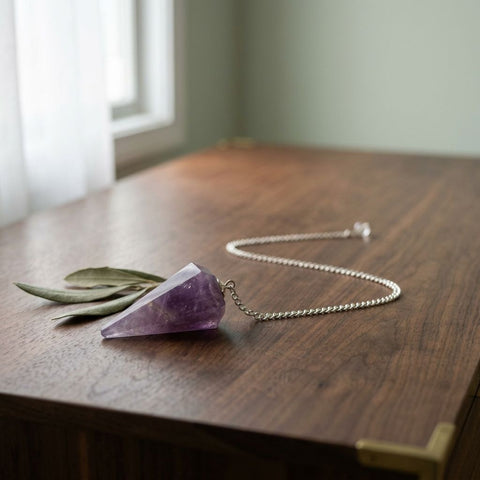 Cut stone pendulum, approx. 4 cm, silver-tone chain
16,90 €
 Rainbow moonstone runes: 25 milky stones engraved in gold
59,90 €
 Rainbow moonstone chips: bluish, by the kilo
37,90 €
 Moonstone chips: pearly, by the kilo
34,90 €
 Four stone shapes – rainbow moonstone
14,90 €