Meditating with a Stone: A Simple Five- to Ten-Minute Exercise
A very simple attention exercise: hold a smooth stone, observe its weight, temperature and texture, and return to it whenever your mind wanders.
Key points
| Duration | 5 to 10 minutes |
|---|---|
| Equipment | A tumbled or smooth stone that fits in the hand |
| Level | Beginner |
| Principle | The stone serves as an object of attention to anchor you in the present |
| Posture | Seated with your back comfortable, or lying down |
| Nature | A concentration exercise, not a treatment |
Why a Stone?
Meditation is first of all about learning to bring your attention back to one point when it wanders. Breath, a sound or a flame are commonly used. A stone offers a support you can feel: its weight, its coolness, the smoothness of its surface. This makes anchoring easier for people who find it hard to follow their breathing.
It is important to be clear: a stone does not “heal” anything and transmits nothing. It serves as a concrete reference point. Any benefits come from the pause, the calm and regularity, as with any attention practice. If you are going through a period of anxiety or depression, speak to a health professional: this exercise is not a treatment.
Choosing Your Stone
- A tumbled stone (polished in a drum) is the most pleasant: without sharp edges, it rests well in the palm (see tumbled stones).
- A size of 3 to 5 cm suits most hands.
- Choose it according to your taste: colour, feel, weight. There is no “right” stone for meditation: tradition associates certain stones with calm, such as amethyst or rose quartz, but this is a cultural association.
- Avoid stones with sharp edges, crumbly stones and soft stones that scratch easily.
The Exercise Step by Step
- Get settled in a quiet place, seated comfortably, back supported, feet flat.
- Hold the stone in the palm of your hand, without squeezing.
- Close your eyes, or rest your gaze on a fixed point.
- Notice the temperature. Is it cool? Does it warm up against your hand? Take a minute.
- Notice the weight. Feel how the stone presses into your palm.
- Notice the surface with your thumb: smooth, rough, veined, with small irregularities.
- When your mind wanders (which always happens), notice it without judgement, then gently bring your attention back to the stone.
- After five to ten minutes, open your eyes, look at the stone and put it down. Take one last breath.
Common Mistakes
- Waiting for an effect. If you are looking for a particular sensation, you miss the exercise. The aim is to notice.
- Judging yourself. A wandering mind is not a failure: what matters is the moment you return to the stone.
- Going on too long at first. Five minutes is enough.
- Forcing a posture. A comfortable position is better than a perfect one.
Variations
- The pocket stone. Keep it in your pocket and hold it for a few moments during the day, for example on public transport, for a short pause.
- The stone while walking. Hold it while you stroll, directing your attention to your steps and to the stone.
- In the evening. End your day with three minutes with the stone resting on your bedside table, then put it away.
- With a sound. Add the sound of a singing bowl (see the sound exercises).
What We Know About Meditation
Mindfulness meditation has been the subject of many studies. The results are encouraging regarding stress, but their extent is still debated. Nothing shows that the choice of stone changes anything. The value of the exercise lies in regularity: five minutes every day is better than an hour once a month.
Safety and Practice
- Keep the stone out of reach of young children and animals: a small stone can be swallowed.
- Do not fall asleep while holding it if it is large or angular.
- If you feel unwell, stop the exercise.
Exercise: for seven days, do five minutes with the same stone. Each evening, note in one sentence what you noticed (weight, temperature, recurring thoughts). At the end of the week, read back over your notes: you will have learned something about how you pay attention.
Frequently asked questions
Which stone is best for meditation?
None is better than another. Choose the one you enjoy holding. The traditional associations (amethyst, rose quartz) are cultural.
Should I purify the stone before meditating?
It is not necessary. If you like the gesture, do it while respecting the material of the stone.
Can I meditate lying down with a stone?
Yes, by resting the stone on your chest or in your hand. Make sure it cannot fall onto your face.
What should I do if I fall asleep?
This is common. Try the seated position, or meditate earlier in the day.
Can a stone replace a treatment?
No. No stone heals. If you are suffering or have symptoms, consult a health professional.
Also read
The meanings mentioned belong to tradition and symbolism. They are neither promises of results nor medical advice. Back to Step-by-step tutorials.
In the shop
Tumbled stones: our products
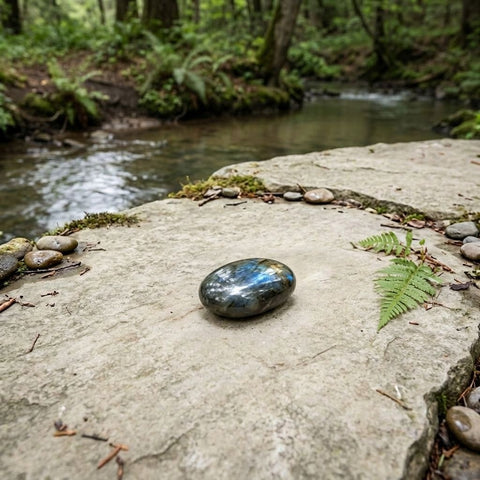 Madagascan labradorite: polished stones with blue flash
10,90 €
 Rainbow moonstone chips: bluish, by the kilo
37,90 €
 Red jasper chips: brick red, by the kilo
34,90 €
 Tiger's eye chips: honey and bronze, by the kilo
34,90 €
 Carnelian chips: apricot orange, by the kilo
34,90 €
 Green aventurine chips: soft green, by the kilo
34,90 €
 Moonstone chips: pearly, by the kilo
34,90 €
 Moss agate chips: sea green, by the kilo
34,90 €