Tumbled stones: making, materials, uses and buying tips
A tumbled stone is polished in a drum for weeks. How it is made, which materials to choose, what to do with it and how to spot dyed stones.
Key points
| Making | Polishing in a rotating drum with abrasives, often 3 to 5 weeks |
|---|---|
| Common size | 2 to 4 cm |
| Shape | Smooth, shiny pebble with no angles |
| Common materials | Quartz, jasper, agate, aventurine, tiger’s eye, obsidian, amethyst |
| Uses | Pocket, bag, decoration, grid, vase, potpourri of stones |
| Pitfalls | Dyed stones (howlite, agate), polished glass |
What is a tumbled stone?
A tumbled stone is a small piece of stone that has been rounded and polished in a rotating drum. The principle imitates the action of a river on pebbles, but accelerated. In a drum filled with stones, water and abrasive, the slow movement gradually wears down the corners. The result is a smooth, often shiny pebble, of a size that fits in the palm.
It is the most accessible form in the stones range: a low price, uniform sizes and a very wide choice of materials. This page is part of the guide to crystal shapes.
How a tumbled stone is made
Tumbling takes place in several stages, with progressively finer abrasives. The first stage, with a coarse abrasive (around 60 to 90 grit), shapes the final form. Then come smoothing stages with finer grains, and a final polish with a powder such as cerium oxide or tin oxide. A full cycle usually takes three to five weeks, depending on the hardness of the stone and the shape required.
To keep the wear even, stones of similar hardness are mixed in the same drum. This is why tumbled stones are often sold in batches of the same material. The drum gives rounded shapes and smooth surfaces, but no fine detail.
Materials and their hardness
| Stone | Hardness (Mohs) | Good to know |
|---|---|---|
| Rose quartz, rock crystal, amethyst | 7 | Very durable |
| Jasper, agate, carnelian | 6.5 to 7 | Varied patterns, solid |
| Green aventurine | 6.5 to 7 | Soft green, often translucent |
| Tiger’s eye | 6.5 to 7 | Silky sheen (chatoyance) |
| Obsidian | 5 to 5.5 | Volcanic glass; fragile under impact |
| Howlite | 3.5 | Soft; absorbs dyes easily |
| Selenite | 2 | Scratches under a fingernail; not suitable for carrying in a pocket |
For pocket stones, favour those of 6.5 and above: they keep their polish for longer.
What are they used for?
- In a pocket: a smooth pebble that you turn between your fingers to calm down. See pocket stones.
- As decoration: in a bowl, a clear vase, a dish or at the base of a plant.
- In a grid: several tumbled stones form a small decorative pattern (see the crystal grid tutorial).
- As a gift: a small pouch of three or seven stones, with a card naming each stone.
- For children: sorting by colour, a touch game. Watch out for small stones, which children under 3 may swallow.
Care
Hard tumbled stones are cleaned with lukewarm water and mild soap. Soft ones (howlite, selenite, fluorite) need a soft cloth. Do not let them soak if their colour comes from a dye. Store them in a fabric pouch or in a separate bowl, so that the harder stones do not scratch the softer ones. For symbolic purification, see the guide to cleansing and recharging your stones.
Recognising the pitfalls
- Dyed stones: white howlite is very often dyed blue to imitate turquoise; some agates and quartz are also dyed in vivid colours.
- Polished glass: a very regular translucent pebble, sometimes with bubbles, may be glass.
- Reconstituted stones: stone powder bound by resin; it looks too uniform.
- Label: a label that names the stone precisely, such as “red jasper” rather than “red stone”, is a good sign of a reputable seller.
See also the howlite entry and our page on real or fake stones.
A short history: from river pebble to tumbler
Pebbles smoothed by water have always fascinated people: a stone polished by the current is smooth, rounded and pleasant to hold. Hobby tumblers spread during the twentieth century, and tumbled stones were part of the decorative fashions of the 1970s (jars, jewellery, stone pots). Today, most of the production comes from specialist workshops that polish large quantities at once.
A tumbled stone is therefore a natural stone whose surface alone has been altered by mechanical work. It keeps its composition and its patterns. What changes from one stone to another is the fineness of the polish: a good polish is bright, even, free of small pits or chips; a poor polish leaves a milky or scratched surface.
How to choose
To start, put together a small assortment of 5 to 7 hard stones in varied colours and materials: rose quartz, jasper, tiger’s eye, aventurine, rock crystal. Look for even sizes so they sit well together. If you want a stone to carry in your pocket, a pebble of about 3 cm with a very smooth surface will be more pleasant than a flat one. Find them in the tumbled stones section and, for first steps, in our for beginners section.
Frequently asked questions
How long does it take to make a tumbled stone?
A full cycle, from rough shaping to final polish, usually takes three to five weeks, depending on the material and the shape wanted.
Why are tumbled stones so smooth?
Because they are worn by friction with progressively finer abrasives, right up to a final polish.
Can tumbled stones go in water?
Hard stones can (quartz, jasper, agate). Avoid soaking soft or dyed stones, which can lose their colour or dull.
Which tumbled stone should I choose for a pocket?
A stone with hardness above 6.5: quartz, jasper, tiger’s eye. It keeps its polish despite rubbing against keys or coins.
Can I make my own tumbled stones?
Yes, with a small hobby tumbler. Allow several weeks and some noise: a tumbler runs day and night. Choose stones of similar hardness.
Also read
The meanings mentioned belong to tradition and symbolism. They are neither promises of results nor medical advice. Back to Guide to crystal shapes.
In the shop
Tumbled stones: our products
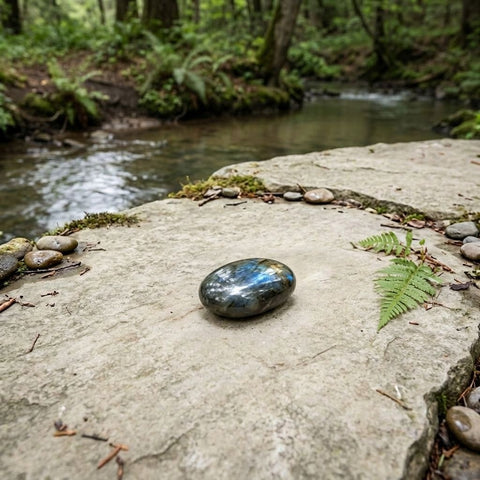 Madagascan labradorite: polished stones with blue flash
10,90 €
 Rainbow moonstone chips: bluish, by the kilo
37,90 €
 Red jasper chips: brick red, by the kilo
34,90 €
 Tiger's eye chips: honey and bronze, by the kilo
34,90 €
 Carnelian chips: apricot orange, by the kilo
34,90 €
 Green aventurine chips: soft green, by the kilo
34,90 €
 Moonstone chips: pearly, by the kilo
34,90 €
 Moss agate chips: sea green, by the kilo
34,90 €