Titanium quartz: surface-treated quartz, symbolism, care
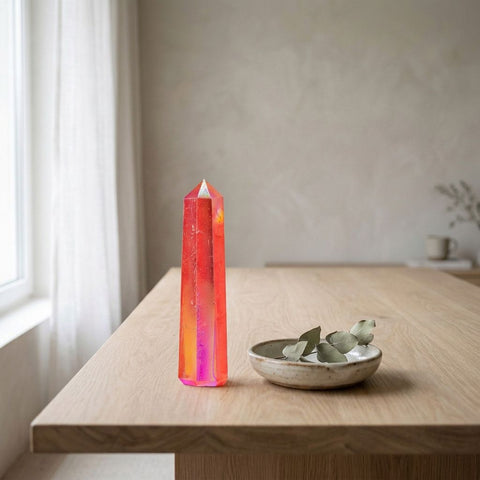
Titanium quartz is a quartz crystal coated under vacuum with a thin layer of titanium, which gives it rainbow reflections. It is a treatment, not a natural colour.
Key points
| Nature | natural quartz coated with a thin layer of titanium oxide (“mystic quartz”, “aura”) |
|---|---|
| Base | rock crystal or quartz cluster |
| Mohs hardness | 7 for the quartz; the coating is more fragile |
| Process | metal deposition under vacuum, with heat (temperature varies by source) |
| Effects | rainbow, flame, blue, gold, violet |
| Other names | titanium aura quartz, titanium aura, flame aura, mystic quartz |
| Traditional chakra | crown, third eye, according to authors |
What is titanium quartz?
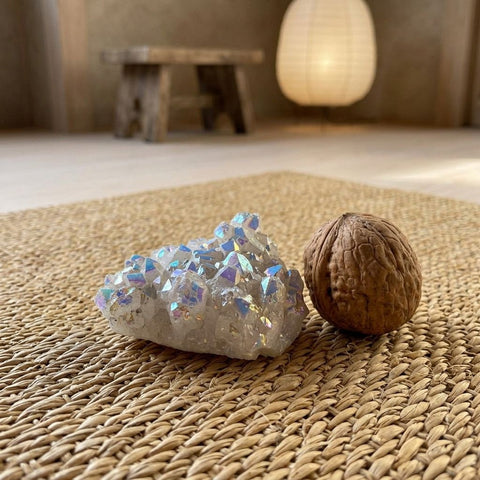
Titanium quartz is a natural quartz, often a cluster or a crystal of rock crystal, whose surface has received, in a laboratory, a very thin coating of titanium (as an oxide). This film, far thinner than a hair, diffuses light like a soap bubble and gives rainbow reflections: blue, violet, gold, pink, green. The process is called vacuum deposition: the crystals are heated in a chamber where the metal is evaporated, and it settles as a thin layer on the surface.
Wikipedia describes it under the name “mystic quartz”: a natural quartz coated, while hot, with a film of titanium oxide that gives an iridescent look. The same article specifies that this is a commercial treatment which does not change the nature of the stone. It is therefore not a natural colour: it is a treatment, and it should be disclosed.
Titanium, gold, silver: the “auras”
There is a whole family of crystals treated in the same way, called “auras”:
- titanium quartz (titanium aura, flame aura): rainbow reflections and flames, thanks to titanium;
- aqua aura: blue-green, obtained with gold;
- angel aura: opalescent, with platinum or silver;
- aura quartz in general.
According to sellers, titanium is the metal of the “flame” effects. Sources differ on the temperature of the process (around 900 °C according to one, much less heat according to others) and on the durability of the coating. We have not been able to verify these independently.
In some catalogues, “titanium quartz” is used by mistake for quartz with rutile needles; see rutile quartz. Check what the seller means.
Traditional symbolism
Shops associate titanium quartz with joy, creativity and wonder, by analogy with the rainbow. Some authors speak of openness to new ideas. As it has no ancient history, this symbolism is entirely modern.
These are associations with no proven effect. The pleasure of looking at it is the main honest argument.
Proposed correspondences
| Element | Association cited |
|---|---|
| Chakra | crown and third eye (crown chakra) |
| Element | air, sometimes fire |
| Signs | views differ; no ancient tradition |
How to use it
- As a decorative cluster: on a shelf near a window, it plays with daylight.
- As a point or pendant: to be worn with care, as the coating can wear.
- As a gift: for someone who likes coloured objects, with a clear mention of the treatment.
Avoid handling it bare-handed for long periods or rubbing it: the film is fragile.
Care
The quartz itself is hard (hardness 7), but the titanium layer is much more fragile. Clean it with a soft, slightly damp cloth, without rubbing. Avoid household products, abrasives, acid, salt, ultrasonic cleaners and hot water, which can damage the layer. Do not let it soak. Store it apart, wrapped in a soft cloth, since other stones scratch it. For symbolic purification, prefer gentle smoke or moonlight; avoid selenite (friction); see cleansing and recharging your stones.
Recognising it and avoiding surprises
- The iridescent reflection of titanium quartz is superficial and metallic: it is seen mostly on the surface, not inside the stone.
- The coating may show worn areas, often near the edges, revealing the clear quartz.
- Glass or resin coated with an iridescent film imitates titanium quartz; hardness and the conchoidal fracture help tell them apart.
- Ask whether the seller declares a treatment. A quartz sold as “natural” with these reflections should be treated with suspicion.
- Compare with bornite or labradorite, which have natural iridescent reflections.
The right questions to ask the seller
Before buying a titanium quartz, ask three simple questions. Is the colour a coating or natural? How can I care for it without damaging the layer? Is the piece described as “treated” on the listing? A reputable seller answers without hesitation. Also take a photo of the piece on receipt: if the coating already shows worn areas, you can point to them. Finally, if the iridescence matters more to you than the symbolism, compare with bornite, whose reflections are natural.
How to choose
Choose by looking at the coating: even colours, no flaking areas. Prices are moderate, higher for large clusters. If you want a natural iridescent stone, look rather at labradorite or bornite. Pair it with aqua aura or aura quartz. See also real or fake stone.
Frequently asked questions
Is titanium quartz natural?
The quartz is natural, but the iridescence is a titanium coating applied in a laboratory. It is a treatment.
Does the coating wear off over time?
It can wear through friction, aggressive products and heat. Handle it gently.
What is the difference from aqua aura?
Aqua aura is quartz coated with gold, blue-green; titanium quartz is coated with titanium, with rainbow reflections and flames.
Can it be worn every day?
It can, but the film will wear faster than an untreated stone. Prefer decoration.
Can it go in water?
A quick clean in lukewarm water is possible; avoid soaking it and aggressive products.
Also read
The meanings mentioned belong to tradition and symbolism. They are neither promises of results nor medical advice. Back to Guide to stones.
In the shop