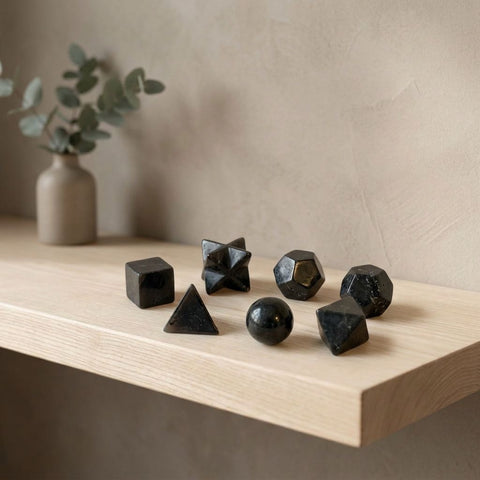
Black agate: meaning, dyeing, care and buying tips
Black agate is a glossy black chalcedony, almost always dyed or heated. Origin, traditional symbolism, how it differs from onyx, and care.
Key points
| Colour | black, opaque; translucent in a very thin slice |
|---|---|
| Mineral family | chalcedony (quartz with microscopic grains), formula SiO2 |
| Hardness (Mohs) | 6.5 to 7 |
| Lustre | vitreous to waxy once polished |
| Very common treatment | dyeing or heating of the agate to obtain a deep black |
| Do not confuse with | black onyx, black obsidian, black tourmaline, jet |
| Traditional correspondences | root chakra, earth element |
| Care | lukewarm water and soft cloth; avoid prolonged sunlight and heat |
What is black agate?
Black agate is chalcedony, a quartz with microscopic grains (SiO2), black, opaque and very fine-grained. It takes a bright, glossy polish and has the hardness of agates: 6.5 to 7. It therefore withstands daily use well.
One important point to know: the solid, uniform black seen in the trade is almost never natural. Agate is a porous stone at the microscopic scale, and this property has been exploited since the 19th century, notably at Idar-Oberstein, in Germany. The stone is soaked in a liquid that turns into black carbon in its pores (the best-known older method uses sugar, then an acid), or it is heated. This is a common and accepted practice, which does not change the hardness, but which must be disclosed.
The rough agates used as a base come from many countries, in particular Brazil and Uruguay, which supply a large part of the agate cut in Germany.
Traditional symbolism
Dark stones have always inspired the idea of inner resource. In the tradition of stones, black agate is associated with grounding, quiet strength and symbolic protection. It is carried in a pocket or worn at the neck as a small talisman, somewhat as one keeps an object that reassures.
As always, these are beliefs and symbols: the stone has no demonstrated effect on health, luck or relationships. If a smooth black object in the hand helps you refocus before a meeting or a difficult moment, that is a good use, as long as one does not ask more of it.
Traditional correspondences
| Area | Most cited association | Note |
|---|---|---|
| Chakra | root | black and dark red are linked to it |
| Element | earth | near-general consensus |
| Zodiac sign | Capricorn, Scorpio, Aquarius | differ according to the authors |
| Keyword | grounding, constancy | modern symbolism |
The root chakra is, in the Indian tradition, the chakra of stability and of a sense of security.
How to use it
- As a bead bracelet: black goes with everything, and the stone's hardness suits daily wear. See the bracelets section.
- As a pendant or ring: as a cabochon or cut stone, for a simple piece of jewellery. Our guide to gemstone jewellery offers pointers.
- As a pocket stone: a small tumbled stone to hold in the hand for a few slow breaths.
- In meditation: placed in front of you, or under your feet, to imagine contact with the ground. It is an aid to attention.
- As a gift: a restrained choice that suits many styles.
Care and cleansing
- Water: lukewarm water and a soft cloth are enough. A quick rinse is harmless. Avoid prolonged soaking of a dyed stone.
- Sunlight and heat: long exposure can dull an applied black. Keep the stone in the shade, away from a radiator or a car windscreen.
- Salt and household products: avoid.
- Smoke and moon bathing: no material effect on the stone; these are symbolic gestures.
- Knocks: a fall onto tiles can chip it.
For cleansing practices (which are symbolic), see the guide to cleansing and recharging your stones.
Recognising black agate and not confusing it with other stones
Names of black stones get mixed up in the trade. A few pointers:
- Black agate and black onyx: true onyx is a banded chalcedony with straight bands, naturally black and white. Many stones sold as “black onyx” are in fact agates dyed black. The two names therefore sometimes cover the same stone.
- Black obsidian: this is a volcanic glass, much softer (about 5), which breaks into sharp shards. See black obsidian.
- Black tourmaline: a crystal with vertical striations, and harder. See black tourmaline.
- Jet: a lignite, an organic material that is light and feels warm to the touch. See jet.
- Black glass: no grain, sometimes bubbles; it is lighter and lacks the coolness of stone to the touch.
A good shop will say that the black has been obtained by treatment. Always ask.
How to choose
- A deep, uniform black is normal for this stone, but be aware that it is most often of treated origin.
- A regular polish, without chips on the edges of beads and without matt patches.
- Shapes: beads (bracelets, necklaces), tumbled stones, cabochons, hearts and spheres.
- Price: low to moderate, since the material is common. A very low price for a large piece is a sign to be cautious: it may be glass.
- Pairings: it is readily combined with light stones for contrast, such as rose quartz, or with other grounding stones.
Frequently asked questions
Is black agate natural?
The base stone is a genuine agate, but its solid black is most often obtained by dyeing or heating. It is a common practice, and you should ask the seller about it.
What is the difference from black onyx?
True onyx is a chalcedony with straight bands. In the trade, many stones called black onyx are agates dyed black.
Can black agate get wet?
Yes: a rinse in lukewarm water and drying with a cloth are fine. Avoid long soaking and prolonged sun exposure.
Is black agate hard?
Yes: 6.5 to 7 on the Mohs scale. It is harder than obsidian, but it can chip if it receives a knock.
Also read
The meanings mentioned belong to tradition and symbolism. They are neither promises of results nor medical advice. Back to Guide to stones.
In the shop