Stone Pyramids and Obelisks: History, Materials and Care
Pyramids and obelisks in quartz, selenite or other stone: where these shapes come from, what science says about “pyramid power”, how to care for them and how to choose one.
Key points
| Shapes | Square-based pyramid, tapered four-sided obelisk |
|---|---|
| Origin of the shapes | Ancient Egypt (tombs, monuments) |
| Common materials | Quartz, selenite, labradorite, obsidian, jasper |
| Common sizes | 3 to 15 cm |
| Effect of the shapes | No proven effect; decorative objects |
| Care | Depends on the hardness of the material |
Two shapes from Egypt
The pyramid and the obelisk were part of the landscape of ancient Egypt. The Great Pyramid of Khufu at Giza was built around 2600 BCE and originally stood about 146 metres tall. The obelisk is a four-sided stone pillar that tapers towards the top and ends in a small pyramid; the Egyptians raised them in front of temples. The Luxor Obelisk, given to France by Egypt, has stood in the Place de la Concorde in Paris since 25 October 1836: it is about 23 metres tall.
The stone pyramids and obelisks sold today are miniature reproductions, carved from a variety of materials. This page is part of the crystal shapes guide.
What does science say about “pyramid power”?
It is sometimes claimed that a pyramid concentrates a special energy, keeps food fresh or sharpens razor blades. The idea goes back to the 1930s, when a French shopkeeper interested in radiesthesia (dowsing), Antoine Bovis, suggested that small pyramid models could preserve food. In 1949, the Czechoslovak inventor Karel Drbal filed a patent application for a “pharaoh's device” supposed to keep razor blades sharp. The book Psychic Discoveries Behind the Iron Curtain (1970) spread the idea in English under the name “pyramid power”.
Controlled tests have not confirmed these claims. In 1973, an experiment found that pyramid-shaped containers did not keep flowers and meat any better than other shapes, and that blunt blades were not resharpened; a 2005 TV myth-busting programme reached the same conclusion. No solid study shows that a pyramid shape has a measurable physical effect on a room, a person or an object.
A stone pyramid is therefore a very attractive decorative object, valued for its aesthetic and symbolic qualities rather than for any physical effect.
Traditional symbolism
The pyramid suggests stability, elevation (a broad base and a single summit) and endurance. The obelisk suggests verticality, the link between earth and sky and, in Egyptian mythology, sometimes a ray of sunlight. These meanings are cultural images. In the language of crystal shops, it is also said that a pyramid “draws the attention”, which is true in a very simple sense: a clean-lined object placed in front of you catches the eye and can serve as a point of focus for a moment of calm.
Materials and their hardness
| Material | Hardness (Mohs) | Care |
|---|---|---|
| Rock crystal, amethyst | 7 | Lukewarm water, mild soap, clean cloth |
| Jasper, agate | 6.5 to 7 | Lukewarm water, soft cloth |
| Labradorite | 6 to 6.5 | Slightly damp cloth; avoid knocks |
| Obsidian | 5 to 5.5 | Avoid knocks; sharp edges if the piece breaks |
| Fluorite | 4 | Avoid hot water and thermal shocks |
| Selenite | 2 | Dry or barely damp cloth; scratches under a fingernail |
A selenite pyramid has a remarkable pearly sheen but wears down very quickly: it is best kept in places that are not handled much.
How to use them
- As decoration: on a shelf, a desk or an entrance table.
- As a focus for attention: look at it for a few minutes while breathing calmly.
- In a crystal grid: at the centre of a composition of tumbled stones (see the tutorial).
- As a gift: a small 5 cm pyramid is a simple, sturdy gift if it is made of quartz or jasper.
Recognising the material and avoiding pitfalls
- Glass: some perfectly transparent “crystal” pyramids are moulded glass. Glass is lighter than quartz and may show small bubbles.
- Resin: light, warm to the touch, scratches under a fingernail.
- Reconstituted stone: stone powder bound with resin, often too uniform. This is not a fault if it is clearly labelled.
- Dyes: a “blue” or “neon pink” quartz indicates a treatment.
- Apex: on a carved pyramid, look at the sharpness of the edges and the symmetry of the faces.
More details on our page real or fake stone.
How to choose
A small pyramid of 4 to 6 cm in quartz or jasper is an excellent choice for beginners: sturdy, easy to clean and pleasant to hold. A piece over 10 cm becomes a decorative object in its own right, to be placed on a flat, stable surface. Our pieces are in the points, spheres and figurines section.
Frequently asked questions
Does a stone pyramid have a particular effect?
No physical effect has been demonstrated. It is a decorative and symbolic object, which can serve as a focus for a moment of calm.
How tall is the Concorde obelisk?
About 23 metres, according to the French Ministry of Culture. It has stood in the Place de la Concorde in Paris since 25 October 1836.
Do pyramids really sharpen blades?
No. The idea, linked to a 1949 patent application by Karel Drbal, did not survive controlled tests, notably those of 1973.
How do I clean a selenite pyramid?
With a dry or barely damp cloth, then dry it immediately. Avoid prolonged contact with water: selenite is soft and slightly soluble.
What is the difference between a pyramid and an obelisk?
A pyramid has a broad base and ends in a point; an obelisk is a tapered four-sided pillar, topped by a small pyramid.
Also read
The meanings mentioned belong to tradition and symbolism. They are neither promises of results nor medical advice. Back to Guide to crystal shapes.
In the shop
Points, spheres and figurines: our products
 Seated carved stone laughing Buddha
23,90 €
 Carved stone lucky cat, raised paw
28,90 €
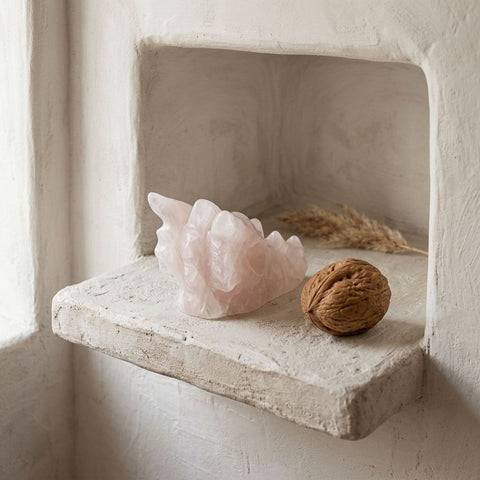 Carved natural stone dragon head
30,90 €
 Carved natural stone skull
23,90 €
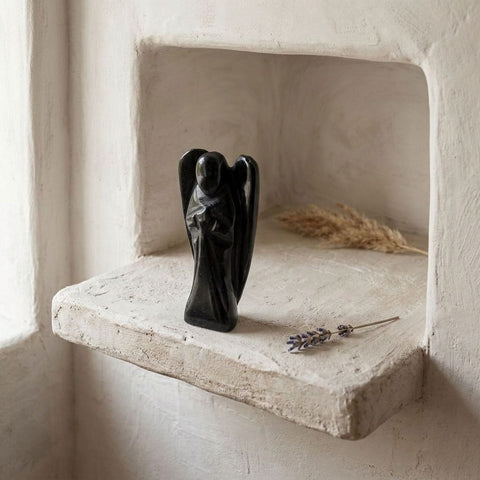 Carved stone guardian angel, folded wings
18,90 €
 Amazonite: set of points with raw base
77,90 €
 Smoky quartz: 11 cm obelisk and set of points with raw base
23,90 €
 Moss agate: polished mini obelisk
18,90 €