Stone spheres: materials, sizes, care and how to choose
A stone sphere is shaped from a block and then polished. Materials, sizes, weight, care and pitfalls to avoid (glass, lead crystal): everything you need to choose without mistakes.
Key points
| Making | Cut from a block of stone, rounded and then polished |
|---|---|
| Common materials | Clear quartz, rose quartz, obsidian, labradorite, selenite, fluorite, jasper |
| Common sizes | From 3 to 10 cm in diameter |
| Indicative weight (quartz) | About 300 g for 6 cm, 700 g for 8 cm |
| Frequent pitfall | Glass or lead crystal sold as rock crystal |
| Precaution | Never leave in the sun behind a window |
| Use | Decoration, meditation, a focus for gazing |
What is a stone sphere?
A stone sphere is an object shaped by a lapidary (a craftsman who cuts stones) from a raw block. The stone is first roughed out, then rounded by abrasion with progressively finer powders, and finally polished. The process is long: a fine sphere can take several days of work. In the past, some workshops rotated the block for weeks in a container filled with abrasive and water; a large Burmese quartz sphere held at the Penn Museum in Philadelphia is said to have been shaped in this way.
Quartz has been the best-known material for spheres since antiquity: a small beryl sphere was found in the tomb of the Frankish king Childeric I, and the tradition of the crystal ball later spread across Europe. For the history of the seer’s ball, see our page on the crystal ball and crystallomancy. This page treats the sphere as an object of decoration and collecting; it is part of the guide to crystal shapes.
Materials, with their hardness
| Material | Hardness (Mohs) | Notes |
|---|---|---|
| Rock crystal (clear quartz) | 7 | Very durable; the most classic |
| Rose quartz | 7 | Often slightly milky; its colour can fade in strong light |
| Obsidian | 5 to 5.5 | Natural volcanic glass; sharp shards if broken |
| Labradorite | 6 to 6.5 | Blue or green reflections depending on the angle; fragile under impact |
| Jasper, agate | 6.5 to 7 | Varied patterns, often opaque |
| Fluorite | 4 | Scratches easily and is sensitive to thermal shock; beautiful but delicate |
| Selenite (gypsum) | 2 | Soft; slightly soluble in water |
A simple rule: the lower the hardness, the more easily the sphere scratches and dulls. A selenite or fluorite sphere should be kept for places that are handled little.
Sizes and weights: a useful guide
Spheres are sold by diameter. Weight rises quickly with size, because it depends on volume. For quartz (density about 2.65), here are calculated approximate values:
| Diameter | Indicative weight | Common use |
|---|---|---|
| 4 cm | about 90 g | Fits in the palm |
| 6 cm | about 300 g | Bedside table, shelf |
| 8 cm | about 700 g | Centrepiece; plan for a stand |
| 10 cm | about 1.4 kg | Check the strength of the furniture |
A sphere therefore weighs more than most people imagine: this is a good clue when buying. A large “crystal” sphere that is very light is probably hollow glass or resin.
Traditional symbolism
The sphere has long been a form rich in symbolism: unity, completeness, the world, the eye. In divination, the crystal ball serves as a focus for gazing (“scrying”): one fixes a point of light until the mind wanders. No study shows that this makes it possible to see the future; psychologists see it rather as a phenomenon of imagination, visual fatigue and suggestion.
In modern crystal healing, some authors associate the sphere with harmony or balance, because it has neither point nor angle. This is a symbolic interpretation, with no scientific basis, which you are free to enjoy or not.
How to use it
- As decoration: on a stand of wood, metal or stone, at the centre of a table or on a shelf.
- In meditation: rest your hands on the cool sphere and follow a few breaths; the coolness and the weight give a pleasant physical anchor.
- As a focus for gazing: look at the sphere under soft light, without staring to the point of discomfort. You can note what comes to mind, as in a reading journal.
Safety: a sphere placed in sunlight acts like a magnifying glass and can set curtains, paper or fabric on fire. Keep it out of direct sun, even in winter.
Care
- Quartz, jasper, agate: lukewarm water, mild soap, clean cloth.
- Obsidian, labradorite: slightly damp soft cloth, dried immediately; avoid knocks.
- Fluorite: gentle wiping; avoid hot water and sudden temperature changes.
- Selenite: no prolonged contact with water; a dry or barely damp cloth, then dry it straight away.
- Store a sphere on a stand or in a cloth, without piling it with harder stones that would scratch it.
Recognising a real stone sphere
- Glass: lighter than quartz of the same size, sometimes with small bubbles; well-made glass is very clear, too clear for natural quartz.
- “Crystal”: in glassware, this word refers to glass containing lead or other oxides, not to rock crystal. A low-priced “crystal ball” is most often glass.
- Resin: it scratches easily with a fingernail and feels warm to the touch.
- Dyed or heated stone: colours that are too vivid indicate a treatment.
- Inclusions: a fine sphere of clear quartz almost always shows a few veils or cracks. A total absence should raise questions: synthetic quartz exists and is sometimes used.
See our page on real or fake stones for more detail.
How to choose your sphere
Start with the purpose: decoration, meditation, gift. For a first sphere, a diameter of 5 to 6 cm in clear quartz, rose quartz or jasper is an excellent choice: durable, affordable and easy to care for. For a gift, think about the stand, often supplied in wood or metal. A very fragile stone (selenite, fluorite) will suit a careful person better than a home with young children.
Discover our models in the points, spheres and figurines section and, for seers’ balls, in the crystal balls section.
Frequently asked questions
Can a crystal sphere start a fire?
Yes. A transparent sphere concentrates sunlight like a magnifying glass and can set nearby paper or fabric alight. Keep it out of direct sun.
How much does an 8 cm quartz sphere weigh?
About 700 g, since quartz has a density of about 2.65. A sphere that is much lighter is probably hollow glass or resin.
Can a selenite sphere be washed?
It is better to avoid it: selenite is soft (2 on the Mohs scale) and slightly soluble. Use a dry or barely damp cloth, then dry it immediately.
What is the difference between rock crystal and crystal glass?
Rock crystal is natural quartz. “Crystal” in glassware is a glass containing, for example, lead: it is manufactured, not extracted from the ground.
Does a sphere help you see the future?
No evidence exists. The crystal ball is a focus for gazing and imagination, which may inspire ideas but predicts nothing.
Also read
The meanings mentioned belong to tradition and symbolism. They are neither promises of results nor medical advice. Back to Guide to crystal shapes.
In the shop
Points, spheres and figurines: our products
 Seated carved stone laughing Buddha
23,90 €
 Carved stone lucky cat, raised paw
28,90 €
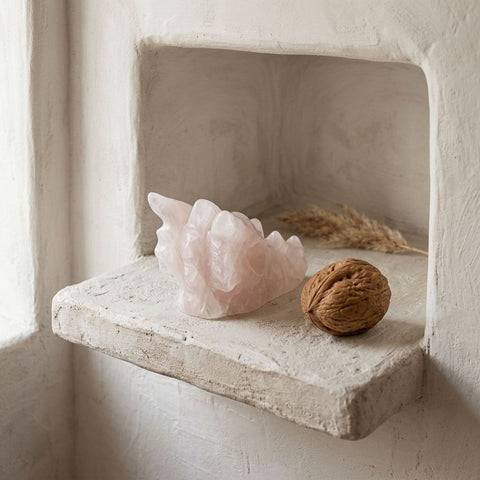 Carved natural stone dragon head
30,90 €
 Carved natural stone skull
23,90 €
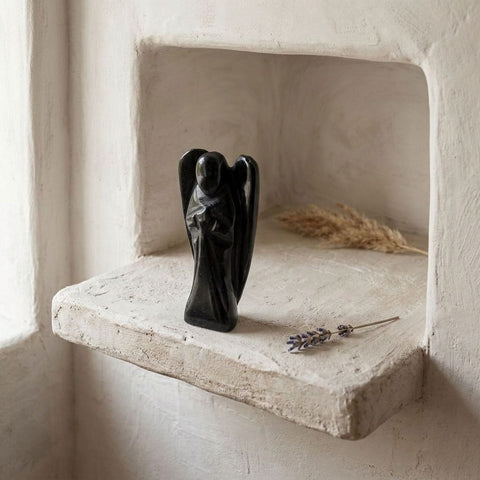 Carved stone guardian angel, folded wings
18,90 €
 Amazonite: set of points with raw base
77,90 €
 Smoky quartz: 11 cm obelisk and set of points with raw base
23,90 €
 Moss agate: polished mini obelisk
18,90 €