Crystal points: formation, shapes, care and how to choose
A crystal point is a quartz prism ending in a tip. Here is how it forms, how to choose one, how to care for it and how to tell it apart from a glass imitation.
Key points
| Most common material | Quartz (silicon dioxide, SiO2), often colourless rock crystal |
|---|---|
| Hardness (Mohs) | 7 |
| Natural form | Six-sided prism ending in a pyramidal tip |
| Common sizes | From 3 cm to more than 30 cm |
| Frequent countries of origin | Brazil, Madagascar, United States (Arkansas), Himalayas |
| Pitfalls | Moulded glass, dyes, metallic surface coatings |
| Use | Decoration, meditation, gift, collecting |
What is a crystal point?
In the trade, a “point” is an elongated crystal that ends in a tip. Most often it is quartz: a mineral made of silica, with a hardness of 7 on the Mohs scale. Quartz crystallises in what is called the trigonal system, but its crystals look like six-sided prisms capped by a tip with sloping faces. This is the silhouette that is known as a point.
The word “crystal” comes from the Greek krystallos, meaning “ice”: the ancients believed that rock crystal was ice hardened by extreme cold. That belief is no longer held, but it explains why clear quartz has always fascinated people. On this page we talk about what can be verified; the symbolism is covered further down, presented as a tradition.
This page is part of our guide to crystal shapes, which presents all the shapes offered in the stones range.
How a point forms in nature
Quartz crystals grow in cavities and cracks in rock, when very hot water carrying dissolved silica cools slowly. Silica is deposited on the walls and the crystals grow towards the empty space. The slower the cooling and the more free space there is, the more regular and transparent the crystals become.
A crystal attached to the wall by one end has a tip only at its free end: this is the classic point. When a crystal grows freely, without being fixed, it can have a tip at each end: this is called a double-terminated point. “Herkimer diamonds” from the state of New York are the best-known example: they are double-terminated quartz found in cavities of a dolomite rock. Be careful with the vocabulary: some sellers reserve this name for crystals from that single region, while others apply it to any double-terminated quartz, which is why prices vary so much.
On the side faces of a real quartz crystal, you often see fine horizontal striations, perpendicular to the axis of the point. This is a good sign of natural origin.
The types of points you will find
| Type | Description | Good to know |
|---|---|---|
| Natural raw point | Crystal as it came out of the rock, sometimes with an irregular base | Each piece is unique; the base may show traces of rock |
| Polished point | Crystal cut and polished by a lapidary, with a flat base | It stands up on its own; the shape is regular, but it has been shaped |
| Double-terminated point | Tip at both ends | Rarer in its natural state; check that it has not simply been cut |
| Clustered point | Several points on a common base | See the page on druses and clusters |
| Wand or “laser” | Thin, long crystal with very regular faces | Trade name, with no scientific definition |
Names such as “generator”, “laser”, “cathedral” or “channeller” are trade names or habits of speech in crystal healing: they do not designate categories recognised in mineralogy.
Traditional symbolism
In contemporary popular traditions, the point is associated with the idea of direction: it is said to be “pointing upwards” to symbolise elevation, focus or mental clarity, and “pointing downwards” to symbolise grounding. These associations are modern and vary from author to author; they rest on no scientific evidence. Clear quartz has also, since antiquity, been the material of the seer’s crystal ball (see crystal ball and crystallomancy).
No effect on health, on the energy of a piece or on mood has been demonstrated. A point is first and foremost a beautiful mineral object, which you can enjoy for its appearance and use as a focus for attention: resting your eyes on a crystal for a few breaths is a simple gesture, whose value lies in the calm you bring to it.
How to use it
- As decoration: on a shelf, a desk or a bedside table, preferably on a small wooden or metal stand.
- In meditation: place it in front of you and look at it for a few minutes, or hold it in your hand.
- In a grid: at the centre or at the corners of a small arrangement of stones (see the crystal grid tutorial).
- As a gift: a point of 6 to 10 cm is a simple size to give.
Safety: a point is pointed by definition. Do not leave it within reach of young children, and do not balance it on the edge of a piece of furniture.
Care and cleaning
Quartz is hard (7) and resists water: a rinse under lukewarm water with a little mild soap, then drying with a clean cloth, is enough to remove dust and fingerprints. An old soft toothbrush helps clean the hollows.
- Avoid knocks: quartz is hard but brittle, and the tip can chip.
- Never leave a crystal in full sun behind a window: like a magnifying glass, it can concentrate the light and set fabric or paper on fire. This is a real fire risk, not a symbolic precaution.
- Points that are dyed or surface-treated (see below) do not tolerate rubbing or products: clean them dry or with a barely damp cloth.
- For symbolic purification (moon, smoke), see our guide to cleansing and recharging your stones.
Recognising a real point and avoiding surprises
Several pitfalls exist, without implying that anyone is at fault: the information is simply useful for buying with confidence.
- Moulded glass: a “point” that is perfectly transparent and regular may be glass. Glass sometimes shows tiny round bubbles and faces that are too perfect; natural quartz tends to show cracks, veils or irregular inclusions.
- Dyed quartz: electric blue, bright pink or very saturated violet on colourless quartz often indicates a dye or treatment. The colours sometimes collect in the cracks.
- “Aura” quartz: the quartz is coated on its surface with a thin metallic layer deposited under vacuum to give iridescent reflections. This is a treatment, and the layer can wear away. See the page on aura quartz.
- Reconstituted quartz: fragments glued or fused together to imitate a larger crystal. A reputable seller will say so.
To go further, read our page on real or fake stones. A safe test at home: natural crystal is cold to the touch and warms up slowly in the hand; glass does too, so this test alone does not settle the question.
How to choose your point
- Size: 5 to 8 cm for a bedside table; 10 to 20 cm for a shelf; above that, check the weight and stability.
- Transparency: a perfectly clear crystal is rarer; “veils” or “phantoms” (silhouettes of former tips visible inside) are what give a natural piece its charm.
- The base: a flat base means you do not need a stand.
- Condition: look for chips at the tip and along the edges.
- Variety: rock crystal, amethyst, smoky quartz, citrine (often obtained by heating amethyst, which is common and normal, but should be disclosed).
Our points are in the points, spheres and figurines section.
Frequently asked questions
Is a crystal point always quartz?
No. Quartz is by far the most common, but you can also find points of calcite, selenite or fluorite, which are much softer. Check the material before you buy: hardness changes everything when it comes to care.
How can I tell whether a point is glass?
Look for tiny round bubbles, faces that are too perfect and a complete absence of inclusions. Natural quartz almost always has small imperfections. If in doubt, ask the seller for the exact material.
Can a quartz point be washed in water?
Yes, untreated natural quartz tolerates lukewarm water and mild soap. Avoid water for a selenite point, and prefer a dry cloth for quartz that is dyed or coated with a metallic layer.
Where should I place a crystal point?
On a stable surface, out of reach of children and animals, and never in full sun behind a window. For the look, a small wooden stand shows it off well.
Does a point have any effect on health?
No effect has been demonstrated. It is a decorative and symbolic object, which you can use to pause for a few moments.
Also read
The meanings mentioned belong to tradition and symbolism. They are neither promises of results nor medical advice. Back to Guide to crystal shapes.
In the shop
Points, spheres and figurines: our products
 Seated carved stone laughing Buddha
23,90 €
 Carved stone lucky cat, raised paw
28,90 €
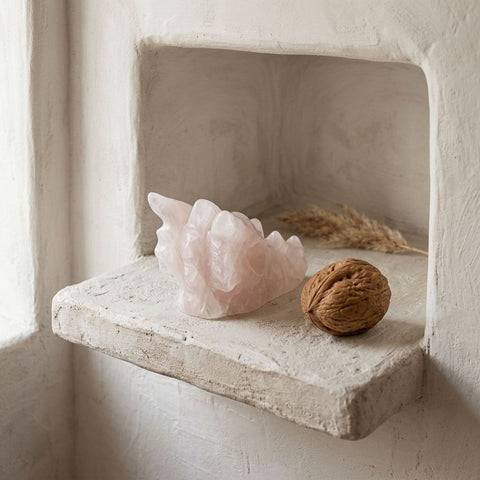 Carved natural stone dragon head
30,90 €
 Carved natural stone skull
23,90 €
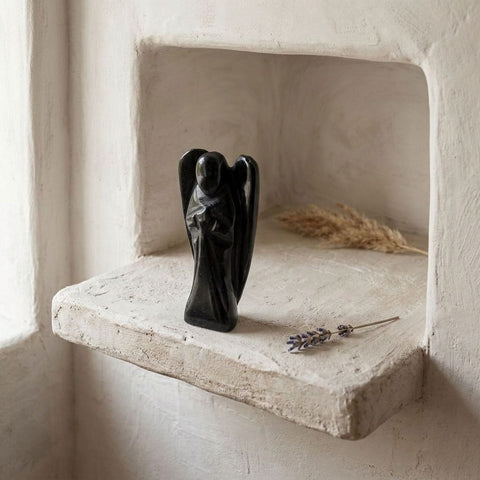 Carved stone guardian angel, folded wings
18,90 €
 Amazonite: set of points with raw base
77,90 €
 Smoky quartz: 11 cm obelisk and set of points with raw base
23,90 €
 Moss agate: polished mini obelisk
18,90 €