Rhabdomancy: Divining Rods, Dowsing and Radiesthesia Put to the Test
Rhabdomancy seeks water, metals or answers with a rod or forked branch. History, vocabulary (dowser, radiesthesia), the ideomotor effect and the results of controlled tests.
Key points
| Name | Rhabdomancy (Greek rhabdos, “rod”); dowsing, radiesthesia |
|---|---|
| Tools | Y-shaped rod, L-shaped rods, pendulum |
| First detailed description | Agricola, De re metallica (1556), German mines |
| Term radiesthesia | Coined by Abbé Bouly in 1927 |
| Common explanation | Ideomotor effect (involuntary movements), described by Chevreul in 1833 |
| Controlled tests | No result above chance has been demonstrated |
A Rod That Dips
Rhabdomancy is divination by the rod (rhabdos in Greek). In common use, dowsing refers to searching for water, while radiesthesia extends the method to metals, “energies” or questions. The dowser holds a Y-shaped forked branch, two L-shaped metal rods, or a pendulum, and walks across the ground until the tool moves.
The practice is widespread: in France, Germany, the United Kingdom and elsewhere, dowsers are still called on by private individuals and sometimes by local councils. It has also prompted tests, which makes the study of its track record particularly instructive.
A History Between Mines and Witchcraft
In Antiquity, divinations with rods are known, though they were not water searches. Herodotus (5th century BCE) describes Scythian diviners who used bundles of willow twigs; a verse of the Book of Hosea, often cited, mentions a people consulting their “wood” (the reading is debated). These texts speak of lots and omens, not prospecting.
The dowsing rod proper appears at the end of the Middle Ages in mining Europe, in Germany. The scholar Georgius Agricola describes it in De re metallica (1556), relating it to the search for ore veins, and expressing his doubts. Several religious reformers considered it suspect. It later spread as a means of finding water, while the Church wavered between tolerance and condemnation.
In the 19th century, scholarly explanations emerged. The French chemist Michel-Eugène Chevreul studied in 1833 the movements of the rod and the pendulum and attributed them to small involuntary muscular contractions: this is the origin of the concept of the ideomotor effect, which the British physiologist William Carpenter named as such in 1852. The term radiesthesia was coined in 1927 by Abbé Alexis Bouly.
How a Search Unfolds
- The dowser holds the rod or rods with a certain tension, hands relaxed.
- He walks slowly over the ground, concentrating on the search.
- When the tool dips, turns or crosses, he marks the spot where the reaction occurred.
- From this he deduces the location, sometimes the depth and flow of a spring.
Practitioners describe these reactions as sensitivity to “radiations” or “currents.” No recognised physical mechanism has been demonstrated. L-rods, held loosely, can swing through tiny wrist movements, without the dowser being aware of it.
What the Tests Show
The central question is simple: does a dowser do better than chance? Trials under controlled conditions, notably a series conducted in Munich at the end of the 1980s, produced results that their promoters found encouraging; a further analysis published by J. T. Enright at the end of the 1990s concluded that they did not exceed what chance produces. Other experiments, including public trials with prizes, showed no performance above chance.
A geological fact should also be kept in mind: in many regions, groundwater is present almost everywhere, at varying depths. A borehole therefore has a good chance of hitting water, whatever the dowser indicates; successes are remembered, while failures are forgotten. For any well or borehole project, hydrogeologists have maps and measurement methods available.
| Question | Honest answer |
|---|---|
| Does the rod move? | Yes, through involuntary muscle movements |
| Does it detect water? | No convincing controlled demonstration |
| Why are there successes? | Groundwater is widespread, field clues, selective memory |
| Can it be used for health? | No: no basis, and it does not replace medical advice |
An Exercise to Understand the Ideomotor Effect
Hold a small object hanging from a thread (a ring, a nut) above a table, elbow resting on it. Think strongly of a back-and-forth motion, without consciously moving. After a few moments, the object often swings in the direction you were thinking of. Try again while thinking of a circle. You have just observed the ideomotor effect: the body makes tiny movements in response to a thought. It is the same mechanism that makes rods and pendulums move.
If you use a pendulum as an aid to reflection, stay aware of this effect: see the tutorials on the pendulum and questions and on getting started with a pendulum. Never use a pendulum or a rod to make a medical, financial or safety decision (for example, locating a pipe before digging).
Vocabulary and Resources
Dowser: someone who searches for water. Radiesthetist: someone who practises radiesthesia. Geobiology: a non-scientific discipline that claims to detect “earth energies.” Ideomotor effect: involuntary muscle movement induced by an idea. To place rhabdomancy among all the divinatory arts, see the guide to other divinations.
Frequently asked questions
What does rhabdomancy mean?
Divination by rod. The word covers practices in which a branch, a rod or a pendulum responds to a question or a place.
Does dowsing work?
Controlled tests have shown no result above chance. The movement of the rod is explained by the ideomotor effect.
What is the ideomotor effect?
An involuntary muscle movement triggered by a thought or an expectation, studied by Chevreul in 1833. It explains the swinging of rods and pendulums.
What is the difference between dowsing and radiesthesia?
Dowsing searches for water. Radiesthesia, a term from 1927, extends the method to other searches and to questions.
Can a pendulum be used for health?
No. No scientific basis allows a pendulum to replace medical advice.
Also read
The meanings mentioned belong to tradition and symbolism. They are neither promises of results nor medical advice. Back to Other divinatory arts.
In the shop
Pendulums: our products
 Orgonite and stone chip pendulum, chain of seven chakra beads
18,90 €
 Pyramid and copper pendulums: three pyramids or crystal with a copper column
16,90 €
 Cone pendulum with silver-tone ring: rock crystal or matching stone
21,90 €
 Merkaba pendulum: six-pointed star in stone or spinning in a copper-tone frame
16,90 €
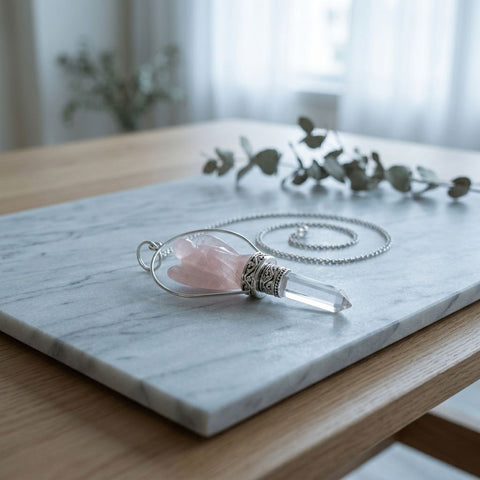 Angel pendulum: small stone angel under a silver-tone hoop
29,90 €
 Tree of Life seven chakra pendulum: cut stone and coloured chips
19,90 €
 Seven chakra pendulum in stones of seven colours
19,90 €
 Three-piece stone pendulum, silver-tone rings
21,90 €