Pendulum and radiesthesia: history, ideomotor effect and limits
Does the pendulum really answer questions? The history of radiesthesia, the ideomotor effect as an explanation, the results of tests, and an honest use as a tool for reflection.
Key points
| Practice | A weight on the end of a thread held in the hand, read as an answer to a question |
|---|---|
| Radiesthesia | A word coined in the early 20th century (Abbé Bouly) from the Latin radius and the Greek aisthêsis |
| Scientific explanation | The ideomotor effect: unconscious micro-movements of the hand |
| Controlled tests | Water diviners do no better than chance in double-blind tests |
| Historical ancestors | Suspended-ring divination (late Antiquity), divining rods (16th century) |
| Reasonable use | A tool for personal reflection, never for health or serious decisions |
What a pendulum is and what it is claimed to do
A pendulum is a small weight (of metal, wood or stone) suspended from a thread or a fine chain. It is held between the thumb and forefinger, with the hand still, and a question is asked of it. Depending on its movement (back and forth, or a circle in one direction or the other), an answer is read: “yes”, “no”, “maybe”. It can also be moved over an alphabet board, a card or a person.
Radiesthesia (from the Latin radius, “ray”, and the Greek aisthêsis, “sensation”) refers to the set of practices that claim to detect, with a pendulum or a rod, sources of water, minerals, illnesses or hidden information. The word is recent, coined in the 1920s by French clergymen, including the Abbé Alexis Bouly. Water diviners (those who search for water with a hazel rod) existed well before.
A little history
The idea of making a suspended object speak is ancient. The Roman historian Ammianus Marcellinus recounts (in the 4th century) how conspirators in the year 371 consulted a ring hung from a thread over a board bearing the twenty-four letters of the Greek alphabet: the ring stopped over the letters to form answers. This account, written in the context of a political trial, shows that suspended-ring divination existed, but says nothing about its effectiveness.
The divining rod is documented in Europe from the Renaissance onward. Georgius Agricola describes it in his treatise on mining (De re metallica, 1556) as a way to find ore veins, and Luther criticised it in 1518, classing it among occult practices. The Church, over the centuries, sometimes condemned it.
Modern radiesthesia was born in France at the start of the 20th century. A first congress of water diviners took place in 1913, the word came into use from the 1920s, and the Abbé Bouly founded an association in 1929. The Abbé Alexis Mermet, nicknamed “the prince of water diviners”, published his book Comment j’opère (How I Work) in the early 1930s (1932 according to some references, 1935 according to others): in it he describes using the pendulum over maps to search for springs or missing persons. The 1930s and 1940s saw a large output of books on the subject. Later, scientists such as the physicist Yves Rocard tried to explain water diviners through the detection of very weak magnetic fields; this hypothesis has not been confirmed.
The ideomotor effect: why the pendulum moves
The pendulum does not move on its own: it is the hand that moves it, without the holder knowing. This phenomenon has a name, the ideomotor effect: a thought or a mental image can trigger small involuntary muscle movements. The French chemist Michel-Eugène Chevreul studied the pendulum as early as 1833 in an open letter to Ampère, then published his observations in 1854: he concluded that the movement comes from the person themselves. The British physiologist William Benjamin Carpenter coined the term “ideomotor” in 1852, and Michael Faraday showed in 1853, with experiments on the spiritualists’ “turning tables”, that the movement was produced by the participants’ hands.
A recent study (2019) using motion capture indicates that the effect occurs when the fingers holding the pendulum oscillate near the pendulum’s natural frequency: very small movements are then enough to produce large swings. In other words, tiny movements, unconscious but very real, can amplify the pendulum. If you think “yes”, your hand may trigger the corresponding movement. This is why the pendulum seems to “respond” to your expectations.
What the tests show
Several experiments have tested the ability of water diviners to find hidden water:
| Test | Set-up | Result |
|---|---|---|
| New Zealand, 1948 (Ongley) | 75 water diviners | None did better than chance |
| United Kingdom, 1971 (Foulkes) | Trials for the Ministry of Defence | Results “no more reliable than guesswork” |
| Review by Vogt and Hyman, 1979 | Summary of controlled studies | None exceeded chance |
| Munich, 1987–1988 (Betz and colleagues) | About 500 pre-selected water diviners, 43 tested, 843 trials | The authors concluded that a few water diviners did better than chance; the analysis has been criticised, and the best performers could not be reproduced |
| Kassel, 1990 | About thirty water diviners, double-blind, buried pipes | Results at chance level; a prize of 10,000 dollars offered by James Randi was not awarded |
The Munich experiment is sometimes cited as proof of the phenomenon; we present it fairly, together with its criticisms. Sources also differ: the English-language encyclopaedia reports that the authors judged that a “core” of phenomena had been “empirically proven”, whereas the French version concludes that there was no effectiveness. In summary, the scientific consensus is that radiesthesia has shown no effectiveness beyond chance under controlled conditions.
A test to try at home
You can test the pendulum safely with one or two friends:
- Place six identical opaque cups on the table, several centimetres apart.
- While you leave the room, another person hides an object under one of the cups, chosen at random (for example by rolling a die).
- Come back and use the pendulum over each cup. Ideally, no one present knows where the object is, and no one gives you a clue, even an unintentional one.
- Note your choice. Repeat twenty times.
- Compare: chance would give about one success in six, that is three or four out of twenty.
This exercise tells you what the pendulum does without expectations. If you get clearly more, repeat it: repetition is the best ally of truth.
Why it is so convincing
Several mechanisms explain why many people sincerely believe their pendulum works:
- Confirmation bias. We remember the answers that turn out to be right and forget the others.
- Easy questions. Many questions have an “obvious” answer for the person (or for those around them), and the hand already knows it.
- Unintentional cues. A card, a context, or an expression on the face of the person asking can guide the hand without our noticing.
- The feeling of not moving. Because the movement is involuntary, it seems to come from elsewhere. This feeling is strong, and it is what makes the experience so striking.
Noticing this is not mockery: these mechanisms affect everyone, including highly educated people, and they also explain the appeal of the 19th-century turning tables, which Faraday countered with simple experiments.
A reasonable use: the tool for reflection
If the pendulum does not detect the invisible, it can nonetheless serve as a mirror of your own expectations. When you ask it a question and observe the answer, you also notice whether it relieves or disappoints you: this is information about what you really want. Such a deliberately light use can help clarify a preference (“which colour should I choose for the living room?”), but it should never take precedence over your own reasoning.
- Never use it for a diagnosis, a choice of treatment, a financial or legal decision, or to search for a missing person.
- “Medical radiesthesia” has no demonstrated value and can delay care.
- Be wary of practitioners who sell “energy measurements” or protective objects against “harmful waves”.
To learn to use a pendulum as a simple game of attention, read our guide getting started with a pendulum, then how to ask your questions. The choice of material (wood, metal, crystal) is a matter of taste: none has been shown to be better.
Frequently asked questions
Does the pendulum really work?
It moves, but it is the hand of the person holding it that makes it move, through the ideomotor effect. In double-blind tests, radiesthesia does no better than chance.
What is the ideomotor effect?
It is the production of small involuntary muscle movements triggered by a thought or an expectation. It explains the pendulum, the divining rod and turning tables.
Who invented radiesthesia?
The word was coined in the 1920s by French clergymen, including the Abbé Alexis Bouly. The pendulum and the rod are much older than the word.
Can I use a pendulum for my health?
No. No diagnosis or treatment should rest on a pendulum. For any health question, consult a professional.
Is a stone a better pendulum than a metal one?
Nothing shows this. The choice of material is a matter of taste, weight and handling.
Can I use it to make decisions?
For trivial choices, such as a game that helps you notice what you prefer, yes. For an important decision, it is better to weigh the facts and seek advice.
Also read
The meanings mentioned belong to tradition and symbolism. They are neither promises of results nor medical advice. Back to Major topics.
In the shop
Pendulums: our products
 Orgonite and stone chip pendulum, chain of seven chakra beads
18,90 €
 Pyramid and copper pendulums: three pyramids or crystal with a copper column
16,90 €
 Cone pendulum with silver-tone ring: rock crystal or matching stone
21,90 €
 Merkaba pendulum: six-pointed star in stone or spinning in a copper-tone frame
16,90 €
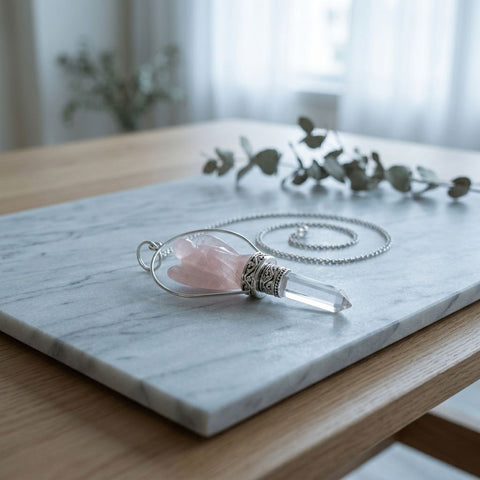 Angel pendulum: small stone angel under a silver-tone hoop
29,90 €
 Tree of Life seven chakra pendulum: cut stone and coloured chips
19,90 €
 Seven chakra pendulum in stones of seven colours
19,90 €
 Three-piece stone pendulum, silver-tone rings
21,90 €