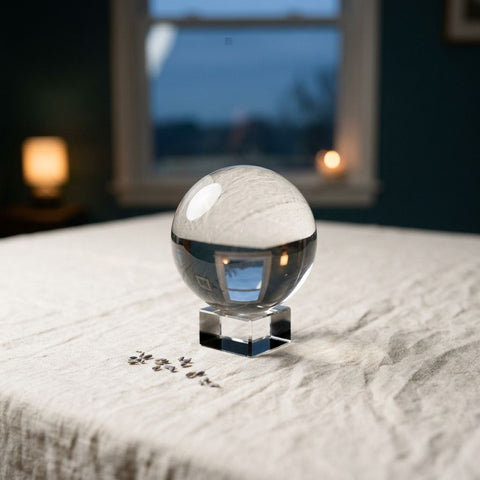
Divinatory Mirrors and Crystal Balls: From Catoptromancy to Crystal
Water mirrors, bowls, beryl, John Dee's obsidian mirror, crystal balls: a history of divinatory gazing (scrying) and current explanations.
Key points
| General name | Scrying, divinatory gazing |
|---|---|
| Forms | Catoptromancy (mirror), hydromancy (water), crystallomancy (crystal, sphere) |
| Antiquity | Mirror lowered into a spring (Pausanias), bowls and basins of water |
| Renaissance | John Dee and Edward Kelley, crystal stone, obsidian mirror |
| 19th century | Crystal ball in spiritualist parlours and the Society for Psychical Research |
| Materials | Natural quartz, glass, lead crystal, obsidian |
Looking in Order to See
Fixing a reflection or a shiny surface in order to make images appear in it is a universal practice. Historians call it scrying (short for descrying, to catch sight of). Its forms include catoptromancy (mirrors), hydromancy (water), lecanomancy (basin or bowl of water) and crystallomancy (crystal, beryl, sphere). The supports change, but the method is the same: a sustained gaze at a calm surface, until shapes or impressions arise.
This page traces the history of these practices and explains how psychology understands them. For the object itself and its use today, see also the page on the crystal ball and crystallomancy.
Antiquity and the Middle Ages
The Greek traveller Pausanias reports a practice at Patras, in Achaea: in a sanctuary of Demeter, a mirror was lowered into a spring to see whether a sick person would recover. The account is Greek, late (2nd century CE) and reflects the religious belief of its time. Other Greek and Roman texts also mention bowls of water consulted in rituals. In Persia, the legend of Jamshid's cup, which showed the entire world, carries the same idea forward.
In the Middle Ages, magic manuals describe using a crystal, a beryl or a mirror to obtain visions, often through a child or a “seer” supposed to be more receptive. The Church condemned these practices as demonic. Nevertheless, they persisted among scholars and magicians.
The Renaissance: John Dee and His Stones
The mathematician and adviser to Queen Elizabeth I, John Dee (1527–1608 or 1609), is the most famous name in scrying. He worked with the medium Edward Kelley, who gazed into a crystal stone (the “shew stone”) to perceive “angels” whose messages were recorded. The British Museum holds an obsidian mirror of Mexican origin, associated with Dee, as well as crystal objects. This obsidian was shaped by the Aztecs before the arrival of the Spanish: the use Dee made of it was a European reuse.
At the same period, tradition credits Nostradamus with the use of a bowl of water set on a tripod, in a scene described in verse in his Prophecies. Historians judge that the text is too allusive to document the practice. These figures show how scrying then belonged to the knowledge of scholars, mixing astrology, alchemy and ceremonial magic.
The 19th Century and the Crystal Ball
The crystal ball, as we imagine it, is above all a 19th-century image. With spiritualism and the taste for the occult, it became a parlour accessory, then a stage and fairground prop. Black mirrors, such as the “Claude glass,” a small tinted convex mirror used by landscape painters in the 18th century, were also repurposed for scrying.
Researchers studied the phenomenon seriously: at the end of the 19th century, members of the Society for Psychical Research (Frederic Myers, Ada Goodrich Freer) collected testimonies from people who saw images in a ball; they recognised in them mental productions rather than revelations. This work anticipated modern explanations.
| Period | Medium | Context |
|---|---|---|
| Antiquity | Mirror in a spring, bowl of water | Religious rituals |
| Middle Ages | Crystal, beryl, mirror | Learned magic, condemned by the Church |
| Renaissance | Crystal stone, obsidian mirror | Dee and Kelley |
| 19th century | Crystal ball, black mirror | Spiritualism, parlours, fairs |
| Today | Ball, mirror, bowl of water | Meditation, play, decoration |
What Happens When You Gaze at a Surface?
Psychology offers several explanations. When you fix your eyes on one point, the visual field fades: this is the Troxler effect, in which peripheral elements disappear. A uniform field viewed for a long time also produces the Ganzfeld effect: deprived of reference points, the brain generates images on its own. Added to this are pareidolia (seeing shapes in blur) and hypnagogic images as one drifts off to sleep. These phenomena are well known and harmless; they are enough to explain “visions” without denying them as experiences.
You should not, however, gaze at a surface for too long if you are tired, anxious or prone to dizziness: ten minutes is enough. Nothing proves that the images seen in this way predict anything.
Ball, Mirror, Bowl: Practical Tips
- Material: a natural quartz ball (rock crystal, see rock crystal) is heavy and cold to the touch, often with small inclusions. Glass or lead crystal, more common and less expensive, is smooth and flawless: it gives the same visual effect.
- Safety: a transparent sphere concentrates sunlight and can set a curtain or paper alight. Never leave it near a sunny window.
- Alternatives: a dark bowl of water, a black mirror or a polished piece of black obsidian allow the same exercise.
- Session: soft light, ten minutes, an open question, a journal within reach.
Find the other arts in the guide to other divinations.
Frequently asked questions
What is crystallomancy?
Divination by gazing into a crystal or ball. It is part of scrying, along with mirrors and water.
Who was John Dee?
An English mathematician and astrologer (1527–1608 or 1609) who worked with Edward Kelley on consultations using a crystal stone and an obsidian mirror.
Is the crystal ball an ancient object?
It became popular mainly from the 19th century. Scrying practices, however, go back to Antiquity.
How are the images people see explained?
By perceptual phenomena: visual fatigue, the Troxler effect, the Ganzfeld effect, pareidolia and hypnagogic imagery.
Can a crystal ball be dangerous?
Yes, it can concentrate sunlight and start a fire. Never leave it in sunlight near a window.
Also read
The meanings mentioned belong to tradition and symbolism. They are neither promises of results nor medical advice. Back to Other divinatory arts.
In the shop