Rose quartz or rose glass: the signs that tell them apart
Natural rose quartz is translucent to milky; rose glass is clearer and more even. Appearance, bubbles, dyes, misleading names (strawberry quartz) and reliable tests.
Key points
| Nature | Pink variety of quartz (SiO2), hardness 7, density about 2.65 |
|---|---|
| Cause of colour | Microscopic fibrous inclusions of the dumortierite type (according to published research) |
| Natural appearance | Pale pink to vivid pink, translucent to milky, often cloudy, rarely very clear |
| Crystals | Rose quartz is almost always massive; well-formed pink crystals (crystalline rose quartz) are rare |
| Deposits | Pegmatites: Brazil (Minas Gerais), Madagascar, India, South Africa, United States |
| Imitations | Rose glass, dyed quartz, plastic, other pink stones |
What rose quartz is, and what it is not
Rose quartz is silicon dioxide, like rock crystal, with a hardness of 7 and a density of about 2.65. Its pink colour comes, according to studies, from microscopic fibre inclusions of a silicate close to dumortierite, rather than from a dye as in amethyst. For a long time rutile was thought to be the cause. These inclusions scatter light, which gives most rose quartz its milky or cloudy look and its often limited translucency. In some spheres and cabochons, aligned fibres produce asterism, a six-rayed star.
Rose quartz forms in the heart of pegmatites, rocks with large crystals. There it is almost always massive, without well-defined crystal faces. Deposits are numerous: Brazil (Minas Gerais), Madagascar, India, South Africa, United States. There is also crystalline rose quartz, transparent and in well-formed crystals, but it is rare and a separate variety; it can fade in strong light.
A general rule: the more transparent and clear a “rose quartz” is, the more questions you should ask. Genuine rose quartz is usually a little cloudy, with hazy patches and internal fractures.
The table of signs
| Sign | Natural rose quartz | Rose glass / imitation |
|---|---|---|
| Transparency | Translucent to milky, often cloudy; light passes poorly | Often very transparent and uniform, or, conversely, opaque like plastic |
| Colour | Pale pink, powdery pink, uneven shades within the same piece | Very uniform bubblegum pink; the same “pastel” shade across the whole batch |
| Bubbles | No round bubbles; irregular fissures, feathers, veils | Small round bubbles, sometimes in lines; wavy streaks |
| Lustre | Greasy to vitreous, soft | Bright vitreous, sometimes “flashy” |
| Temperature | Cool | Glass: cool too; plastic: lukewarm |
| Fractures | Colour identical to the mass | Dye more concentrated in the fractures (dyed quartz) |
No single sign is enough. Compare several pieces from the same batch and combine the signs.
Simple, safe tests
- Read the listing. “Natural rose quartz”, “dyed rose quartz”, “glass”. A piece sold as “pink crystal” or “pink stone” remains ambiguous.
- Hold the stone against the light. Natural rose quartz lets light through diffused (a milky or misty look); rose glass lets light through sharply, like a coloured window pane.
- Look under a loupe (10x magnification): round bubbles and streaks = glass; fissures, veils, feathers = quartz.
- Check the colour in the fractures: a darker shade in the cracks indicates dye.
- Damp white cotton, lukewarm water only, on an inconspicuous area: if the cotton turns pink, the colour is superficial. A negative result proves nothing.
- Compare weight and feel with a quartz you know to be genuine.
Avoid. Acid, flame, solvents, and scratching the piece you want to keep. Rose quartz does not react to common acids: an acid test would be useless and dangerous.
What these tests do not prove. They do not detect synthetic rose quartz or certain treatments. For a large, valuable piece, a laboratory certificate is useful.
Dyed quartz, strawberry quartz and other names
Dyed quartz is clear quartz, often fractured by heating, then dyed pink, blue or another colour to make coloured beads. Its colour is very vivid and concentrates in the fractures.
Strawberry quartz is, when natural, a transparent quartz containing fine inclusions of red iron oxides (haematite, sometimes lepidocrocite according to reports), whose colour tends towards pinkish-red. It is rare and its availability is limited. Pieces sold under this name or similar names (“cherry quartz”) may be glass: ask about the material before buying. See also the strawberry quartz profile.
Other pink stones often confused with it, with very different hardness: rhodochrosite (3.5 to 4, banded), rhodonite (5.5 to 6.5, with black veins), pink calcite (3), morganite (pink beryl, 7.5 to 8, used in jewellery), pink opal (common opal from Peru, opaque), pink aventurine and glitter pink glass. The hardness differences are real, but a scratch test leaves a mark: we do not recommend it on a piece you want to keep.
Care and choosing
Rose quartz tolerates water and gentle cleaning, but some pieces fade in prolonged strong light: keep them away from a sunny window. Avoid knocks on the edges. See the cleansing guide for suitable practices.
Before buying: ask for the material (natural quartz, dyed, glass), the stated origin, the weight and the dimensions. As colour changes with lighting and screens, treat photos as indicative (see our commitments). To go further: the rose quartz profile, “How to recognise real rose quartz” and real or fake stone.
Frequently asked questions
Is very transparent rose quartz real?
It is a warning sign. Massive rose quartz is usually translucent to milky. Clear crystalline rose quartz does exist but it is rare; rose glass is more likely.
Why is rose quartz pink?
According to studies, the colour comes from tiny fibres of a mineral close to dumortierite, trapped within the quartz. They also create the milky appearance.
Does rose quartz fade in the sun?
Some pieces, especially crystalline rose quartz, fade with prolonged strong light. Keep them in the shade.
Is strawberry quartz real quartz?
Naturally, it is a transparent quartz containing red iron oxide inclusions. But pieces sold under this name may be glass: ask what the material is.
How can I test rose quartz at home?
Check transparency against the light, look for bubbles under a loupe, check the colour in the fractures and read the profile. No acid or flame test.
Also read
The meanings mentioned belong to tradition and symbolism. They are neither promises of results nor medical advice. Back to Recognizing real stones.
In the shop
Rose quartz: our products
 Polished natural stone mini obelisk, 5 cm
15,90 €
 Rose quartz bracelet
10,90 €
 Thin 6 mm stone bead bracelet, stretch, wrist size 17 cm
12,90 €
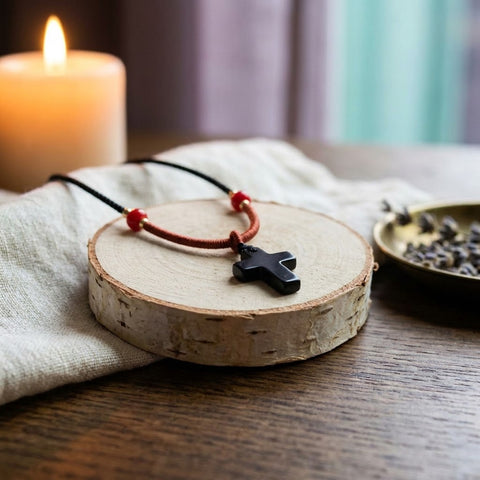 Adjustable cord necklace with small carved stone
21,90 €
 Choker of long stone chips and round beads, 44 cm
20,90 €
 Necklace with drop-shaped stone in a black cord net, adjustable cord
19,90 €
 Stone chip Tree of Life pendant on a black cord, 3 cm
14,90 €
 Glass vial necklace filled with stone chips, silver-plated chain
22,90 €