Redstone: Meaning, Symbolic Properties, Care
Redstone is a red-brown synthetic glass flecked with copper, a cousin of goldstone, invented in Venice. It is not a natural stone, which changes how it should be cared for and how it is understood.
Key points
| Colour | Red-brown to coppery red, flecked with golden glints |
|---|---|
| Nature | Manufactured glass (so not a mineral) containing tiny crystals of metallic copper |
| Hardness | About 5 to 6 (glass); softer than quartz |
| Relative | Goldstone or “gold stone” (glass of the same family), born in Venice in the 17th century |
| Density | Around 2.5 to 2.8 for goldstone, depending on the references |
| Other names | Red goldstone, red gold stone; “sunstone” is sometimes used wrongly |
| Natural neighbouring stone | Sunstone (glittering feldspar), rarer, of which goldstone is an imitation |
| Traditional chakra | No ancient tradition: sellers cite the root or sacral chakra |
What is redstone?
Redstone is not a natural stone. It is glass, made in a furnace from sand, substances that make glass melt, and copper salts. Heated in a furnace without oxygen (a “reducing atmosphere”), the copper turns into tiny metallic crystals distributed throughout the glass: these are what sparkle like golden flakes. This is known as aventurescence, the effect of glittering flecks that some natural stones also show.
This glass belongs to the same family as goldstone (the “gold stone”). Redstone is the red-brown version, the most common. It is cut and polished like a stone: cabochons, beads, tumbled stones, spheres. The result is very convincing to the eye, and that is precisely why it is important to be open about its nature.
A glass born in Venice
Goldstone is generally associated with the Miotti family, Venetian glassmakers of the 17th century, who are said to have held a privilege for its manufacture. Accounts that speak of an accidental discovery by monks or alchemists have no written evidence before that period. A goldstone amulet kept at the University of Pennsylvania, dated to Persia in the 12th and 13th centuries, suggests that other craftsmen had found the process earlier.
What is known is that the recipe was kept secret for a long time before being taken up elsewhere. Today goldstone and redstone are made in many places, and they can be found at very low prices, far from the Renaissance glass of Murano.
Traditional symbolism
Since redstone is a manufactured glass, it has no symbolism of its own from history. Stone sellers generally associate it with vitality, energy and perseverance, through its red colour and golden sparkle, which evoke fire and warmth. These are trade associations rather than ancient traditions.
This does not diminish the interest of the material: its colour and glints are genuinely beautiful, and everyone may link it with whatever intention they wish. No effect on energy or health has been demonstrated.
Common correspondences
| Area | Association cited by sellers |
|---|---|
| Chakra | Root (see the root chakra) or sacral (the sacral chakra) |
| Element | Fire |
| Signs | Aries and Leo, through the colour; no ancient tradition |
| Intention | Energy, courage, momentum |
See also courage.
How to use it
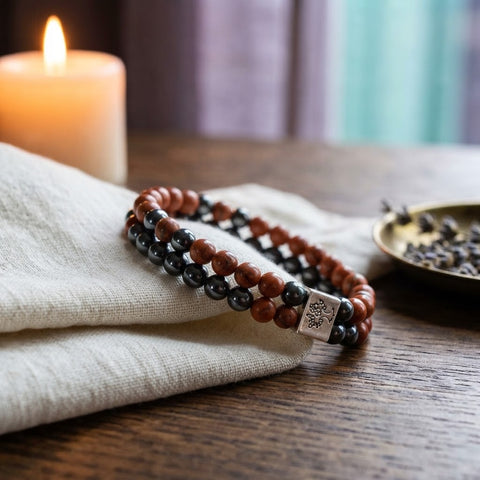
- As a bracelet or necklace: redstone beads sparkle in daylight and are easy to wear.
- As a tumbled stone: a small pocket stone, pleasant to handle.
- As a sphere or decorative object: the flecked effect is very visible under a spotlight.
For jewellery, see the guide to stone jewellery.
Care and cleansing
- Cleaning: lukewarm water and a soft cloth are enough; glass is not affected by water.
- Knocks: glass can shatter or chip. Avoid falls onto tiles and remove the jewellery before sport.
- Thermal shock: avoid moving from very hot water to cold water.
- Sunlight: no known risk to the material in the short term; still, avoid leaving it for hours behind a scorching window.
- Symbolic cleansing: incense smoke, moonlight or selenite. See the cleansing guide.
Redstone and sunstone: do not confuse them
Sunstone is a genuine stone, a feldspar whose glints come from tiny platelets enclosed in the crystal (native copper or iron oxides, depending on the origin). It is harder (about 6 to 6.5 on the Mohs scale) and rarer than redstone. Goldstone is often used as an imitation of sunstone, which is the source of the confusion.
- Under a loupe, natural sunstone shows small platelets, whereas goldstone offers an even and very regular sparkle.
- A stone called “sunstone” sold at very low prices, brown-orange and flecked, is very probably glass.
- There is no deception in redstone, provided it is sold for what it is: a manufactured glass.
To recognise natural stones, our guide to choosing and caring for your stones gives the clues.
How to choose your redstone
Choose it for its colour and glints, as a decorative material. A few tips: look at it from several angles, since the sparkle varies; check that the edges are free of chips; prefer a maker or seller who states “glass”. It remains very affordable, which makes it a good choice for a first bracelet or a stone as a gift.
It goes well with tiger’s eye, carnelian or goldstone, from the same family. See also the bracelets section.
Frequently asked questions
Is redstone a real stone?
No. It is a manufactured glass, containing metallic copper in tiny crystals. It belongs to the same family as goldstone.
What is the difference between redstone and goldstone?
Goldstone is the original flecked glass, generally brown-gold; redstone is its red-brown shade. Blue or violet goldstones also exist.
Is redstone a sunstone?
No. Sunstone is a harder natural feldspar. Goldstone glass is a common imitation of it.
Can redstone get wet?
Yes, it is glass: lukewarm water and a soft cloth. Avoid knocks and sudden changes of temperature.
Why buy redstone if it is glass?
For its colour, its sparkle and its price. It is an honest decorative material, as long as it is sold as such.
Also read
The meanings mentioned belong to tradition and symbolism. They are neither promises of results nor medical advice. Back to Guide to stones.
In the shop