Polychrome Jasper: Meaning, Symbolic Properties, Care
“Polychrome jasper” is a trade name for multicoloured jaspers, most often from Madagascar: an opaque, hard microcrystalline silica with very varied patterns.
Key points
| Name | trade name, not a mineral species |
|---|---|
| Mineral family | microcrystalline quartz (chalcedony) mixed with clay and oxides |
| Simplified composition | silica SiO2 (80 to 95% depending on the usual definition) with iron, manganese and clay impurities |
| Mohs hardness | 6.5 to 7 |
| Lustre | matt to vitreous once polished, opaque |
| Origin cited | most often Madagascar, according to sellers |
| Traditional chakra | root or solar plexus depending on the authors |
What is polychrome jasper?
Let us start with an honest clarification: “polychrome jasper” is not the name of a species recognised by mineralogists. It is a trade name, which appeared in stone shops, for jaspers showing several colours at once (red, yellow, green, brown, cream, sometimes blue-grey). “Polychrome” comes from Greek and simply means “of several colours”.
Jasper itself is well defined: an opaque siliceous rock that usually contains 80 to 95% silica, together with clay and iron or manganese oxides. These impurities create the colours. The word comes from the Latin iaspis, itself borrowed from Greek, and traces back to Semitic languages; it is often glossed as “spotted stone”. Sellers most often place polychrome jasper in Madagascar, an island known for its jaspers, but the exact origin varies from one batch to another and is almost never guaranteed.
How does a jasper form?
Jasper forms when very fine silica is deposited and solidifies in sediments, volcanic ash or cracks in rocks. The colours come from what gets trapped: hematite gives red, goethite gives yellow and brown, chlorite or other minerals give green. In a polychrome jasper, several deposition episodes followed one another, hence the zones, spots, bands or rings of different shades.
Each piece of jasper is therefore almost unique. This is what makes its charm for enthusiasts: no sphere or tumbled stone looks exactly like another.
A little history of jasper
Jasper has accompanied humanity for a very long time. Fire drills were made from it at Mehrgarh, in present-day Pakistan, more than four thousand years ago; engraved seals were cut in Minoan Crete around 1800 BCE; and hardstone mosaics were made in the workshops of the Medici in Florence, founded in 1588. The Russian emperors had jaspers from the Urals and the Altai carved into large vases.
These examples concern jasper in general. “Polychrome jasper” proper is a recent product of the lithotherapy and decoration trade, with no history of its own.
Traditional symbolism
In the tradition of stones, jasper is one of the stones of the earth, of solidity and of everyday life. Contemporary authors attribute to it the idea of stability, endurance and grounding. Polychrome jasper, because it combines several shades, is often presented as a symbol of diversity: accepting that several facets of a person or of a day can coexist.
These are modern symbolic associations, specific to each author. They have no proven effect and do not replace a doctor or a psychologist.
Traditional correspondences
| Element | Association cited |
|---|---|
| Chakra | root (root chakra), sometimes solar plexus |
| Element | earth |
| Signs | opinions differ widely: Taurus, Virgo or Capricorn come up, with no consensus |
| Dominant colours | reds, browns and earthy yellows, with green or cream touches |
These correspondences vary from one book to another: take them as a set of reference points, not as a rule.
How to use it
- As a pocket tumbled stone: a small smooth pebble that you hold in your hand for a moment of calm.
- As a sphere or egg on a desk: the pattern changes with the angle and is best looked at for a long time.
- As beads for bracelets: jasper beads are sturdy and stand up well to daily wear.
- In simple meditation: place the stone in front of you and describe quietly each colour and each pattern you see. This attention exercise helps you settle, whatever the stone.
- As a gift: since each piece is unique, it lends itself well to a small personalised present.
Care and cleansing
With a hardness of 6.5 to 7, jasper resists scratches and water well. Wash it in lukewarm water with a little mild soap, rinse and dry it with a cloth. Very long exposure to sunlight can fade certain shades if the piece has been dyed or coloured with fragile compounds; when in doubt, avoid prolonged full sun.
Avoid sharp knocks, which can chip the edges, and acidic products. For a symbolic cleansing, you may use gentle smoke or selenite; see cleansing and recharging your stones.
Recognising real jasper and avoiding surprises
- Real jasper is opaque, hard and slightly cool to the touch; it will not be scratched by a steel point.
- Colours that are too bright and too uniform (electric blue, bubblegum pink, neon green) often betray dye. Dyed jaspers exist and should be declared.
- Moulded glass or resin mixed with powdered stone can imitate a pattern: round bubbles, or a warm, light surface to the touch, are clues.
- The word “polychrome” guarantees neither origin nor deposit: ask the seller what they know.
How to choose
Choose by looking at the piece: patterns you like, an even polish, no cracks. Prices are generally affordable, with variations depending on size and the fineness of the patterns. Pair it with a neighbouring jasper such as ocean jasper, landscape jasper or orbicular jasper. See also choosing and caring for your stones.
Frequently asked questions
Is polychrome jasper a natural stone?
Yes, it is a natural jasper, but “polychrome” is a trade name, not a mineral species. Be wary of pieces with very bright colours, which are sometimes dyed.
Where does polychrome jasper come from?
Sellers mainly cite Madagascar. The exact origin is rarely documented and varies from one batch to another.
What is its hardness?
Between 6.5 and 7 on the Mohs scale, like most jaspers: it is hard to scratch.
Can it be washed in water?
Yes, in lukewarm water with mild soap, then dry it. Avoid acidic products and knocks.
How does it differ from ocean jasper?
Ocean jasper is an orbicular jasper with circles from Madagascar; polychrome jasper covers jaspers with very variable patterns and shades.
Also read
The meanings mentioned belong to tradition and symbolism. They are neither promises of results nor medical advice. Back to Guide to stones.
In the shop
Jasper: our products
 Red jasper: polished mini obelisk
18,90 €
 Raw stone pendulum wrapped in silver-tone wire: choice of 5 stones
16,90 €
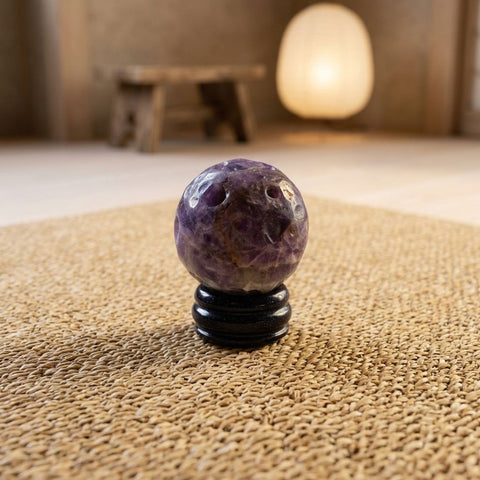 Stone planet with craters on a stand, 40 mm: three stones
27,90 €
 Red jasper tree on a rock base
19,90 €
 Natural stone ball pendulum: choice of 8 stones, silver-tone chain
19,90 €
 Thin map jasper, mookaite and blood spider stone bracelets: 5 mm beads
14,90 €
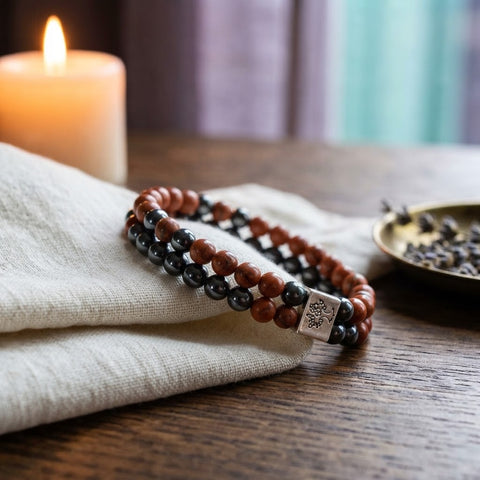 Red jasper bracelet: faceted beads or double wrap with magnetic clasp
14,90 €
 Picasso jasper and picture jasper bracelet
14,90 €