Epidote: Meaning, Symbolic Properties and Care
Epidote is an olive to dark green silicate, described by Haüy in 1801. Its Greek name suggests growth; in tradition it is linked to renewal, the heart and perseverance.
Key points
| Colour | olive green, pistachio green to very dark green, sometimes brown or blackish |
|---|---|
| Mineral family | silicate (sorosilicate) of calcium, aluminium and iron |
| Simplified composition | Ca2(Fe,Al)Al2(SiO4)(Si2O7)O(OH) |
| Mohs hardness | 6 to 7 |
| Crystal system | monoclinic; elongated, finely striated crystals |
| Origin of the name | Greek epidosis, “growth” |
| Deposits | France (Bourg-d’Oisans), Austria, Norway, Pakistan, Madagascar, Alaska |
| Traditional correspondence | heart chakra; Earth element; Virgo, Taurus, depending on the authors |
| Care | lukewarm water and a soft cloth; rough crystals are fragile |
What Is Epidote?
Epidote is a calcium, aluminium and iron silicate that forms in metamorphic and hydrothermal rocks, that is, rocks transformed by heat, pressure or hot waters rich in minerals. It also appears when the feldspar in a rock weathers (this is the phenomenon of “saussuritisation”). Its colour ranges from olive green to pistachio green, and to almost black shades when iron dominates.
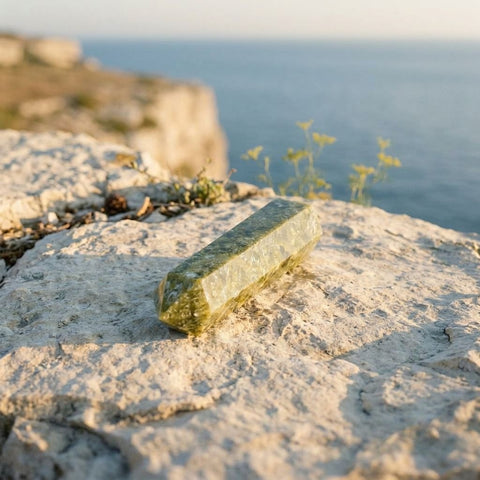
Its hardness is 6 to 7. It crystallises in the monoclinic system as elongated crystals, finely striated lengthwise, with a very distinct cleavage: a good rough piece is therefore more fragile than it looks. Some crystals can reach 35 cm, but most pieces sold fit in the hand.
The name comes from the Greek epidosis: “increase”, “progress”, “growth”. It was given by René-Just Haüy in 1801; the common explanation is that it alludes to the shape of some crystals, one face of whose prism is more developed than the other. It is this etymology that has nourished its modern symbolism.
Where Is It Found?
Epidote is widespread: the type locality is Bourg-d’Oisans in the French Alps. It is also mined in Austria, Norway (Arendal), Pakistan (Shigar Valley), Madagascar, Alaska and many other countries. It occurs as single crystals, in sprays, or in aggregates on their host rock (the matrix), and as cabochons or beads when massive.
It is also found in epidosite, a rock made of epidote and quartz, and in unakite, a green and pink rock composed of epidote, pink feldspar and quartz.
Traditional Symbolism
Epidote has no long ritual history; its meanings come mainly from its name and its colour, and from modern lithotherapy.
- Its Greek name, “growth”, makes it a symbol of personal development and perseverance.
- Its deep green links it to renewal and to nature springing back to life.
- It is associated with patience and gentleness towards oneself, and is readily suggested for times of transition.
These are symbolic beliefs, with no proven effect on health.
Traditional Correspondences
| Area | Common association | Note |
|---|---|---|
| Chakra | Heart | Through its green colour |
| Element | Earth | According to most authors |
| Signs | Virgo, Taurus, Capricorn | The lists differ |
How to Use It
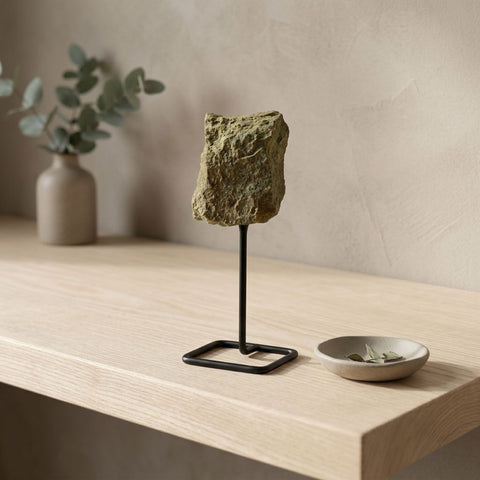
- As rough stone: a crystal or a small cluster on its matrix, to place on a shelf or desk.
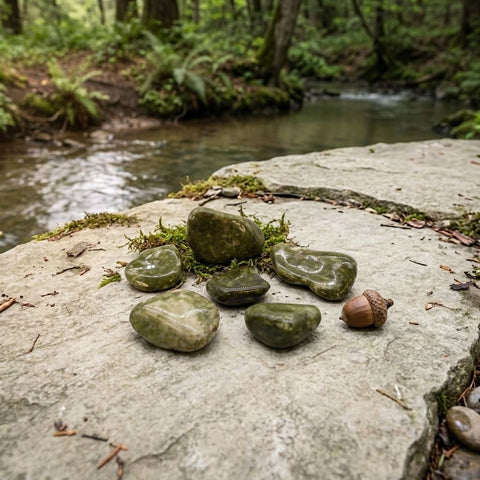
- As tumbled or polished stone: to carry in a pocket, or to hold during meditation.
- As jewellery: cabochons and beads are possible, but should be worn with care. See our guide to gemstone jewellery.
- As a gift: to mark a change in life (a fresh start, a birth, returning to study).
Care and Cleansing
- Water: epidote tolerates lukewarm water; clean with a soft cloth and dry thoroughly, especially if the piece is on a porous matrix.
- Rough crystals: handle them with care; the points break easily because of the cleavage. Do not rub them against other stones.
- Sunlight: no known concern.
- Household products, ultrasonic cleaners: avoid them on fragile rough pieces.
- Storage: keep apart from harder quartz and agates.
- Symbolic purification: smoke, moonlight. See our guide to purifying and recharging your stones.
Recognising Genuine Epidote
To our knowledge, there are no common treatments or imitations of epidote. The surprises mostly come from confusion:
- Rough epidote is often sold mixed with its host rock (quartz, feldspar): this is normal, but the proportion of green may be small.
- It can be confused with green tourmaline, peridot, actinolite or fuchsite.
- A very bright, very uniform green stone sold cheaply may be glass or a dyed stone.
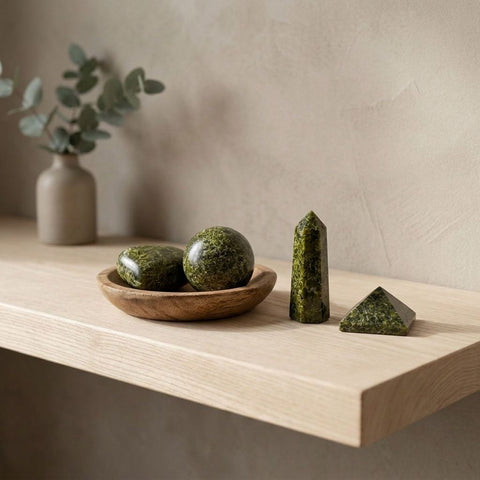
- Polished forms (eggs, spheres) are often made from epidosite or from a mixed rock, not from pure epidote: ask for the exact material.
See our guide to choosing and caring for your stones.
How to Choose Your Epidote
- For crystals: intact points, a deep colour, good contrast with the matrix.
- A “bright” piece (sharp crystals, reflections) is more prized than a dull, opaque lump.
- On a fragile base, choose a stand or a small box.
- Pairings: unakite (which contains it), fuchsite and green aventurine for a set of greens; carnelian for a warm contrast.
Frequently asked questions
What does the word epidote mean?
It comes from the Greek epidosis: “increase”, “progress”. René-Just Haüy chose it in 1801 for a peculiarity in the shape of its crystals.
Is epidote fragile?
Its hardness is 6 to 7, but its cleavage is very distinct: points and edges break easily. Handle the crystals with care.
What is the difference between epidote and unakite?
Epidote is a mineral. Unakite is a rock composed of green epidote, pink feldspar and quartz.
Can epidote be washed?
Yes, in lukewarm water with a soft cloth. Dry it well and avoid ultrasonic cleaners on rough crystals.
Is epidote treated?
To our knowledge, there is no common treatment. However, the material sold is sometimes epidosite or a mixture of rocks; ask for the composition.
Also read
The meanings mentioned belong to tradition and symbolism. They are neither promises of results nor medical advice. Back to Guide to stones.