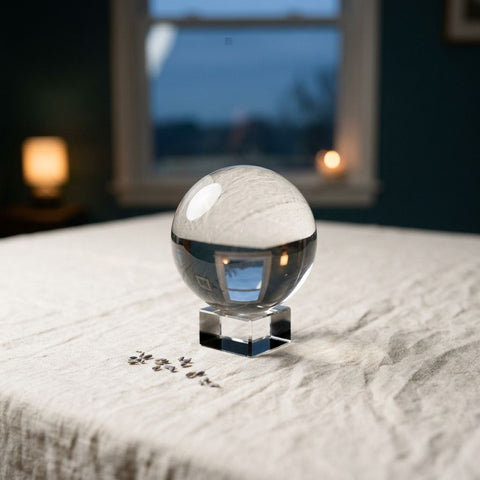
Choosing a crystal ball: material, size, weight, safety
Rock crystal, glass, lead crystal or resin? Size, weight, stand, inclusions, care and safety: everything you need to choose a crystal ball without being taken in.
Key points
| Common materials | Rock crystal (quartz), glass, lead crystal, obsidian, resin |
|---|---|
| Density of quartz | About 2.65: a 10 cm sphere weighs about 1.4 kg |
| Ordinary glass | Density about 2.5: weight very close to quartz |
| Lead crystal | At least 24% lead oxide under the European definition |
| Inclusions | Clouds and fractures in quartz; round bubbles in glass |
| Safety | A clear sphere can set curtains or paper alight in sunlight |
| Divinatory power | No demonstration; the images come from the observer |
Before choosing: what will it be used for?
A crystal ball can serve as decoration, a collector's piece, a meditation focus, or a tool for “crystal gazing” (looking into a sphere to perceive images). This practice is old and ritualized, but no study shows that it allows anyone to see the future; psychologists explain it through perception, imagination and visual fatigue. See our page on the crystal ball and crystal gazing.
Your use determines your choice: for decoration, the material and the stand matter; for contemplative gazing, transparency and visual calm; for a collection, the exact nature of the material. This page helps you choose with full knowledge.
The materials: what you are really being sold
| Material | What it is | Good to know |
|---|---|---|
| Rock crystal (colourless quartz) | Natural quartz, hardness 7, density about 2.65 | Almost always has some clouds or inclusions; a large, perfectly clear sphere is rare and expensive |
| Synthetic quartz | Quartz grown in a laboratory, same composition | Perfectly clear; must be declared as synthetic |
| Glass | Manufactured material, hardness 5 to 6, density about 2.5 | Very clear, often with small round bubbles; the most common |
| “Crystal” (lead) | Glass containing lead | Heavier and more brilliant; softer; see below |
| Obsidian | Natural volcanic glass, black, hardness 5 to 5.5 | Black ball with reflections; scratches and can chip |
| Amethyst, smoky quartz, rose quartz | Coloured varieties of quartz | Translucent rather than transparent; images less sharp |
| Resin | Molded plastic | Light, warm to the touch, scratches with a fingernail; cannot be sold as stone |
In everyday language, “crystal” means rock crystal. In glassmaking, the word refers to glass containing lead oxide or other metal oxides. Under the European glass directive, “lead crystal” contains at least 24% lead oxide and has a density of at least 2.9 (values taken from transposing texts, which we have not checked against the official text). A modestly priced crystal ball is therefore, most often, glass: this is not objectionable if it is stated.
Size and weight: a very useful guide
The weight of a sphere depends on the cube of its diameter: doubling the diameter multiplies the weight by eight. Here are calculated values (mass = 4/3 × π × radius³ × density). They are indicative.
| Diameter | Quartz (2.65) | Glass (about 2.5) | Lead crystal (about 2.9) |
|---|---|---|---|
| 4 cm | about 90 g | about 85 g | about 100 g |
| 6 cm | about 300 g | about 285 g | about 330 g |
| 8 cm | about 710 g | about 670 g | about 780 g |
| 10 cm | about 1.4 kg | about 1.3 kg | about 1.5 kg |
| 12 cm | about 2.4 kg | about 2.3 kg | about 2.6 kg |
| 15 cm | about 4.7 kg | about 4.4 kg | about 5.1 kg |
What this table tells you: weight does not allow you to tell quartz from glass (only a 6% difference). However, a 10 cm sphere weighing only 500 to 700 g is probably hollow or made of resin (a resin of density 1.15 would weigh about 600 g). If the seller announces “10 cm, rock crystal” and the package weighs 600 g, there is a problem.
Telling quartz from glass: safe checks
- Bubbles. Examine the sphere in the light, with a magnifier if possible. Small, isolated round bubbles point rather to glass. Clouds, irregular fractures and “feathers” point rather to natural quartz.
- Coolness to the touch. Quartz conducts heat better than glass: when you place your hand on it, it feels cooler for longer. This is a clue, not proof.
- Too perfect. A large sphere with no flaw at all is unlikely in natural quartz. It may be glass or synthetic quartz.
- Inverted image. Any transparent sphere inverts the image seen through it (magnifying effect): this is not a criterion.
None of these tests proves anything on its own. For an expensive piece, ask for a gemological laboratory certificate. Do not scratch the sphere, and do not try acid or flame. See rock crystal or glass and real or fake stone.
Stand, size and space
A sphere rolls: it needs a stand (wooden ring, metal base, stone foot) that is stable and fairly deep. Place it on a solid piece of furniture, away from the edge and out of reach of young children and pets. A 10 cm sphere weighs about 1.4 kg: it can injure someone if it falls, and can break the floor or the furniture. For table or desk use, 5 to 8 cm is comfortable; above 10 cm, provide a solid stand. Also choose a stand suited to the size: a hole that is too wide lets the sphere sink in, and a ring that is too small makes it slip.
Safety: fire risk
A transparent sphere works like a magnifying glass: it focuses the sun's rays into a burning point a few centimeters to a few dozen centimeters behind it. Placed near a window, it can set paper, a curtain or a sofa alight. Domestic fires have been attributed to glass balls. Never leave a crystal ball in direct sunlight, even in winter, or near flammable materials, and keep it under an opaque cloth if light enters the room.
Another precaution: lead crystal should not be used as a food container and should be handled with clean hands; wash your hands after handling an old or damaged object. If you use a candle to create an atmosphere, choose a stable holder, away from curtains, and never leave it unattended.
Care
Quartz and glass tolerate lukewarm water and mild soap, but not impacts or sudden temperature changes. Wipe with a clean microfiber cloth; fingerprints show a great deal on a clear surface. For obsidian, avoid rubbing, which scratches it. A sphere in soft or porous stone (selenite, fluorite) must not get wet. For symbolic purification, which remains a personal gesture, see purifying and recharging your stones.
Our advice for choosing
- Decide on the use: decoration, contemplation or collection.
- Choose a reasonable diameter: 6 to 8 cm to start.
- Read the material on the product page: “rock crystal” (quartz), “glass”, “crystal” (lead glass), “resin”.
- Check the stated weight: it should match the diameter.
- Provide a stable stand and a place away from direct sunlight.
Find our models in the crystal balls section, and our decorative spheres in points, spheres and figurines. Photos are indicative: see our commitments. For the sphere as an object, see also stone spheres.
Frequently asked questions
How can I tell whether a crystal ball is glass or rock crystal?
Look for round bubbles (glass) or irregular clouds and fractures (quartz). Weight alone is not enough, as glass and quartz have close densities. For an expensive piece, ask for a laboratory certificate.
What size of crystal ball should I choose to start with?
Between 6 and 8 cm: large enough to gaze into, and light enough (about 300 to 700 g for quartz) to handle comfortably.
Can a crystal ball start a fire?
Yes, it can focus sunlight like a magnifying glass. Never leave it in direct sunlight or near curtains or paper.
Does a crystal ball let you see the future?
No study has shown this. The images perceived come from perception and imagination; the practice can nevertheless offer a moment of calm and daydreaming.
Is lead crystal dangerous?
At rest, a decorative sphere poses no particular problem. However, do not use it as a food container, and wash your hands after handling it.
Also read
The meanings mentioned belong to tradition and symbolism. They are neither promises of results nor medical advice. Back to Buying guides and gift ideas.
In the shop