Choir of Thrones: Origin, Pseudo-Dionysius and Angels 17 to 24
The Thrones, third choir of angels: seat of God, wheels of Ezekiel and judgment, the name, the Bible, Pseudo-Dionysius and angels 17 to 24 of the list of 72, from Lauviah to Haheuiah.
Key points
| Rank | third of the 9 choirs (first triad) |
|---|---|
| Angels of the list of 72 | nos. 17 to 24 (Lauviah to Haheuiah) |
| Annual reigns | June 9 to July 18 |
| Daily hours | 05:20 to 08:00 |
| Greek word | thronoi, “seats, thrones” |
| Biblical texts | Colossians 1:16; Daniel 7:9; Ezekiel 1 |
| Main source | Pseudo-Dionysius, Celestial Hierarchy, chapter 7 |
Who are the Thrones?
The Thrones are, in the classical order, the third choir of angels and the last of the first triad. The Greek word thronos means “high seat”: that of a king or of a judge. Applied to angels, it evokes stability, height and justice, more than action.
The term is rare: for angelic beings it appears only in one verse of the New Testament (Colossians 1:16), which lists “thrones, dominions, principalities, powers”. Tradition then sought correspondences in the Old Testament. In the list of 72 angels, this choir groups angels 17 to 24. For the origin of the system, read our introduction to the 72 angels.
The Thrones in the Bible
The central verse is Colossians 1:16: all things were created by Christ and for him, “thrones, dominions, principalities, powers”. The apostle cites categories of beings without describing them.
Christian readers have therefore linked these thrones to images from the Old Testament:
- Isaiah 6:1: the Lord sits upon a very high throne.
- Daniel 7:9: thrones are set up; that of the Ancient of Days has wheels of burning fire.
- Ezekiel 1:15-21 and 1:26: interlocking wheels, rimmed with eyes, accompany the living creatures, and above them appears a throne like sapphire.
- Revelation 4: a throne in heaven, surrounded by twenty-four thrones occupied by elders.
In Hebrew, Ezekiel’s beings are called ophanim (“wheels”); Christian tradition often identifies them with the Thrones. This identification is a reading, not a fact of the text.
The Thrones according to Pseudo-Dionysius
In the “Celestial Hierarchy” attributed to Pseudo-Dionysius the Areopagite (around 500, chapter 7), the Thrones are the third order of the first triad. The author sees in them beings raised above all that is low, turned upward, and capable of “bearing” the divine presence without effort or burden, as a seat bears a king.
Gregory the Great (late sixth century), in his homily 34 on the Gospels, calls them thus because God sits upon them and, through them, he renders his judgments. Hence the lasting association of the Thrones with divine justice, which extends that of the psalms.
The eight angels of the choir in the list of 72
In the list of 72 names of the Shem HaMephorash, the Thrones group eight angels, from no. 17 to no. 24. Each reigns five days in the year and twenty minutes in the day, according to the most common calendar.
| No. | Angel | Reign period | Reign hour |
|---|---|---|---|
| 17 | Lauviah | June 9 to 13 | 05:20 to 05:40 |
| 18 | Caliel | June 14 to 18 | 05:40 to 06:00 |
| 19 | Leuviah | June 19 to 23 | 06:00 to 06:20 |
| 20 | Pahaliah | June 24 to 28 | 06:20 to 06:40 |
| 21 | Nelchael | June 29 to July 3 | 06:40 to 07:00 |
| 22 | Yeiayel | July 4 to 8 | 07:00 to 07:20 |
| 23 | Melahel | July 9 to 13 | 07:20 to 07:40 |
| 24 | Haheuiah | July 14 to 18 | 07:40 to 08:00 |
Dates follow the most common calendar (angel no. 1 reigns from March 21 to 25, then five days per angel); sources sometimes shift by a few days: see how to calculate your guardian angel.
Other readings and images
Some other images:
- Maimonides (12th century) places the ophanim in the second rank of his ten categories of angels, just after the hayyot (living creatures).
- Christian Kabbalah (Agrippa) connects the ophanim with the sphere of wisdom (Hokhmah) in the classical correspondence of the Tree of Life.
- Iconography depicts them as wheels of fire with many wings or eyes, or as empty thrones surrounded by flames. These striking figures serve as a reminder that the text speaks of realities beyond words.
- The first Book of Enoch (61:10), an ancient apocryphal text, mentions “ophannim” alongside the cherubim and seraphim among those who keep watch without sleeping.
A symbolism for today
A throne is first of all a place where one sits, where one holds firm. In today’s symbolism, the Thrones evoke stability, groundedness, and the capacity to hold one’s place without crushing anyone. Through Gregory the Great, they are also those of justice rendered calmly.
This reading lends itself to reflection on how to hold a position, a family, a team. It says nothing of what will happen.
A gentle practice
An exercise of “place held”, ten minutes:
- Sit on a steady chair, both feet on the floor, back straight without stiffness.
- Breathe calmly for two minutes, feeling the contact of the seat.
- Note the three commitments you are holding best at the moment (a person, a task, a habit).
- Identify the one that weighs on you and ask whether you can delegate it, reduce it or clarify it.
This exercise belongs to personal reflection and does not replace medical advice or psychological support.
What to keep in mind
The nine choirs are a construction of Christian theology, based on Pseudo-Dionysius (around 500), then on Gregory the Great and Thomas Aquinas. This scheme relies on lists of names from the New Testament; it is not an official teaching of the Church, which affirms the existence of angels (Catechism, § 328) without fixing a precise hierarchy.
The attribution of eight Kabbalistic angels to each choir is, for its part, an esoteric construction of the Renaissance, which the Catholic Church does not recognise: it retains only the three archangels named in Scripture, Michael, Gabriel and Raphael. Nothing shows that a specific angel corresponds to your date of birth, and no one can promise you protection or an event. Read these pages as a symbolic bestiary: for the images and the reflection they inspire.
See also the guide to the 72 angels and the guide to the archangels.
Frequently asked questions
What does “Thrones” mean for angels?
The Greek word thronos means “high seat”. In Christian tradition, the Thrones are the angels who bear the presence of God and symbolise justice and stability.
Are the Thrones the ophanim?
They are often brought close to the ophanim (the “wheels” of Ezekiel), but the biblical text does not identify them with each other. This is a reading of Christian tradition; Maimonides classifies the ophanim differently.
Which angels of the list of 72 are Thrones?
According to the division of eight angels per choir, the Thrones group angels 17 to 24, from Lauviah to Haheuiah, who reign from June 9 to July 18.
Why are the Thrones linked to justice?
Because a throne is the seat of a king and of a judge, and Gregory the Great explains the name by the fact that God sits upon them to render his judgments.
Are the Thrones mentioned in the Bible?
The New Testament names them in Colossians 1:16, without describing them. The images of thrones and wheels come from other books, such as Daniel and Ezekiel.
Also read
The meanings mentioned belong to tradition and symbolism. They are neither promises of results nor medical advice. Back to Guide to the 72 guardian angels.
In the shop
Stone jewellery: our products
 Faceted stone necklace with butterfly in real silver-tone leaf, 42 cm
23,90 €
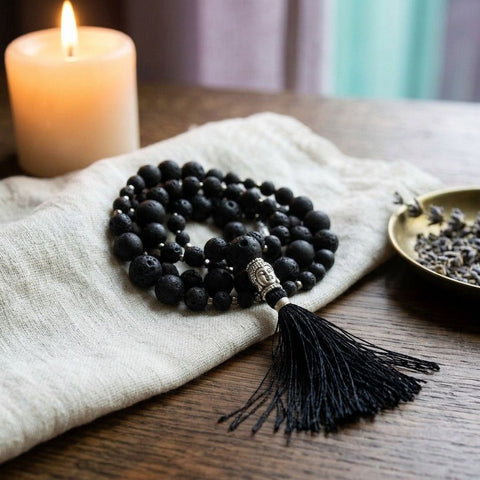 Long lava stone necklace, 42 cm, comes in a gift box with its card
22,90 €
 Engraved brass or copper cuff bracelet: Nepalese designs, adjustable
23,90 €
 Hand-knotted Balinese temple thread bracelet with beads
27,90 €
 Set of three semi-precious stone bracelets with butterfly: 7 gift boxes
31,90 €
 Wooden bead bracelet with Buddha head
10,90 €
 Wooden bead bracelet with lucky coin: 6 tie-on colours
13,90 €
 Tri Hita Karana wood, glass and stone bracelet from Bali
24,90 €