Angel Haheuiah (No. 24): Regency, Psalm, Symbolism and Reading
Haheuiah, the twenty-fourth angel of the Shem HaMephorash, reigns from 14 to 18 July and closes the choir of Thrones. Dates, hour, Psalm 33 and symbolism according to tradition.
Key points
| Number | 24 of 72 |
|---|---|
| Regency period | 14 to 18 July |
| Regency hour | 7:40 a.m. to 8:00 a.m. |
| Choir | Thrones |
| Associated psalm | Psalm 33, verse 18 |
| Hebrew letter triplet | חהו (Heth, He, Vav) |
| Symbolic theme | The caring gaze, refuge, hospitality |
Who is Haheuiah, angel No. 24?
Haheuiah is the twenty-fourth angel in the classical table of the 72 angels, the one who closes the choir of Thrones. His name also appears in the forms Haiviah or Hahuiah. Tradition links him to a simple image: the gaze. He is the angel of a God who keeps watch over those who feel exposed, far away or lost.
In nineteenth-century French editions, he is often presented as an angel of refuge: the protector of exiles, travellers and anyone whom circumstances have taken away from home. More recent lists add the protection of property and of the home.
Haheuiah bears the number 24 in the list of the 72 angels of the Shem HaMephorash, which Kabbalistic tradition draws from three verses of Exodus (14:19 to 21). Everything that follows is presented according to Kabbalistic and esoteric tradition. For the origin of the system, read our introduction to the 72 angels.
Reference points in tradition
| Reference point | According to tradition |
|---|---|
| Number in the classical list | 24 of 72 |
| Regency period (5 days) | 14 to 18 July |
| Regency hour (20 minutes) | 7:40 a.m. to 8:00 a.m. |
| Choir | Thrones (the 8th of the 8 angels of the choir) |
| Traditionally associated psalm | Psalm 33, verse 18 |
| Triplet of Hebrew letters | חהו (Heth, He, Vav) with the suffix יה |
| Approximate zodiac sign | Cancer |
The dates follow the most common calendar (angel No. 1 reigns from 21 to 25 March, then five days per angel over 365 days). Sources sometimes shift by a few days, and leap years are treated differently: see how to calculate your guardian angel. According to many authors, the hour is counted in local solar time.
The verse and the name
The verse chosen is the eighteenth verse of Psalm 33. The psalmist affirms that the divine gaze rests on those who revere God and trust in his faithfulness. Psalm 33 is a hymn of praise to creation and providence; this verse is its passage of trust, reminding us that God’s attention is not given only to the powerful.
It is from this “gaze” that the image of the caring eye, often linked to Haheuiah, comes. In a symbolic reading, the idea is less one of surveillance than of attention: to feel seen is also to feel welcomed.
According to tradition, the name is formed from the triplet of letters חהו (Heth, He, Vav) followed by the endings Yod and He (Yah, a name of God). French spellings vary (Haiviah, Hahuiah) depending on transliteration. Psalm 33 has no title; its verse 18 bears the same number in Hebrew, French and English Bibles, and corresponds to Psalm 32 in the Vulgate. Lists of verses also differ slightly from one author to another.
What tradition associates with Haheuiah
According to various authors, the following themes are associated with Haheuiah. None of these lists is authoritative:
- Refuge and hospitality: the angel of exiles, travellers and those who leave one place for another.
- Protection of property, in recent lists: the home, what one owns, against theft or domestic accidents. This is an imaginative reading of the verse.
- Clemency: the hope of being judged with humanity, which some sources connect with human justice.
- Clarity of vision: seeing situations and people without confining them within a label.
These attributes come mainly from French authors of the nineteenth and twentieth centuries. They extend the word “gaze” from the verse; they do not appear in any ancient text.
A reading for today
For anyone interested today in this tradition, Haheuiah offers an accessible theme: to look and to be looked at with kindness. Periods of moving house, travel, starting a new job or settling in a foreign country are moments when one feels “out of place”. The figure of an attentive gaze can serve as a soothing metaphor, and that is all one can honestly say about it.
His period of the year and his sign
Haheuiah’s period, from 14 to 18 July, falls in summer (northern hemisphere, within the framework of the original calendar). It roughly covers the sign of Cancer. In the table of the 36 decans, each ten-day span receives two angels: Haheuiah shares his with Melahel (No. 23).
In the choir of Thrones
The Thrones belong to the first triad of the “Celestial Hierarchy” attributed to Pseudo-Dionysius the Areopagite (around the year 500), the beings closest to God, along with the Seraphim and the Cherubim. The name evokes the seat, stability, the idea of a place where divine justice “rests”. In the list of 72, this choir groups angels 17 to 24.
Haheuiah is the eighth and last angel of the Thrones. He thus forms the link with the following choir, that of the Dominions, which Nith-Haiah opens. In the image of the choirs, he holds a threshold position between the stability of the Thrones and the ordering function of the Dominions.
To place Haheuiah in the sequence of angels, here are his immediate neighbours: Melahel (No. 23) before him and Nith-Haiah (No. 25) after him. The choir is presented in detail on the page Choir of Thrones.
A gentle practice with Haheuiah
Here is an exercise of five to ten minutes, which you may adapt. It promises no result; its purpose is to set aside a moment of attention.
- Settle yourself in a quiet place, seated, feet resting on the floor. Breathe slowly a few times.
- Read verse 18 of Psalm 33 quietly, in the Bible of your choice, or summarise it in your own words.
- Look around you for one minute, silently naming three things you can see, without judging them.
- Write in a notebook: “Where do I need a refuge right now?” then “What could I offer as a welcome to someone else?”
If you light a candle, place it in a stable holder on a non-flammable surface, away from curtains, and blow it out before leaving the room.
What to keep in mind
This system is symbolic, not an established fact. Nothing demonstrates that a given angel corresponds to your date of birth, and no one can promise you protection or an outcome. Read these pages as a bestiary: for the images and the reflection they inspire.
The Catholic Church does not recognise this system: it retains only the three archangels named in Scripture, Michael, Gabriel and Raphael. Believers of all denominations nevertheless find in the psalms a text for prayer.
See also the guide to the 72 angels and the guide to the archangels.
Frequently asked questions
What is Haheuiah’s regency period?
According to the classical calendar, Haheuiah (angel No. 24) reigns from 14 to 18 July. Some sources shift these dates by a few days, and leap years are treated differently depending on the author.
At what time does Haheuiah reign?
His regency hour of 20 minutes runs from 7:40 a.m. to 8:00 a.m., every day, according to tradition. Many authors specify that this is local solar time.
Which psalm is associated with Haheuiah?
Tradition associates Haheuiah with Psalm 33, verse 18. Verse numbers vary from one Bible to another, and lists of verses are not all identical.
Is Haheuiah the angel of travellers?
This is one of the most widespread attributions in French editions, which rely on the image of the gaze and of refuge. It is a symbolic reading of the tradition, not a fact.
Does Haheuiah really protect those born in his period?
No evidence supports this idea. Tradition holds that an angel “reigns” over each five-day period; it can be seen as a prompt for reflection, not a guarantee.
Also read
The meanings mentioned belong to tradition and symbolism. They are neither promises of results nor medical advice. Back to Guide to the 72 guardian angels.
In the shop
Stone jewellery: our products
 Faceted stone necklace with butterfly in real silver-tone leaf, 42 cm
23,90 €
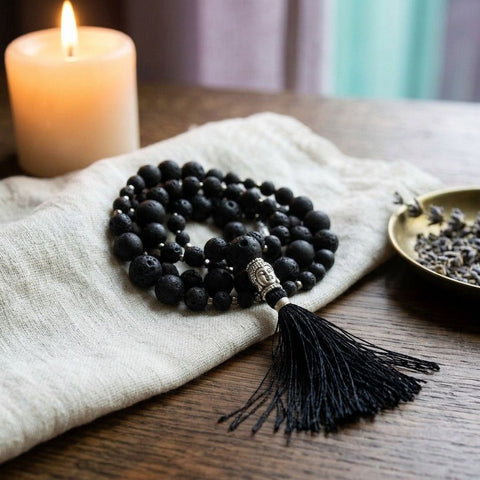 Long lava stone necklace, 42 cm, comes in a gift box with its card
22,90 €
 Engraved brass or copper cuff bracelet: Nepalese designs, adjustable
23,90 €
 Hand-knotted Balinese temple thread bracelet with beads
27,90 €
 Set of three semi-precious stone bracelets with butterfly: 7 gift boxes
31,90 €
 Wooden bead bracelet with Buddha head
10,90 €
 Wooden bead bracelet with lucky coin: 6 tie-on colours
13,90 €
 Tri Hita Karana wood, glass and stone bracelet from Bali
24,90 €