Gold-Plated, 925 Silver, Brass, Steel: Reading Jewellery Metals
What 750 gold, 925 silver, gold plating, vermeil, brass, 316L steel and titanium really mean: definitions, legal standards, thicknesses, vague-word pitfalls and questions to ask.
Key points
| Solid gold | Legal standards in France: 999, 916, 750, 585 or 375 parts per thousand of gold |
|---|---|
| 925 silver | 92.5% silver; legal standards are 999, 925 and 800 parts per thousand |
| Gold plating | Layer of gold of at least 3 microns over a base metal, according to the DGCCRF (the French consumer protection authority) |
| Vermeil | Gold over silver, layer of at least 5 microns, according to the DGCCRF |
| Below 3 microns | The terms “gilt” or “platinum-finished” are the only ones allowed |
| One micron | One thousandth of a millimeter |
| Words with no fixed definition | “Hypoallergenic”, “surgical steel”, “silver-plated metal” |
Why the words matter
On a jewellery listing, one word can change the price several times over: “gold”, “gold-plated”, “gilt”. Some terms are regulated by law, others are sales wording. Knowing how to read these words protects you from disappointment, without any need to cast suspicion on anyone: a brass piece honestly described as gilt is a good purchase at its price.
This page is a reading guide. For the detailed composition of each metal, you can complement it with our page on silver, steel, brass.
Solid gold: karats and parts per thousand
Pure gold (24 karat) is too soft for jewellery: it is alloyed with other metals. The fineness expresses the proportion of gold in parts per thousand; the karat expresses the same thing out of 24. In France, the legal standards for gold are 999, 916, 750, 585 and 375 parts per thousand.
| Karat | Fineness | Gold content |
|---|---|---|
| 24 karat | 999 | 99.9% |
| 22 karat | 916 | 91.6% |
| 18 karat | 750 | 75% |
| 14 karat | 585 | 58.5% |
| 9 karat | 375 | 37.5% |
Calculation: 18 karat = 18 ÷ 24 = 0.75, that is 750 parts per thousand. For 14 karat, 14 ÷ 24 gives 583; the legal standard adopted in France is 585. “Solid” gold means the piece is made entirely of a gold alloy at one of these standards, and is not simply coated. Note: white gold is an alloy of gold with other metals, which may contain nickel; see nickel allergy.
Silver: 925, 800, “solid”, rhodium-plated
Pure silver (999) is too soft. 925 silver (or sterling silver) contains 92.5% silver, the rest being most often copper; the French legal standards are 999, 925 and 800. “Solid silver” means the piece is not simply plated. Silver tarnishes on contact with sulfur in the air and with sweat: this is normal and can be reversed by gentle polishing.
Rhodium-plated silver is covered with a thin layer of rhodium, a metal from the platinum group, which gives a white shine and limits tarnishing. The layer eventually wears off. A piece described as “silver-plated metal”, “silver tone” or “silvered” is not silver: it is a base metal coated with a silver layer.
Plated, filled, vermeil, gilt: how thick is the gold?
According to the DGCCRF sheet on jewellery labeling, the terms “gold-plated”, “filled” and “vermeil” are regulated: they require a minimum amount of gold deposited on a base metal, with a maker's mark. The thresholds used are 3 microns of gold for gold plating and 5 microns for vermeil (gold over silver, with gold of at least 750 parts per thousand). A micron is one thousandth of a millimeter. If the gold layer is thinner than 3 microns, the piece may only be sold under the terms “gilt” or “platinum-finished”.
| Term | Principle | Indicative lifespan |
|---|---|---|
| Gilt, fine gold finish | Very thin gold layer over a base metal | A few months of daily wear |
| Gold-plated | At least 3 microns of gold | Longer, depending on use; the layer always wears |
| Vermeil | At least 5 microns of gold over 925 silver | More durable; the underlayer is silver |
| Solid gold | Gold alloy throughout | Lasts for decades |
These figures come from an administrative sheet that we have read ourselves, but we have not been able to review the text of the French General Tax Code (Code général des impôts) that sets them: ask the seller for the gold thickness and the nature of the base metal. Lifespans are orders of magnitude, which depend on sweat, friction and care.
Brass, steel, titanium: metals without precious metal
- Brass. An alloy of copper and zinc. It can darken or leave a greenish mark on the skin (a reaction between copper and sweat), which is harmless in itself. Very common in costume jewellery, often plated.
- Stainless steel (for example 316L). An alloy mainly of iron, chromium and nickel; it does not tarnish and resists water. “Surgical steel” is mainly a sales term. It contains nickel, firmly bound within the alloy.
- Nickel silver (copper-nickel-zinc alloy). Despite its sometimes misleading name (“German silver”, “nickel silver”), it contains no silver, but it does contain nickel. Avoid it if you have an allergy.
- Titanium, niobium. Metals well tolerated by sensitive skin, rarer in stone jewellery.
- Zinc alloys. Light, cast, often brittle. Common in costume pendants.
Questions to ask before buying
- What is the setting made of: solid or plated? On which base metal?
- How thick is the gold layer, in microns?
- Is the fineness stated (925, 750) and is a maker's mark visible?
- Are the clasp and chain made of the same material as the setting?
- Does the product comply with the European limits on nickel, lead and cadmium?
- Who is the seller and what do they offer in case of a return?
A good seller answers without difficulty. For our products, the material is stated on the listing; see our commitments.
What you cannot check yourself
No home test replaces a laboratory analysis. “File” tests, “acid” tests or “flame” tests are dangerous and damage the piece; do not carry them out. A magnet proves nothing: gold and silver are not magnetic, but many costume metals are not magnetic either. For a valuable piece, go to a jeweller or a laboratory. For stones, see real or fake stone.
Frequently asked questions
What is the difference between 925 silver and solid silver?
925 silver is an alloy with 92.5% silver. It is called “solid” when the entire piece is silver at this standard, and not simply coated with a silver layer.
How much gold does an 18-karat gold piece contain?
75%, that is 750 parts per thousand. The rest is made of other metals, such as copper, silver or, for white gold, metals that may contain nickel.
Gold-plated or gilt: what is the difference?
Gold plating has, according to the DGCCRF, at least 3 microns of gold; below that, the piece is simply “gilt”. The thicker the layer, the longer it lasts.
Is vermeil gold?
It is 925 silver coated with a layer of gold of at least 5 microns, according to the DGCCRF. It is not solid gold.
Is stainless steel nickel-free?
No: common steels such as 316L contain nickel, often bound within the alloy. For an allergy, titanium or niobium are better choices, after medical advice.
Also read
The meanings mentioned belong to tradition and symbolism. They are neither promises of results nor medical advice. Back to Buying guides and gift ideas.
In the shop
Stone jewellery: our products
 Faceted stone necklace with butterfly in real silver-tone leaf, 42 cm
23,90 €
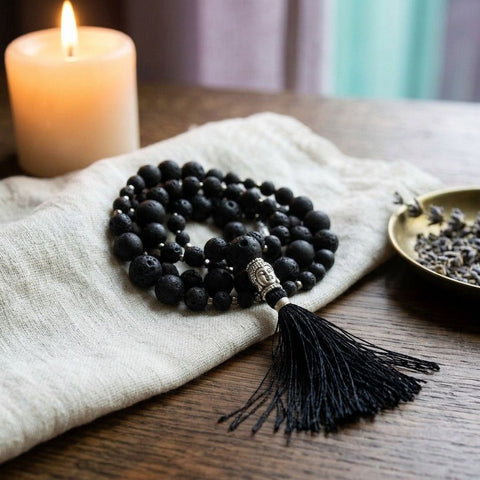 Long lava stone necklace, 42 cm, comes in a gift box with its card
22,90 €
 Engraved brass or copper cuff bracelet: Nepalese designs, adjustable
23,90 €
 Hand-knotted Balinese temple thread bracelet with beads
27,90 €
 Set of three semi-precious stone bracelets with butterfly: 7 gift boxes
31,90 €
 Wooden bead bracelet with Buddha head
10,90 €
 Wooden bead bracelet with lucky coin: 6 tie-on colours
13,90 €
 Tri Hita Karana wood, glass and stone bracelet from Bali
24,90 €