Solar Plexus Chakra (Manipura): Symbolism, Stones, Practices
The solar plexus chakra, or Manipura, the third of the seven chakras: associated with fire, yellow and, symbolically, with willpower and self-confidence.
Key points
| Sanskrit name | Maṇipūra (“the city of jewels”) |
|---|---|
| Traditional position | Navel area, upper abdomen |
| Element | Fire |
| Seed syllable (bija) | Raṁ (“ram”) |
| Lotus petals | 10 |
| Colour (modern Western usage) | Yellow |
| Symbolic themes | Willpower, confidence, drive to act, identity |
| Stones often associated | Citrine, tiger’s eye, pyrite, amber |
What is the solar plexus chakra?
The solar plexus chakra is the third centre. Its Sanskrit name, Maṇipūra, is commonly translated as “city of jewels” (maṇi, jewel, and pūra, city). Classical texts place it at the level of the navel. The name “solar plexus”, however, comes from another vocabulary: it is the name of a network of nerves in the upper abdomen, so called for its radiating shape. Western authors have brought the two together, which explains why this centre is today placed between the navel and the lower end of the breastbone.
It is depicted as a ten-petaled lotus, at the centre of which is a downward-pointing triangle, the sign of fire. Its animal in classic images is the ram. As with the others, it is a framework for imagination and meditation.
The traditional profile at a glance
| Reference | In the tradition |
|---|---|
| Name | Maṇipūra |
| Location | Navel, upper abdomen |
| Element | Fire (agni) |
| Seed syllable | Raṁ |
| Petals | 10 |
| Symbolic form | Triangle |
| Western colour | Yellow (modern convention) |
The yellow of this centre is also a Western convention: it became established with the rainbow of the chakras, whereas Indian texts evoke rather dark-cloud or red tones for fire.
Symbolic themes of the solar plexus
Fire is the image of transformation: it warms, lights and consumes. It is associated with willpower, the drive to act, self-confidence, the courage to say no, and the sense of a personal identity. Everyday words say it well: “having guts”, “having a knot in your stomach”, “digesting a decision”.
This is a symbolic language. One cannot conclude from a digestive discomfort or from shyness that “the solar plexus chakra is unbalanced”; if these situations worry you, they call for a medical or psychological opinion. In practice, you can use these themes as a logbook: where do I need to dare, set a limit, take the initiative again?
From Indian yoga to the West: a modern adaptation
The system of the seven chakras as it is presented today in the West (seven wheels, seven colours of the rainbow, lists of qualities) is a modern adaptation of an Indian tradition that is much older and more varied. Medieval Indian texts do not always count the same number of centres depending on the school. The “six centres plus the summit” model comes from the Ṣaṭ-cakra-nirūpaṇa, translated into English by John Woodroffe (under the name Arthur Avalon) in The Serpent Power (1919). Theosophists, then authors such as Charles Leadbeater (1927), linked the centres to the colours of the rainbow and to lists of qualities, well beyond the original descriptions.
Some details of this history remain debated among sources. The qualities of “self-confidence” and “personal power” attributed to this centre come mainly from 20th-century Western literature; they are absent or much more discreet in Indian texts.
Stones associated by modern tradition
Yellow, the colour of the sun and of fire, guides the choice of stones:
- Citrine: yellow-orange quartz; most citrines sold are in fact heat-treated amethyst, which is not shocking as long as the seller says so.
- Tiger’s eye: fibrous quartz with golden and brown shimmer, a classic of bracelets.
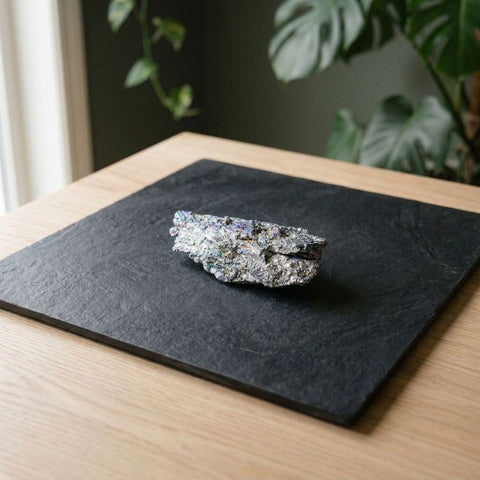
- Pyrite: iron sulfide with a metallic luster; its Greek name means “fire stone”.
- Amber: fossil resin (and not a stone), warm to the touch, often imitated by plastic or reconstituted resin.
- Sunstone: feldspar with golden shimmer.
These associations are modern and vary: tiger’s eye, for example, is sometimes placed at the root chakra, and citrine at the sacral. No effect has been demonstrated. If you buy online, see how to recognise treatments in the stone glossary.
Gentle practices around heat and drive
These habits are offered without any therapeutic claim.
- Breathing: seated, hands resting on the upper belly, breathe in through the nose, gently swelling the abdomen, and breathe out through a slightly open mouth. Eight to ten cycles; if tension or dizziness appears, return to your natural breathing.
- Posture: gentle stretches of the torso (seated twists, a moderate boat pose or light core work), at your own level and without pain. A brisk walk in the sun plays the same role of momentum.
- Meditation: imagine a golden yellow sun beneath the ribs, shining softly. Some people repeat “ram”. Then name one small action you want to take during the day.
- Colours and atmosphere: a yellow cloth or candle, a warm herbal tea, morning light.
What does science say?
No study has demonstrated the physical existence of the chakras or a way to measure them: they are a spiritual and symbolic model, not an anatomical fact. This does not prevent finding, in yoga or meditation, a moment of calm; but that calm comes from the practice itself and proves nothing about the chakras.
Frequently asked questions
Where is the solar plexus chakra?
In the Indian tradition, around the navel; in Western usage, between the navel and the lower end of the breastbone. It remains a symbolic position.
What does Manipura mean?
It is translated as “city of jewels”: mani, jewel, and pura, city.
What colour is the solar plexus chakra?
Yellow in the modern Western convention, associated with the element fire.
Which stone for the solar plexus?
Citrine, tiger’s eye, pyrite and amber are cited. It is a modern tradition with no demonstrated effect.
Is the solar plexus of the chakras the body’s solar plexus?
No: the solar plexus is a network of nerves in the abdomen. Western authors have linked it to the Manipura centre, but these are two different notions.
Also read
The meanings mentioned belong to tradition and symbolism. They are neither promises of results nor medical advice. Back to Guide to the chakras.
In the shop