Angel Yelahiah (No. 44): regency, psalm, symbolism and reading
Yelahiah, forty-fourth angel of the Shem HaMephorash, of the choir of the Virtues, reigns from 22 to 26 October. Dates, hour, Psalm 119 and symbolism according to tradition.
Key points
| Number | 44 of 72 |
|---|---|
| Regency period | 22 to 26 October |
| Regency hour | 2:20 p.m. to 2:40 p.m. |
| Choir | Virtues |
| Associated psalm | Psalm 119, verse 108 |
| Hebrew triplet | ילה (Yod, Lamed, He) |
| Symbolic theme | Courage in trial, the offering of speech, study |
Who is Yelahiah, angel no. 44?
Yelahiah is the forty-fourth angel on the list and the fourth of the choir of the Virtues. English editions give Ielahiah. Tradition makes him the angel of struggles, in the broad sense: trial, competition, legal proceedings, examinations.
His image is that of the loyal warrior. In the imagination of the nineteenth century, he was readily cited in connection with soldiers and knights; today, we more readily see in him the courage of athletes or students.
Yelahiah bears the number 44 in the list of the 72 angels of the Shem HaMephorash, which Kabbalistic tradition draws from three verses of Exodus (14:19 to 21). Everything that follows is presented according to the Kabbalistic and esoteric tradition. For the origin of the system, read our introduction to the 72 angels.
Traditional benchmarks
| Benchmark | According to tradition |
|---|---|
| Number in the classical list | 44 of 72 |
| Regency period (5 days) | 22 to 26 October |
| Regency hour (20 minutes) | 2:20 p.m. to 2:40 p.m. |
| Choir | Virtues (the 4th of the 8 angels of the choir) |
| Traditionally associated psalm | Psalm 119, verse 108 |
| Hebrew letter triplet | ילה (Yod, Lamed, He) with the suffix יה |
| Approximate zodiac sign | Libra, then Scorpio |
Dates follow the most common calendar (angel no. 1 reigns from 21 to 25 March, then five days per angel over 365 days); sources sometimes shift by a few days, and leap years are handled differently: see how the guardian angel is calculated. According to many authors, the hour is counted in local solar time.
The verse and the name
The verse retained comes from the long Psalm 119, a hymn to the Law: “Accept, Lord, the offerings of my mouth, and teach me your judgments.” The offering of the mouth is the words of praise, which Jewish tradition regards as a spiritual sacrifice. The psalmist also asks to be taught.
One sees why the authors made this angel a model of loyalty: one offers one's word, asks to be instructed, and submits to a rule. The struggle here is that of honesty and study rather than of strength.
The name is formed, according to tradition, from the Hebrew letter triplet ילה (Yod, Lamed, He) followed by the ending Yod and He (Yah, a name of God). Spellings vary (Ielahiah) according to transliteration. Psalm 119, the longest in the Psalter, is Psalm 118 in the Vulgate; verse 108 belongs to the Nun stanza. The verse lists also differ slightly from one author to another.
What tradition associates with Yelahiah
According to the works, Yelahiah is associated with:
- Courage in the face of adversity, whether physical or moral.
- Study: the desire to learn, a theme drawn directly from the verse.
- Success in trials: legal proceedings, exams and competitions, according to recent lists.
- Recognition: the idea of being distinguished for one's merit.
No angel wins a lawsuit or a competition. Lists that suggest otherwise attribute to Yelahiah an effectiveness that nothing establishes. Preparation remains the decisive factor.
A reading for today
Facing an important trial, many people feel the need for a ritual: a phrase, an object, a gesture. Researchers have observed that such rituals can reduce anxiety before a performance, whatever the content of the ritual. That would be a reasonable use of the figure of Yelahiah.
What truly matters is preparation: revising, practising, sleeping well.
Its period of the year and its sign
Yelahiah's period, 22 to 26 October, falls in autumn (northern hemisphere, within the framework of the original calendar). It roughly covers the passage from the sign of Libra to that of Scorpio. In the table of the 36 decans, each ten-day span receives two angels: Yelahiah shares his with Veuliah (no. 43).
In the choir of the Virtues
In the writings of Pseudo-Dionysius (around 500), the Virtues belong to the second triad; the word comes from the Greek dynameis, “forces”. Tradition sees in them the angels of the strength of the soul and of the “signs”. In the list of 72, this choir comprises angels 41 to 48, and follows that of the Powers (33 to 40), whereas Dionysius reverses the two.
Yelahiah is the fourth angel of the Virtues, at the centre of the choir. He embodies its combative dimension, in the sense of quiet courage.
To place Yelahiah in the sequence of angels, here are his immediate neighbours: Veuliah (no. 43) before him and Sealiah (no. 45) after him. The choir is presented in detail on the page Choir of the Virtues.
A gentle practice with Yelahiah
A preparation exercise, lasting ten minutes:
- Think of an upcoming trial (exam, interview, competition, difficult step).
- List three concrete preparation actions you can take this week.
- Read verse 108 of Psalm 119, thinking of “offering what I know how to do”.
- Choose a calming gesture for before the trial: three slow breaths, for example.
The ritual never replaces preparation.
What to keep in mind
Take this sheet as an honest account of a tradition, with its sources and its disagreements: no diagnosis, no horoscope, no prediction. If an idea speaks to you, so much the better; if not, the tradition itself asks nothing of you.
The Catholic Church does not recognise this system: it retains only the three archangels named in Scripture, Michael, Gabriel and Raphael. Believers of all faiths nevertheless find in the psalms a text for prayer.
See also the guide to the 72 angels and the guide to the archangels.
Frequently asked questions
What is Yelahiah's regency period?
According to the classical calendar, Yelahiah (angel no. 44) reigns from 22 to 26 October. Some sources shift these dates by a few days, and leap years are treated differently by different authors.
At what time does Yelahiah reign?
His 20-minute regency hour runs from 2:20 p.m. to 2:40 p.m., every day, according to tradition. Many authors specify that this is local solar time.
Which psalm is associated with Yelahiah?
Tradition associates Yelahiah with Psalm 119, verse 108. Verse numbers vary from one Bible to another, and verse lists are not all identical.
Does Yelahiah win lawsuits?
No. Some recent lists suggest it, without foundation. For a legal matter, consult a lawyer.
Why is Yelahiah called a warrior?
Because nineteenth-century authors associated the choir of the Virtues with strength and action. The image of the warrior is symbolic: it evokes courage rather than violence.
Also read
The meanings mentioned belong to tradition and symbolism. They are neither promises of results nor medical advice. Back to Guide to the 72 guardian angels.
In the shop
Stone jewellery: our products
 Faceted stone necklace with butterfly in real silver-tone leaf, 42 cm
23,90 €
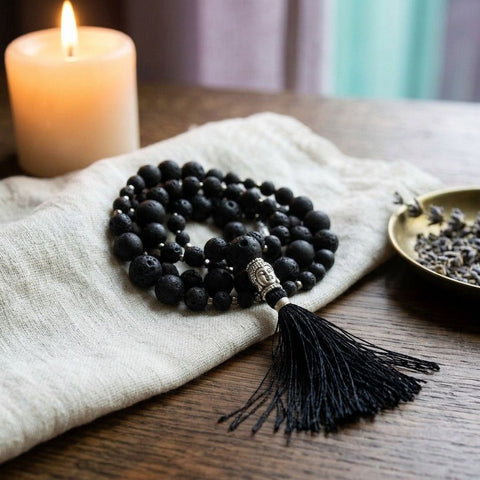 Long lava stone necklace, 42 cm, comes in a gift box with its card
22,90 €
 Engraved brass or copper cuff bracelet: Nepalese designs, adjustable
23,90 €
 Hand-knotted Balinese temple thread bracelet with beads
27,90 €
 Set of three semi-precious stone bracelets with butterfly: 7 gift boxes
31,90 €
 Wooden bead bracelet with Buddha head
10,90 €
 Wooden bead bracelet with lucky coin: 6 tie-on colours
13,90 €
 Tri Hita Karana wood, glass and stone bracelet from Bali
24,90 €