Laoviah: Angel No. 11, Ruling Dates, Psalm and Symbolism
Laoviah, angel no. 11 of the 72 according to the Kabbalistic and esoteric tradition: victory, renown and gratitude after effort. Ruling period from May 10 to May 14, from 3:20 a.m. to 3:40 a.m., Choir of Cherubim.
Key points
| Number | 11 of 72 |
|---|---|
| Annual ruling period | May 10 to May 14 |
| Daily ruling period | 3:20 a.m. to 3:40 a.m. |
| Choir | Cherubim |
| Psalm | Psalm 18, verse 47 (Vulgate: Psalm 17, verse 47) |
| Three-letter name | לאו (lamed-aleph-vav) |
| Meaning of the name | "God praised and exalted" |
| Zodiac | 20° to 25° of Taurus |
Who is Laoviah?
Laoviah is the eleventh angel on the list, of the Choir of Cherubim. His name reads "God praised and exalted". He is associated with victory won after effort, public recognition and gratitude. Take care not to confuse him with Lauviah, the seventeenth angel: the two names are close because they come from exactly the same three letters.
To understand this name, one must go back to Exodus: by reading verses 14:19 to 14:21 (72 letters each) according to a precise rule, one extracts 72 groups of three letters, among them לאו (lamed-aleph-vav) for this angel. With the ending -iah, which recalls the divine name Yah, this gives Laoviah, which French esoteric literature translates as "God praised and exalted". This meaning is an interpretation, not the translation of a common Hebrew word.
This page is part of our guide to the 72 angels. The correspondences given here (dates, hour, choir, psalm) are presented according to the Kabbalistic and esoteric tradition: they are symbolic reference points, which each reader is free to accept or not. The historical background is detailed in the introduction to the 72 angels.
Laoviah's key facts
Here are Laoviah's key facts, as handed down by tradition.
| Key fact | According to the Kabbalistic and esoteric tradition |
|---|---|
| Number | 11 of 72 |
| Three-letter name | לאו (lamed-aleph-vav) |
| Ruling period | May 10 to May 14 |
| Daily ruling hour | 3:20 a.m. to 3:40 a.m. (20 minutes) |
| Choir | Cherubim (angels no. 9 to 16) |
| Psalm | Psalm 18, verse 47 (Vulgate: Psalm 17, verse 47) |
| Zodiac quinary | 20° to 25° of Taurus |
| Decan and planet | 3rd decan of Taurus, Saturn (Chaldean order) |
From one source to another, the dates shift a little. Our page applies the rule of five days per angel, one after the other, from March 21 over a 365-day year; some websites prefer to align the periods with the signs, hence possible differences. The quinary is the 5-degree slice of the zodiac linked to this angel; it does not exactly match the real position of the Sun on these dates. The decan (10 degrees) and its planet come from classical astrology: see the page on the sign of Taurus and the entry on the associated planet.
Laoviah's psalm
The associated psalm is Psalm 18, verse 47: "The Lord lives, and blessed be my rock, and exalted be the God of my salvation." (Vulgate: Psalm 17). This long psalm is a song of victory attributed to David, who sings it, according to its title, on the day the Lord delivered him from his enemies and from Saul. It is found almost word for word in 2 Samuel 22. It begins with "I love you, O Lord, my strength" and accumulates images of solidity: rock, fortress, shield. Laoviah's verse is a cry of thanksgiving: victory is credited to someone greater than oneself, which fits the meaning "God praised and exalted".
Traditional symbolism
Laoviah evokes success that is the fruit of work and mutual help, and that ends in gratitude rather than pride. Esoteric authors credit him with renown, intelligence and the joy of the result. The heart of his theme is that a victory is complete only when it is recognised and shared.
- Victory: measuring what has been accomplished to reach it
- Renown: being recognised for what truly matters
- Gratitude: thanking those who helped along the way
These attributions come from esoteric literature of the 19th and 20th centuries; they differ from one author to another and rest on no established ancient text. They are themes for reflection, never guaranteed effects.
Laoviah's time of year and hour
Laoviah's period corresponds to that of the Ice Saints (May 11, 12 and 13: Mamertus, Pancras and Servatius), according to a gardeners' saying: until they have passed, late frosts can destroy tender plants. Once past this point, one plants with confidence. This idea of a final trial before victory illustrates the theme of the angel. Depending on the year, Pentecost may also fall from May 10 onwards.
In the division of the day into 72 slices of 20 minutes, Laoviah occupies the interval from 3:20 a.m. to 3:40 a.m. Tradition makes him the "angel of the hour" for people born at that moment. Legal time, as recorded on the birth certificate, is the most used; solar time is sometimes preferred, and sources do not agree. Refer to the calculation page.
A gentle practice with Laoviah
For one week, keep a "journal of small victories": three lines each evening about what went well and the person who contributed to it. Then write a word of thanks to one of them. The idea is to train a gaze that notices what has succeeded.
A few questions to ask yourself, in writing or aloud:
- What small victory have I won recently, and who helped me?
- What would I like my name to be associated with?
- How can I celebrate a success without crushing anyone?
These exercises belong to personal reflection and do not replace medical advice or psychological support.
What belongs to tradition, and its limits
Keep this in mind: the 72 angels form an esoteric system from the Renaissance, popularised in France in the 19th century, which the Catholic Church does not recognise (it retains only Michael, Gabriel and Raphael). The dates, hours and psalms are conventions, which vary. In many books, Laoviah and Lauviah are written in the same way, which creates confusion: rely on the number (11 or 17), the choir and the psalm. The renown the tradition speaks of is not a promise of fame.
To put this guide in perspective, see also the guide to the archangels and the page on angel oracles.
Frequently asked questions
Who is Laoviah in the tradition of the 72 angels?
According to the Kabbalistic and esoteric tradition, Laoviah is the 11th of the 72 angels, of the Choir of Cherubim. His name is understood as "God praised and exalted", and he is associated with victory, renown and gratitude after effort.
What are Laoviah's ruling dates?
In the classic calendar of five days per angel, Laoviah rules from May 10 to May 14, and from 3:20 a.m. to 3:40 a.m. during the day. Dates sometimes vary by one to a few days depending on the author.
Which psalm is associated with Laoviah?
Psalm 18, verse 47 (Vulgate: Psalm 17, verse 47). It is the verse "The Lord lives, and blessed be my rock", taken from a song of victory attributed to David.
What is the difference between Laoviah and Lauviah?
Laoviah is the eleventh angel (Choir of Cherubim) and Lauviah the seventeenth (Choir of Thrones). Their names come from the same three Hebrew letters, לאו, which appear twice in the list. The dates, hour, psalm and attributes differ.
Does Laoviah guarantee fame or success?
No. According to tradition, he symbolises victory after effort and gratitude. No form of success is guaranteed; this guide offers a theme for reflection.
Also read
The meanings mentioned belong to tradition and symbolism. They are neither promises of results nor medical advice. Back to Guide to the 72 guardian angels.
In the shop
Stone jewellery: our products
 Faceted stone necklace with butterfly in real silver-tone leaf, 42 cm
23,90 €
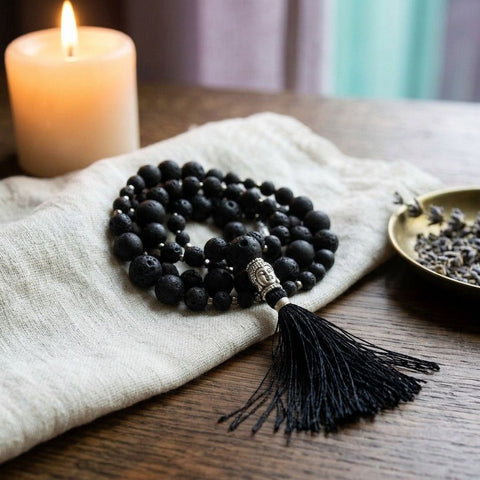 Long lava stone necklace, 42 cm, comes in a gift box with its card
22,90 €
 Engraved brass or copper cuff bracelet: Nepalese designs, adjustable
23,90 €
 Hand-knotted Balinese temple thread bracelet with beads
27,90 €
 Set of three semi-precious stone bracelets with butterfly: 7 gift boxes
31,90 €
 Wooden bead bracelet with Buddha head
10,90 €
 Wooden bead bracelet with lucky coin: 6 tie-on colours
13,90 €
 Tri Hita Karana wood, glass and stone bracelet from Bali
24,90 €